New Robotic Hands for NEO: 25 Degrees of Freedom and Tactile Sensing
Note: This article was created with the support of artificial intelligence and editorially reviewed.
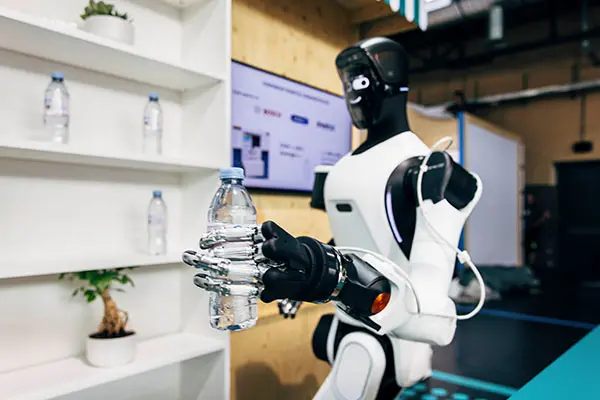
1X has introduced new hands for its humanoid robot NEO. The tendon-driven system offers a total of 25 degrees of freedom. Of these, 22 are located in the fingers and palm, while three are assigned to the wrist. According to the company, the hands are designed to combine a high level of mobility with force control and tactile perception.
Joints That Also Act as Sensors
The hands use the Tendon Drive system developed by 1X. According to the company, the transmission ratios range from approximately 5:1 to 15:1. All 25 degrees of freedom are force-controlled and backdrivable.
When a finger is moved by an external force, it can yield while measuring the force being applied. 1X refers to this capability as “Force Transparency.” Because each joint operates within a closed control loop, the system also continuously monitors the position of every joint.
Tactile Perception in the Fingers and Palms
The surfaces of the hands contain high-resolution tactile sensors. These measure normal forces, contact position and shear forces. This is intended to allow NEO to detect when an object begins to slip and adjust its grip in real time.
According to 1X, this type of contact feedback is especially important when handling small, transparent, deformable or partially obscured objects that cannot always be reliably assessed using cameras alone.
From USB-C Connectors to Screwdrivers
1X demonstrates NEO performing a range of fine-motor tasks. These include picking up screws and coins, inserting a USB-C connector, using a screwdriver, turning a light bulb, closing a zipper and sorting grapes.
The company states a positioning accuracy of ±0.2 millimetres. The hands are IP68-rated for protection against dust and water and, according to 1X, are made from food-safe materials.
Designed for Continuous Operation
According to 1X, individual components and complete finger assemblies have been tested over millions of movement cycles. The wrist assemblies are also said to have completed more than two million test cycles under high loads.
The motors are located in the forearm and move the fingers through tendons. 1X says it develops and integrates key components itself, including motors, electronics, sensors, tendon systems and firmware. The company has already produced hundreds of hands on its own production line and states a production capacity of up to 10,000 hands in 2026.
By combining mobility, force control and tactile sensing, the new hands are intended to serve as more than simple gripping tools. They also collect information about physical contact with objects, making them an important interface between the robotic system and its environment.
Source: 1X Technologies, “NEO’s Hands – An API to the Physical World,” published on 9 July 2026.
https://www.1x.tech/discover/neos-hands