Why Investors Are Increasingly Backing Physical AI and Robotics
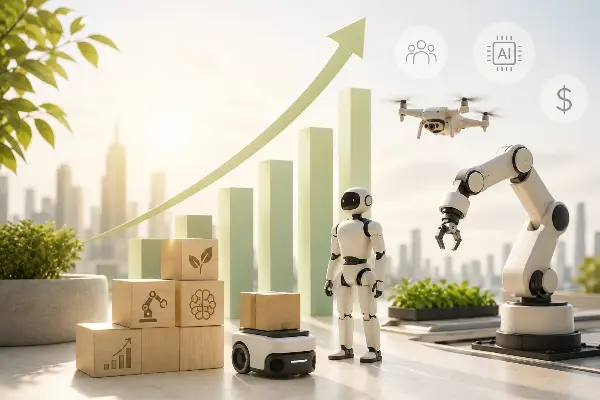
Artificial intelligence was long associated mainly with software, data analysis and digital services. Attention is now shifting increasingly toward Physical AI.
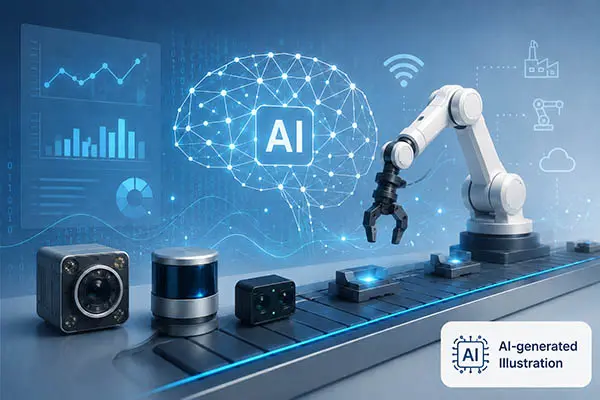
Physical AI connects artificial intelligence with machines, robots, vehicles and other physical systems. These systems use sensors to perceive their environment, interpret the data and perform real-world actions.
Humanoid robots, autonomous vehicles, mobile logistics robots, intelligent machines and AI-powered drones are among the most visible examples.
For investors, this creates a new technology market at the intersection of AI, sensing, semiconductors, robotics and industrial automation.
The potential is significant. At the same time, Physical AI companies differ substantially from conventional software startups. They require more capital, longer development cycles and extensive technical infrastructure.
What Is Physical AI?
Physical AI refers to AI systems that interact with the real world.
They combine:
sensors,
data processing,
machine learning,
decision logic,
actuators,
mechanical systems.
A typical process is:
Sensors capture the environment.
An AI system interprets the data.
The system selects an action.
Motors or other actuators perform the action.
New sensor data verifies the result.
This creates a closed perception-and-action loop.
Why Is Physical AI Becoming Attractive to Investors?
Several economic and technological developments are occurring at the same time.
These include:
progress in AI models,
more capable edge hardware,
better sensors,
falling costs for selected components,
labour shortages,
pressure to automate,
demographic change,
demand for more flexible machines.
Together, these factors create new markets for intelligent physical systems.
From Digital AI to Physical AI
Generative AI demonstrated how quickly powerful models can create new applications.
Many investors are now looking for the next major field of growth.
Physical AI applies AI capabilities to real-world tasks.
These include:
grasping objects,
moving goods,
operating machinery,
monitoring fields,
inspecting buildings,
controlling vehicles,
assisting people.
The potential economic value is considerable because physical work represents a large part of global economic activity.
Robotics as a Growth Market
Robotics is already used in many industries.
Typical areas include:
manufacturing,
logistics,
agriculture,
healthcare,
construction,
inspection,
security,
domestic environments.
Historically, robots were often designed for clearly defined tasks and structured environments.
AI is intended to increase their flexibility.
A robot may learn to:
recognise different objects,
assess changing grasp positions,
predict human movement,
adapt to new environments,
derive tasks from language or demonstration.
This greater adaptability expands the potential market.
Labour Shortages as an Investment Driver
Many industries struggle to recruit skilled workers.
Affected sectors include:
manufacturing,
logistics,
care,
agriculture,
hospitality,
construction,
technical maintenance.
Robotics may help reduce some of these shortages.
Investors are particularly interested in systems that perform tasks for which companies already have difficulty finding staff.
Economic value depends on whether the robot is reliable, affordable and easy to integrate.
Demographic Change
In many countries, the average age of the population is rising.
At the same time, some regions face a decline in the available workforce.
Physical AI may therefore become relevant in:
care assistance,
rehabilitation,
logistics,
household support,
automation of physically demanding work.
Investors view this as long-term structural demand rather than only a temporary technology trend.
Progress in AI Models
Modern AI models can process language, images, video and sensor data together.
This multimodal capability is particularly important in robotics.
A robot may need to:
understand a spoken instruction,
recognise an object visually,
determine its location,
plan a grasp,
analyse force data during movement.
Multimodal models can increasingly connect these information types.
Foundation Models for Robotics
Foundation models are trained on large and varied datasets.
In robotics, they are intended to provide general capabilities that can be transferred to different tasks.
A robotics model may learn from movement and image data across many scenarios.
It can then be adapted to a new task with less additional training.
This is attractive to investors because reusable models may accelerate the development of new applications.
Simulation and Synthetic Data
Training physical systems is expensive and time-consuming.
A robot cannot make unlimited mistakes in the real world.
Simulation allows systems to train in virtual environments.
They can:
test millions of movements,
create rare scenarios,
simulate dangerous failures,
learn different environments.
Synthetic data can complement real measurements.
This creates new business opportunities for simulation platforms, digital twins and training infrastructure.
Edge AI as a Requirement
Physical-AI systems often need to respond in real time.
A machine, vehicle or robot cannot wait for a remote cloud service before every decision.
Edge AI processes data directly on the device.
Benefits include:
low latency,
operation without a stable connection,
greater control over sensitive data,
reduced data transmission,
rapid response.
Investors therefore focus not only on robot manufacturers but also on:
AI chips,
edge processors,
sensor modules,
operating systems,
optimisation software,
local inference platforms.
Sensors as a Key Technology
Physical AI requires reliable data from the real world.
Common sensors include:
cameras,
LiDAR,
radar,
force sensors,
inertial sensors,
tactile sensors,
microphones,
temperature sensors,
position sensors.
Sensor quality directly affects the performance of the complete system.
A capable AI model cannot fully compensate for missing or highly inaccurate measurements.
Humanoid Robots
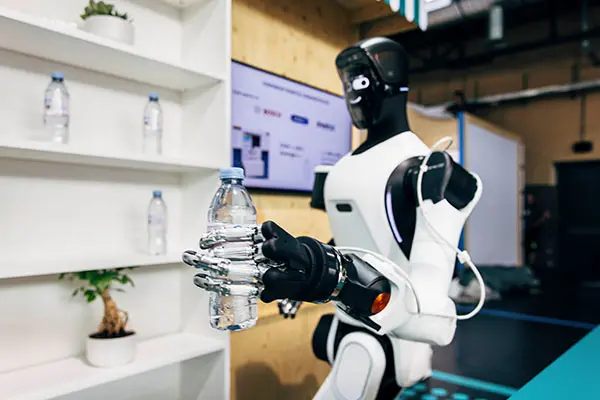
Humanoid robots attract significant attention.
Their human-like form is intended to let them use existing workplaces and tools.
They may eventually perform tasks in:
manufacturing,
warehousing,
retail,
facility management,
services,
care assistance.
The market vision is large.
At the same time, humanoid systems are technically demanding.
They require:
reliable walking,
balance,
precise grasping,
safe human–robot interaction,
energy efficiency,
robust software.
Logistics Robotics
Logistics is one of the areas where robotics is already commercially established.
Typical applications include:
autonomous mobile robots,
sorting systems,
palletising,
order picking,
inventory monitoring,
transport within warehouses.
The environment is often more structured than a private home.
This allows systems to reach commercial use more quickly.
Investors often prefer applications with measurable value and short payback periods.
Industrial Robotics
Industrial robots have been used for decades.
Physical AI adds:
visual perception,
flexible grasp planning,
adaptive process control,
language interaction,
learned movement patterns.
This enables applications that are difficult to implement with fixed programming.
Tasks involving many product variants or changing conditions are particularly relevant.
Mobile Robotics
Autonomous mobile robots move through buildings or outdoor environments.
They use:
cameras,
LiDAR,
radar,
positioning systems,
inertial sensors,
maps.
AI supports navigation, obstacle detection and route planning.
Mobile robotics is relevant in:
warehouses,
hospitals,
hotels,
airports,
factories,
agriculture.
Autonomous Vehicles
Autonomous vehicles are an important part of Physical AI.
Examples include:
self-driving cars,
autonomous delivery vehicles,
mining vehicles,
agricultural machinery,
port vehicles,
industrial transport vehicles.
Full autonomy in public traffic is technically and legally demanding.
Limited operating environments may become economically attractive earlier.
Drones and Uncrewed Systems
Drones use sensors and AI for:
inspection,
mapping,
agriculture,
infrastructure monitoring,
logistics,
security,
environmental observation.
AI enables automated flight planning, object recognition and situation assessment.
Investors are particularly interested in specialised applications with clear commercial demand.
Physical AI in Agriculture
Agricultural operations face pressure to use labour, water, fertiliser and crop protection more efficiently.
Physical AI can support:
autonomous agricultural machinery,
harvesting and weeding robots,
drones,
soil sensors,
livestock monitoring,
precision irrigation.
The potential markets are large, but seasonal conditions and demanding environments make development difficult.
Physical AI in Healthcare
Robotics can be used in healthcare for:
rehabilitation,
surgical assistance,
medication transport,
hospital logistics,
exoskeletons,
care support.
Medical applications require high safety, regulatory approval and clinical validation.
Development cycles are therefore long, but barriers to entry may also be significant.
Attractive Business Models
Investors evaluate not only technology but also the business model.
Possible models include:
robot sales,
leasing,
Robotics as a Service,
software subscriptions,
maintenance contracts,
usage-based pricing,
data and analytics services.
Robotics as a Service
With Robotics as a Service, customers pay a recurring fee.
The provider supplies the robot, software, maintenance and updates.
Benefits for customers include:
lower upfront investment,
predictable costs,
easier access to technology,
ongoing maintenance.
Providers gain recurring revenue.
However, they often need to finance substantial hardware costs before receiving long-term returns.
Recurring Software Revenue
Many robotics companies combine hardware sales with software revenue.
Software may support:
fleet management,
analytics,
remote monitoring,
updates,
task planning,
simulation.
Investors often value recurring revenue because it is more predictable than one-time equipment sales.
Data as a Competitive Advantage
Robots and autonomous systems generate large amounts of operational data.
This data can improve AI models.
A company with many deployed systems may therefore build a strong advantage.
More devices create more data. Better data improves the models. Better models may attract more customers.
This cycle can become a powerful competitive moat.
Hardware as a Barrier to Entry
Hardware is expensive and complex.
At the same time, this complexity can provide protection from competitors.
A functioning Physical-AI system requires:
mechanics,
electronics,
sensors,
software,
AI,
manufacturing,
service.
This combination is difficult to reproduce.
It can be attractive to investors when a company has already built a reliable technical platform.
Patents and Intellectual Property
Physical-AI companies often own valuable intellectual property.
This may include:
mechanical designs,
sensor architectures,
control methods,
training methods,
datasets,
simulation models,
AI models.
Patents alone do not guarantee commercial success.
The key question is whether the technology can be converted into a reliable product and sustainable business.
Strategic Investors
Industrial companies also invest in robotics and Physical AI.
Their objectives may include:
access to technology,
joint product development,
automation of their own operations,
supply-chain security,
future acquisition,
development of new business areas.
Strategic investors can provide startups with access to customers, manufacturing and industry expertise.
However, close alignment with one large company may limit other partnerships.
Public Funding
Physical AI is increasingly regarded as a strategic technology.
Governments support:
robotics research,
semiconductor production,
AI computing infrastructure,
autonomous systems,
industrial digitalisation,
workforce development.
Economic and geopolitical interests play a role.
Countries aim to reduce dependence on foreign technology and build domestic industrial capabilities.
Why Capital Requirements Are High
Physical-AI companies often require substantially more capital than software-only businesses.
Costs include:
prototypes,
hardware components,
laboratories,
test systems,
production,
certification,
spare parts,
service,
inventory.
Several hardware generations may be needed before a market-ready product emerges.
Long Development Cycles
Software can be changed and released quickly.
Robotic systems are more difficult to modify.
Mechanics, electronics and safety must be tested together.
A failure may cause physical damage.
Investors therefore need to accept longer development and payback periods.
Scaling Is Harder Than Software
Software can theoretically be distributed rapidly to many users.
Robots need to be manufactured, shipped, installed and maintained.
Scaling depends on:
manufacturing capacity,
supply chains,
component availability,
quality control,
service organisations,
customer training.
A large order backlog does not automatically mean that a company can deliver quickly.
Technical Risk
Many Physical-AI projects operate near the limits of current technology.
A prototype may perform well in a demonstration but fail during continuous operation.
Investors need to ask:
Does the system work outside the laboratory?
What is the failure rate?
How long can it operate?
How safe is it?
What maintenance is required?
How much does performance vary?
Pilot Project or Scalable Product?
A common risk is confusing a customised pilot with a scalable product.
A system may work for one customer because it received extensive modification.
For scalable growth, it needs to:
work across many customers,
be easy to install,
use standardised interfaces,
be economical to maintain,
deliver consistent performance.
Safety and Liability
Physical AI acts in the real world.
Failures may harm people, equipment or products.
This creates requirements for:
safety concepts,
redundancy,
testing,
documentation,
insurance,
liability.
These requirements increase cost but may also create barriers to entry.
Regulation
Different regulations apply depending on the use case.
Relevant areas include:
machinery safety,
vehicle approval,
privacy,
occupational safety,
medical-device regulation,
product liability.
Regulation can slow market entry.
Companies that build regulatory expertise early may gain an advantage.
Valuing a Physical-AI Startup
Investors evaluate additional technical factors alongside conventional financial metrics.
These include:
technology readiness,
reliability,
level of autonomy,
data access,
hardware cost,
manufacturing capability,
safety architecture,
maintenance requirements,
integration time,
customer value.
Important Metrics
Depending on the business model, relevant metrics include:
revenue,
recurring revenue,
order backlog,
number of deployed systems,
operating hours,
failure rate,
maintenance cost,
hardware margin,
customer-acquisition cost,
customer payback period.
In robotics, real operational performance is often more important than an impressive demonstration.
Total Cost of Ownership
Customers evaluate more than the purchase price.
The complete operating cost includes:
installation,
energy,
maintenance,
downtime,
spare parts,
software fees,
training,
integration.
A more expensive robot may be more economical if it is more reliable and requires less service.
Customer Return on Investment
Investors want to understand the economic value for the customer.
Possible benefits include:
lower labour costs,
higher productivity,
less scrap,
fewer accidents,
longer operating hours,
better quality,
lower energy use.
The clearer and faster the customer ROI, the easier the system may be to sell.
Why Not Every Robotics Startup Will Succeed
Large market opportunities attract many competitors.
Not every company will survive.
Possible reasons include:
hardware that is too expensive,
unreliable systems,
difficult customer integration,
slow manufacturing,
insufficient customer value,
high cash consumption,
strong competition,
regulatory obstacles.
Valuation Risk and Hype
Physical AI is an attractive future market.
Valuations may therefore rise faster than revenue or technology maturity.
Investors need to distinguish between:
a working prototype,
a successful pilot,
a production-ready product,
a scalable company.
An impressive demonstration does not replace a robust market and manufacturing strategy.
M&A Potential
Physical-AI startups can become attractive acquisition targets.
Possible buyers include:
industrial groups,
automotive companies,
logistics providers,
semiconductor companies,
machinery manufacturers,
software companies,
aerospace and defence groups.
Buyers may seek:
technology,
patents,
teams,
data,
customers,
market access.
Market Consolidation
The Physical-AI sector includes many specialised companies.
Consolidation is likely over time.
Larger suppliers may acquire companies to build complete platforms combining:
robot hardware,
sensors,
AI software,
simulation,
fleet management,
service.
Opportunities for Sensor Companies
Sensor manufacturers may benefit from the growth of Physical AI.
More autonomous machines require more perception technology.
Relevant areas include:
compact sensors,
low-power sensing,
robust industrial sensors,
tactile sensing,
3D sensing,
sensor fusion,
integrated edge processing.
Sensor companies may move from component supply toward complete systems.
Opportunities for Semiconductor Companies
Physical AI requires specialised computing hardware.
Demand exists for chips supporting:
AI inference,
motor control,
image processing,
sensor fusion,
real-time communication,
power management.
Energy efficiency is especially important because mobile robots have limited battery capacity.
Opportunities for Software Companies
Software providers also benefit.
Relevant areas include:
robotics operating systems,
simulation,
digital twins,
fleet management,
data platforms,
security software,
development tools.
Many Physical-AI companies need a combination of proprietary technology and external software infrastructure.
Opportunities for Industrial Companies
Industrial companies can invest in Physical AI to automate their own operations or develop new products.
Possible strategies include:
internal development,
partnerships,
minority investments,
joint ventures,
acquisitions.
What Should Investors Examine?
Important questions include:
Which specific problem does the system solve?
How large is the economic benefit?
Does it work under real conditions?
What are hardware and service costs?
How quickly can production scale?
Which data improves the system?
Are there regulatory barriers?
How strong is the competition?
Which recurring revenue streams are possible?
How much additional capital will be required?
Conclusion
Investors are increasingly backing Physical AI and robotics because AI is moving from digital applications into the physical world.
Labour shortages, demographic change, better sensors, more capable edge hardware and multimodal AI models are creating new markets.
The opportunity extends from manufacturing and logistics to agriculture, healthcare and autonomous vehicles.
Physical AI is not a simple software business. High capital requirements, long development cycles, safety obligations and difficult scaling increase risk.
The companies most likely to succeed will not be those with the most impressive demonstrations, but those that deliver reliable products, clear business models and measurable customer value.