Smart Buildings and Smart Cities: Connecting Intelligent Buildings with the Urban Ecosystem
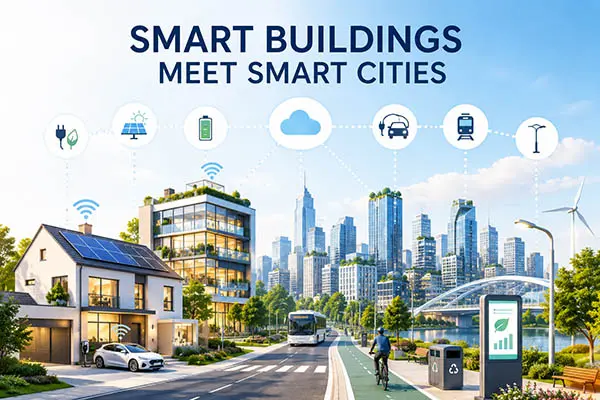
Smart homes and smart buildings do not have to operate as isolated systems. When buildings communicate with energy networks, mobility services and municipal infrastructure, they become active components of a smart city. Sensors, edge AI and interoperable platforms provide the foundation for this connection.
From an intelligent building to an intelligent city
A smart building adapts lighting, heating, cooling, ventilation and other technical systems to the way the property is actually being used. Sensors can monitor occupancy, temperature, air quality, daylight and energy consumption. Building controls then respond to changing conditions without requiring every process to be managed manually.
A smart home applies the same principle on a smaller scale. It may lower the heating when nobody is present, operate blinds according to solar radiation or charge an electric vehicle when electricity is readily available. A home energy management system can coordinate rooftop solar, battery storage, a heat pump and selected appliances.
A smart city extends this approach beyond a single property. It connects buildings with electricity grids, transport systems, street lighting, water infrastructure, waste management and public services.
As a result, the building changes from a largely self-contained unit into an active participant in the urban ecosystem.
Buildings as the sensors and actuators of a city
Smart buildings can do more than generate data. They can respond to external signals and support the wider operation of a district or city.
An office building may know its current energy demand, occupancy level and expected room use. At the same time, an urban energy platform may provide information about electricity prices, grid congestion or the expected availability of renewable power.
Combining these inputs enables automated actions:
A heat pump can increase output when abundant solar electricity is available.
A battery can charge before a period of high grid demand.
Non-critical cooling loads can be shifted.
Electric vehicles can charge outside peak periods.
Surplus electricity can be shared or marketed within a district.
Buildings can therefore act as flexible consumers, energy stores and, in many cases, power producers. The International Energy Agency identifies controllable building loads such as heating, cooling and water heating as an important source of demand flexibility. Grid-interactive buildings can better align consumption with renewable generation while maintaining the comfort expected by occupants.
Application example 1: District-level energy optimisation
Consider a mixed urban district containing homes, offices, schools and public facilities. Many of its buildings have solar panels, heat pumps, battery storage and digital energy management systems.
On a sunny morning, the district produces more solar electricity than its buildings need immediately. Rather than exporting all of that energy to the grid at the same time, a district platform can activate flexible loads. Hot-water tanks begin heating, electric vehicles start charging and stationary batteries store the remaining surplus.
Later in the day, when city-wide electricity demand rises, the buildings reduce their grid consumption. They use stored energy and temporarily lower the demand of non-essential equipment.
This does not have to reduce occupant comfort. Intelligent controls use the flexibility that already exists. A resident may not notice whether a water tank is heated at 11 a.m. or 1 p.m., but the timing can make a meaningful difference to the electricity system.
The European Commission considers decentralised renewable generation, storage, demand response and smart charging important ways for buildings to support grid flexibility.
Application example 2: Buildings connected to intelligent mobility
Buildings are major starting points, destinations and transfer locations for urban journeys. Apartment complexes, offices, shopping centres, railway stations and parking facilities can therefore become important elements of smart mobility systems.
An office building can combine expected occupancy with information about its charging infrastructure. On a day when fewer employees are present, unused charging points might be offered to visitors or commercial fleets.
Parking guidance can also benefit from building data. Instead of directing drivers towards a facility that is already full, mobility platforms can identify available spaces before vehicles enter a congested area.
Connected applications may include:
Reservable parking and charging spaces
Dynamic adjustment of vehicle charging to the building’s total load
Use of vehicle batteries as temporary energy storage
Integration of parking facilities with public transport, cycling and sharing services
Demand-based access to loading areas and delivery zones
European smart-city initiatives already treat building renovation, energy management, electric mobility, connected street lighting and urban data platforms as parts of the same transformation rather than unrelated technology projects.
Application example 3: Heat protection and a healthier urban environment
Temperature, humidity and air-quality sensors inside buildings can be combined with weather stations, traffic information and environmental sensors in public spaces.
During a heatwave, a city could identify not only the overall temperature but also the streets and types of buildings experiencing the greatest heat stress.
Libraries, schools or municipal buildings could be designated as publicly accessible cooling locations. Their building management systems could prepare suitable areas in advance, while city information services direct residents towards available facilities.
The same information can support long-term planning. When recurring heat islands are identified, authorities can target tree planting, shading, water features and reflective surfaces more effectively.
Such services do not necessarily require personal movement profiles. Aggregated information about occupancy, indoor temperature or visitor numbers will often be sufficient.
Application example 4: Water management, leaks and heavy rainfall
Water sensors inside buildings can detect leaks, burst pipes and unusual consumption patterns. Connecting selected building systems with municipal infrastructure creates additional possibilities.
Before forecast heavy rainfall, smart rainwater tanks could release stored water in a controlled manner. This would create capacity to capture more rainfall during the storm. Green roofs, cisterns and retention systems across multiple properties could operate as a distributed storage network instead of acting independently.
Water-level, soil-moisture and rainfall sensors could simultaneously identify areas at risk of flooding. Edge AI can analyse the relevant signals close to the source and trigger warnings or local control measures without waiting for every data point to be transferred to a central cloud.
This illustrates an important point: smart buildings are not only tools for energy efficiency. They can also contribute to urban climate adaptation.
Application example 5: Public services based on actual demand
Building information can help cities make public services more responsive, provided that data protection and purpose limitation are built into the system.
Potential applications include:
Waste containers collected according to fill level rather than a fixed schedule
Street lighting adjusted to actual pedestrian and traffic activity
Cleaning and maintenance aligned with the use of public buildings
Delivery zones managed according to congestion and building demand
Relevant access, fire-zone and occupancy information supplied to emergency services
The objective should not be to collect as much data as possible. Cities and building operators need specific, reliable data for a clearly defined purpose, supported by transparent responsibilities.
Sensors, edge AI and cloud platforms have different roles
The connection between smart buildings and smart cities usually involves several technical layers.
Sensors measure conditions such as temperature, movement, air quality, electricity consumption, water levels or vibration.
Actuators turn decisions into physical actions. They regulate valves, operate ventilation, dim lights or modify charging power.
Edge AI processes time-critical information within a building, streetlight, charging station or local gateway. Systems can react quickly even when connectivity is limited, and sensitive raw data does not always have to leave the site.
Cloud and urban platforms combine larger datasets, identify broader patterns and support forecasting, planning and coordination across multiple systems.
Not every piece of information needs to travel through every layer. A local heating decision can remain within the building. For city-level energy coordination, it may be enough to communicate how much flexible capacity the property can offer during a defined period.
The hardest problem is not the sensor
Most of the individual technologies required for connected buildings and cities already exist. The more difficult challenge is making products, data models, platforms and organisations work together.
One building system may describe rooms and equipment differently from another. Devices may use incompatible protocols, measurement units or security mechanisms. Without common interfaces, cities risk creating isolated solutions that are expensive to extend and difficult to replace.
NIST identifies interoperability as an essential requirement for scalable smart-city systems. Shared architectural principles and clearly defined connection points can reduce fragmentation and help prevent permanent dependence on a single platform provider.
Technical compatibility is only part of the issue. Connected projects must also answer practical governance questions:
Who owns the data?
For which purposes may it be used?
Which decisions may be fully automated?
How will systems be protected against manipulation and failure?
How can residents and businesses grant or withdraw consent?
Who is responsible when several connected systems produce a harmful decision?
A city does not become smart by installing the highest possible number of connected devices. Intelligence comes from exchanging the right information safely and using it to create a measurable public benefit.
People remain the point of reference
A smart city should not become a completely automated environment. Technology should make everyday life easier, reduce resource consumption and improve quality of life.
Residents must remain able to influence their own homes. Building users should be able to understand why a system has taken a particular action. Municipal authorities need to explain what information is being used and what benefit each application is expected to deliver.
This becomes especially important when artificial intelligence is involved. An optimisation model may be very effective at managing electricity use, traffic or space. It does not automatically understand the social priorities of a community.
Technical efficiency cannot therefore be the only measure of success. Accessibility, privacy, resilience and a fair distribution of benefits matter just as much.
Conclusion: Buildings are becoming active parts of the city
Smart buildings and smart cities are not separate markets. They are different layers of the same connected environment.
A smart building initially optimises its own operation. The next step is to exchange selected information with energy, mobility and municipal platforms. This can reduce peak demand, improve the use of renewable energy, coordinate transport and increase the climate resilience of a district.
The decisive step is not connecting every device directly to the cloud. Successful projects combine local intelligence, interoperable interfaces and a clearly defined data strategy.
In this model, buildings no longer consume only energy and urban space. They become active nodes that provide information, respond flexibly and work with city infrastructure to support better decisions.