Smart Homes: How Sensors, Connectivity and AI Make Buildings More Intelligent
A smart home connects sensors, devices, controllers and digital services within a shared system. Lighting, heating, shading, security, energy systems and household appliances can then be controlled automatically or through a central interface.
In a simple application, a light responds to a motion detector. More advanced systems combine several sources of information. A smart home may consider occupancy, room temperature, air quality, time of day, weather data and electricity prices before adjusting heating, ventilation or energy consumption.
Artificial intelligence expands these capabilities. It can identify usage patterns, detect unusual conditions and adapt settings to actual demand. This gradually transforms a connected building into a learning system.
What Is a Smart Home?
A smart home is a house or apartment in which technical devices communicate with one another and can be controlled automatically.
Typical areas include:
lighting,
heating and cooling,
ventilation,
shading,
energy consumption,
security,
access control,
household appliances,
entertainment systems,
garden irrigation,
electric-vehicle charging.
Control may take place through switches, apps, voice assistants, schedules or automation rules.
A smart home does not need to be completely automated. Individual connected components can already provide practical value. The defining feature is that devices and sensors exchange information and respond to defined conditions.
How Does a Smart Home Work?
A smart-home system usually consists of several layers.
Sensors
Sensors monitor conditions inside rooms and around the building.
Examples include:
motion detectors,
presence sensors,
temperature sensors,
humidity sensors,
air-quality sensors,
brightness sensors,
window and door contacts,
smoke detectors,
water-leak sensors,
electricity and power meters,
cameras,
acoustic sensors.
Actuators
Actuators convert control commands into physical actions.
They switch or adjust:
lights,
radiator valves,
heat pumps,
air-conditioning systems,
blinds,
door locks,
power sockets,
ventilation systems,
irrigation systems.
Controller
A central or distributed controller processes sensor data and decides which action should be triggered.
This may be a local controller, gateway, server, app or cloud service.
Communication
Sensors, actuators and controllers must communicate.
Both wired and wireless technologies are used.
User Interface
Residents monitor and control the system through:
wall switches,
displays,
smartphone apps,
web interfaces,
voice control,
automation rules.
Which Sensors Are Used in Smart Homes?
Sensors form the foundation of building automation.
Motion and Presence Sensors
Motion detectors identify movement within a monitored area.
Presence sensors can often detect much smaller movements and are therefore better able to determine whether a person remains in a room.
Typical applications include:
automatic lighting,
demand-based heating,
security functions,
activation of ventilation or shading.
Temperature and Humidity Sensors
These sensors monitor indoor climate.
They can help:
reduce heating energy,
prevent overheating,
control ventilation,
reduce the risk of mould,
improve comfort.
Air-Quality Sensors
Depending on the device, air-quality sensors may measure:
carbon dioxide,
volatile organic compounds,
particulate matter,
humidity,
temperature.
The system can use this information to activate ventilation or prompt residents to open a window.
Brightness Sensors
Brightness sensors measure available daylight or artificial light.
The smart home can adjust lighting and shading accordingly.
This helps avoid unnecessary electricity consumption.
Window and Door Contacts
Magnetic contacts detect whether windows and doors are open or closed.
They are used for:
intrusion detection,
heating control,
occupancy monitoring,
notifications.
An open window may automatically cause the heating in that room to be reduced.
Smoke, Gas and Water Sensors
Safety sensors detect hazardous conditions.
These include:
smoke,
carbon monoxide,
leaking gas,
water leaks,
unusual moisture.
The system can trigger an alarm, notify residents or close a valve automatically.
Energy and Power Sensors
Smart meters and connected plugs measure the consumption of individual devices or complete circuits.
This allows residents to identify:
which devices use the most energy,
when load peaks occur,
whether a device is running unusually long,
how much locally generated solar energy is being used.
What Role Does Artificial Intelligence Play?
Many smart-home systems initially operate with fixed rules.
A typical example is:
If motion is detected and the room is dark, switch on the light.
AI-based systems can also identify patterns in historical and current data.
They may learn:
when rooms are usually occupied,
which temperatures residents prefer,
when ventilation typically takes place,
which devices consume an unusual amount of energy,
which movement patterns differ from normal behaviour.
This allows control to become more adaptive.
Learning-Based Heating Control
A learning heating system may consider:
outdoor temperature,
the thermal characteristics of the building,
occupancy,
time of day,
individual habits,
weather forecasts.
The system may begin heating earlier if a room warms slowly or reduce the temperature when nobody is expected to be present.
Anomaly Detection
AI can identify unusual conditions.
Examples include:
unexpectedly high electricity consumption,
a household appliance running continuously,
movement detected while residents are away,
changed heating behaviour,
slow water leakage,
abnormal room temperatures.
An anomaly is not automatically a fault. It is initially a deviation from normal behaviour that may require further investigation.
Speech and Image Recognition
Voice assistants allow devices to be controlled through spoken commands.
Depending on the application and privacy concept, camera systems may:
distinguish between people,
detect parcels,
identify pets,
report unusual movement.
Such functions require clear security and privacy rules.
Comfort as a Key Application
One of the main goals of smart homes is to simplify everyday routines.
Typical automations include:
lighting that responds to room use,
blinds that react to time and sunlight,
rooms that are heated before use,
doors that can be opened without a conventional key,
scenes that combine several functions.
A “leaving home” scene may:
switch off the lights,
reduce the heating,
disconnect selected appliances,
lock the doors,
activate the security system.
Energy Efficiency and Load Management
Smart homes can monitor and manage energy consumption.
This becomes especially relevant when combined with:
solar power systems,
battery storage,
heat pumps,
electric vehicles,
dynamic electricity tariffs.
An energy-management system can decide when appliances should operate or storage systems should be charged.
A washing machine may start when sufficient solar power is available. An electric vehicle may be charged during periods of low grid demand or lower prices.
Smart Homes and Smart Grids
A smart grid is an intelligent electricity network that coordinates generation, consumption and storage.
Smart homes can become part of this system.
They may adjust consumption when:
renewable electricity is widely available,
electricity prices are low,
the grid is heavily loaded,
local solar power is being generated.
Electric vehicles and battery systems can provide additional flexibility.
The smart home therefore develops from a passive consumer into an actively managed part of the energy system.
Security and Access Control
Smart-home systems can combine several security functions.
These may include:
door and window sensors,
motion detectors,
cameras,
smart locks,
smoke and water sensors,
occupancy simulation,
automatic notifications.
A system may detect that a door has been opened even though nobody should be at home.
It can then:
send a notification,
activate cameras,
switch on lights,
trigger an alarm.
Automated security should not create a false sense of complete protection. Sensors can fail, wireless communication can be interrupted and false alarms can occur.
Assisted Living and Accessibility
Smart-home technology can support older people and individuals with physical limitations.
Possible applications include:
voice-controlled lighting,
automatic doors,
cooker monitoring,
fall detection,
reminder functions,
emergency-call systems,
automatic adjustment of light and temperature.
Sensors may identify unusual routines, such as a lack of movement over an extended period.
Such systems require particularly careful handling of privacy, reliability and false alarms.
Local Processing or Cloud?
Smart-home data can be processed locally, in the cloud or through a hybrid architecture.
Local Processing
With local control, much of the data remains inside the building.
Benefits include:
fast responses,
operation without an internet connection,
greater control over personal data,
less dependence on external services.
Cloud Processing
Cloud services can provide:
remote access,
central updates,
advanced speech processing,
cross-device analysis,
simpler setup for certain services.
Possible disadvantages include dependence on the provider, privacy concerns and reduced functionality during internet outages.
Hybrid Systems
Many smart homes combine both approaches.
Time-critical and sensitive functions operate locally, while cloud services provide convenience features and remote access.
Which Communication Standards Are Used?
Smart-home devices use different communication technologies.
These include:
Wi-Fi,
Bluetooth,
Zigbee,
Z-Wave,
Thread,
Ethernet,
KNX,
proprietary wireless protocols.
The large number of different systems has created compatibility problems for many years.
Devices from different manufacturers have often required additional gateways or cloud services in order to work together.
Open, cross-manufacturer standards are intended to simplify integration. Buyers should nevertheless check whether devices are likely to remain compatible and locally controllable over the long term.
Interoperability as a Challenge
A smart home often contains products from several manufacturers.
Problems arise when:
devices use different protocols,
functions are available only within a specific app,
cloud interfaces are discontinued,
software updates change compatibility,
manufacturers close their ecosystems.
A sustainable architecture should therefore rely where possible on documented interfaces, established standards and essential local functions.
Privacy
Smart homes collect detailed information about the daily lives of their residents.
Sensor data may reveal:
when people are at home,
which rooms are used,
when people sleep,
which appliances are used,
which routines exist.
Cameras, microphones and presence sensors are particularly sensitive.
Important privacy principles include:
collect only necessary data,
prefer local processing,
encrypt data,
restrict access clearly,
define retention periods,
inform residents and visitors.
A gain in convenience should not automatically result in comprehensive surveillance.
Cybersecurity
Every connected device can create a potential attack surface.
Risks include:
weak passwords,
outdated firmware,
poorly protected cloud accounts,
unencrypted communication,
unsupported devices,
open network interfaces.
Important protection measures include:
individual and strong passwords,
multi-factor authentication,
regular updates,
separate networks for IoT devices,
encrypted communication,
disabling unnecessary remote access.
Systems that control doors, cameras, heating or electrical loads require particular protection.
What Happens During a Failure?
A smart home should continue to operate sensibly when faults occur.
Possible failures include:
internet outage,
power failure,
defective sensor,
failed gateway,
empty battery,
unavailable cloud service.
Important basic functions should remain manually controllable.
A light should still be operable through a switch. A door should have a secure alternative opening method. Heating should not depend completely on an external cloud service.
These fallback mechanisms improve reliability and user acceptance.
How Should a Smart-Home Project Begin?
The starting point should not be the number of devices but a clearly defined objective.
Possible objectives include:
reducing heating energy,
improving security,
automating lighting,
increasing self-consumption of solar energy,
improving accessibility,
simplifying specific routines.
The following questions should then be considered:
Which functions provide real value?
Which data is required?
Which systems need to communicate?
Is local control possible?
What continues to work during an internet or cloud outage?
How long will devices receive updates?
Can functions be expanded later?
How will privacy be protected?
A gradual approach is often more practical than creating a fully connected system from the beginning.
Smart Homes and Smart Buildings
Smart homes mainly refer to houses and private apartments.
Smart buildings include larger properties such as:
offices,
hotels,
hospitals,
schools,
industrial buildings,
residential complexes.
The technical principles are similar. Sensors monitor occupancy, indoor climate, energy use and equipment conditions.
In larger buildings, requirements increase for:
scalability,
maintenance,
access rights,
system integration,
privacy,
operational reliability.
Smart Homes and Physical AI
Smart homes are not always directly associated with robotics, but they are part of the connected physical world.
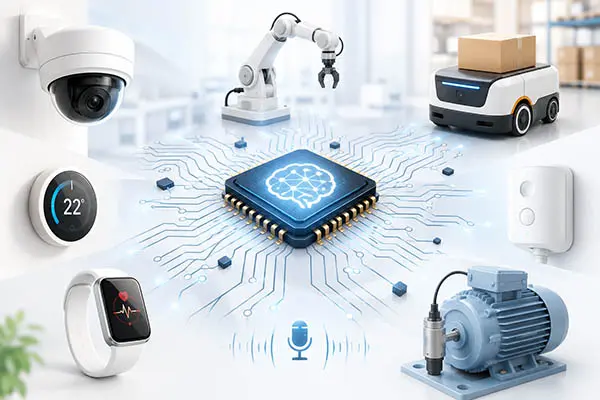
Sensors monitor real conditions. Software evaluates the data. Actuators change lighting, temperature, airflow or access.
This creates a basic perception-and-action loop.
When mobile robots, assistance systems or learning controllers are added, the smart home moves closer to the concept of Physical AI.
The building no longer reacts only to fixed rules. It adapts its behaviour to situations and occupants.
Conclusion
Smart homes combine sensing, connectivity and automated control within an intelligent building system.
They can improve comfort, safety, energy efficiency and accessibility. AI extends these capabilities by identifying usage patterns, detecting anomalies and adapting settings to actual needs.
The value of a smart home does not depend on the number of connected devices. Reliable sensors, compatible systems, local fallback mechanisms, long-term software support and responsible use of personal data are more important.
A well-designed smart home operates quietly in the background, supports its residents and remains controllable even when individual digital services fail.