Types and Applications of Humanoid Robots
Humanoid robots are among the most visible developments at the intersection of robotics, artificial intelligence and advanced sensor technology. Their human-like shape is not simply a design choice. It is intended to help machines operate in environments originally built for people.
Stairs, doors, tools, shelves, workstations and vehicles are designed around human physical capabilities. A robot equipped with arms, hands, cameras, joints and, in some cases, two legs can use this infrastructure without requiring a factory, warehouse or building to be completely redesigned.
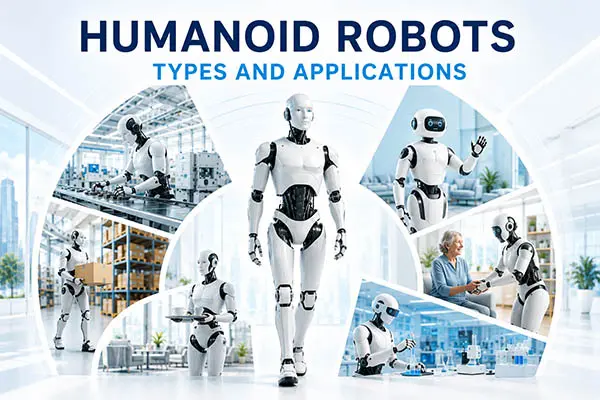
The term “humanoid robot” covers a broad range of machines. Some have a complete body with legs, arms and hands. Others consist of an upper body, a head or a pair of robotic arms. Social robots with human-like faces, voices or gestures are also often included in this category.
What defines a humanoid robot?
Humanoid robots reproduce selected physical or communicative characteristics of the human body. Typical components include:
cameras and depth sensors for environmental perception
microphones and speech recognition systems
force, pressure and touch sensors
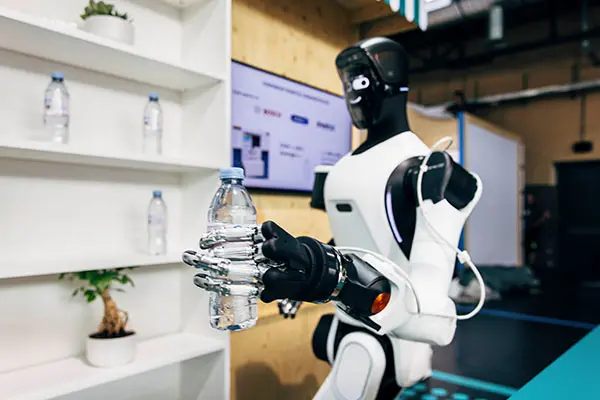
articulated arms, hands and fingers
a head or display for gaze and facial expressions
legs or a mobile base for movement
AI systems for perception, planning and decision-making
Not every humanoid robot includes all of these features. The defining factor is that its form or behaviour is adapted to human abilities, tools or working environments.
Bipedal humanoid robots
Bipedal robots most closely resemble the structure of the human body. They usually have an upper body, two arms, two legs and a movable head. Their main advantage is the ability to move through buildings and work areas designed for people.
They can potentially climb stairs, step over obstacles, move between machines and handle tools or containers. This makes them suitable for flexible tasks where conventional industrial robots or automated guided vehicles are limited.
Walking on two legs is technically demanding. A robot must continuously control its balance, recognise uneven surfaces and adjust its movements in real time. Cameras, inertial measurement units, force sensors and precise joint actuators are used to support this process.
Humanoid robots on mobile bases
A humanoid robot does not necessarily need to walk. Many systems combine a human-like upper body with a wheeled mobile base. This design is generally more stable, energy-efficient and cost-effective than a bipedal platform.
These robots can move through hospitals, hotels, offices, shopping centres and warehouses. With their arms, they can transport objects, open doors, operate equipment or assist people with simple tasks.
Wheeled humanoid robots are particularly suitable for level indoor environments. Stairs, high thresholds and rough terrain can still restrict their movement.
Stationary humanoid upper-body systems
Industrial and research organisations also use humanoid systems that are permanently installed at a workstation. These robots may have two arms, hands, cameras and a movable torso, but no legs or mobile base.
Their main advantage is the combination of stability and human-like manipulation. They can perform processes that require coordinated use of both arms, such as assembling components, sorting different objects or handling tools.
Stationary humanoid robots can be useful when a manual workstation needs to be automated without redesigning the entire production process.
Social and communication robots
Social robots are designed to communicate with people, provide information and respond to speech, gestures or emotional cues. They often have a head, a face, a display or a deliberately friendly appearance.
Their primary purpose is interaction rather than physical work. They can welcome visitors, answer questions, explain products or support educational activities.
A highly realistic human appearance is not always necessary. In many applications, eye contact, speech and simple gestures are sufficient. An overly human-like design may even cause discomfort when facial expressions or movements do not appear natural.
Research and education robots
Humanoid robots are widely used in research and education. Universities, institutes and development teams use them to test new methods for locomotion, manipulation, speech processing and human-robot interaction.
Smaller humanoid platforms can also help students learn programming, mechanics, control systems and artificial intelligence.
Research robots do not always need to deliver immediate commercial value. Their purpose is to evaluate technologies that may later be transferred to industrial, service or assistance robots.
Teleoperated humanoid robots
Teleoperated robots are controlled remotely by a human operator. Cameras, microphones and sensors provide information about the robot’s surroundings, while the operator controls movements, grasping actions or individual tasks.
These systems are useful when fully autonomous operation is not yet reliable. They can also protect people from dangerous, physically demanding or inaccessible environments.
In many future applications, teleoperation and autonomy will be combined. A robot may complete familiar tasks independently, while a human operator intervenes only when an unusual or difficult situation occurs.
Applications of humanoid robots
Manufacturing and assembly
In manufacturing, humanoid robots are being developed to perform flexible and repetitive tasks. Potential activities include loading components, operating machinery, completing simple assembly steps, carrying out quality checks and transporting small parts.
One of their main advantages is the ability to use existing tools and workstations. Instead of rebuilding an entire production line, a company may be able to deploy a robot in a space previously occupied by a human worker.
Humanoid robots are particularly relevant for production environments with frequent product changes or relatively small batch sizes. Conventional industrial robots are usually faster and more precise in highly standardised processes. Humanoid systems are intended to provide greater flexibility when tasks and conditions vary.
Logistics and warehousing
In warehouses and logistics centres, humanoid robots can pick up containers, sort goods, retrieve items from shelves and prepare orders. They may also load and unload carts, conveyors or storage systems.
The wide variety of objects is one of the main challenges. Packages differ in size, weight, material and stability. A robot must determine how to grasp and move each item safely.
Advances in computer vision, tactile sensing and AI-based motion planning are gradually improving these capabilities.
Healthcare and care services
In healthcare and care environments, humanoid robots can support staff with physically demanding or organisational tasks. Possible applications include transporting supplies, delivering objects, accompanying patients and assisting with basic movement exercises.
Social robots may also provide reminders, support conversations or participate in therapeutic and educational activities.
Humanoid robots are not a substitute for human care. Their most valuable role is to reduce routine workload so that professionals can spend more time on tasks requiring empathy, medical responsibility and personal attention.
Hospitality, retail and public services
Humanoid robots can welcome visitors, provide directions, take orders and answer questions in hotels, airports, shopping centres and restaurants.
Robots with arms may also hand over objects, transport dishes or perform simple service tasks. These applications are best suited to clearly defined processes in controlled indoor environments.
Reliable speech recognition, safe movement and intuitive interaction are essential. The robot must also cope with background noise, different languages and unexpected situations.
Homes and personal assistance
A long-term objective of humanoid robotics is to provide support in private homes. A general-purpose household robot could tidy rooms, retrieve items, sort laundry or assist people with limited mobility.
The home is one of the most challenging environments for a robot. Every household is arranged differently, objects are often placed unpredictably and many tasks require delicate hand movements.
For this reason, early household robots are more likely to perform a limited number of clearly defined tasks before truly general-purpose systems become practical.
Hazardous environments
Humanoid robots can be deployed in locations where human workers would face significant health or safety risks. Examples include areas exposed to radiation, chemical contamination, fire, unstable structures or underground hazards.
Because many of these environments are designed for human workers, a humanoid form can be useful. A robot may be able to open doors, climb ladders, turn valves and operate existing tools.
In these applications, safety and access are more important than speed.
Construction, maintenance and inspection
On construction sites and in technical facilities, humanoid robots could transport materials, perform measurements, install components and conduct inspections.
Maintenance is another important field. A robot may operate switches, read displays, identify leaks or inspect areas that are difficult for people to access.
Such applications require robust machines capable of operating in dust, moisture, changing light conditions and uneven terrain.
Research and space exploration
In space exploration, humanoid robots could perform tasks that are dangerous or time-consuming for astronauts. These may include external maintenance, repairs, infrastructure construction and preparation for future missions.
A human-like design offers the advantage of being able to use tools, handrails and controls already designed for astronauts.
Similar concepts may be suitable for underwater operations, remote research stations and other difficult-to-access environments.
The role of sensors and artificial intelligence
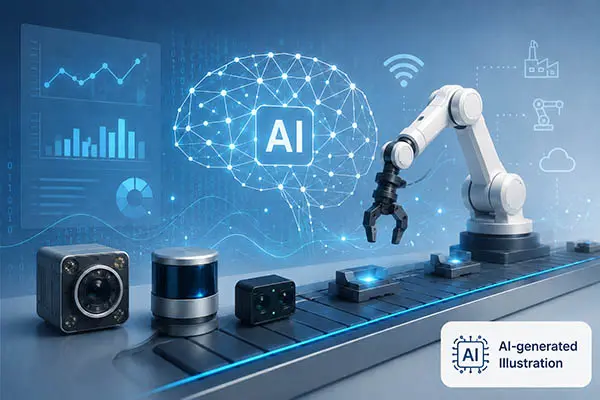
The performance of a humanoid robot depends heavily on its sensor systems. Cameras provide visual information, depth sensors measure distances and force sensors detect contact with objects or people.
Inertial sensors help stabilise the body. Tactile sensors in the hands and fingers allow the robot to control its grip. Microphones and speech systems support communication.
Artificial intelligence combines this information into a useful representation of the environment. The robot must recognise objects, plan movements, understand language and respond to changing conditions.
Many of these processes need to run directly on the robot or close to the machine. Edge AI therefore plays an important role, particularly when low latency, data privacy and reliable operation without a permanent cloud connection are required.
Challenges and limitations
Despite rapid progress, humanoid robots still face considerable technical and economic challenges.
The most important issues include:
safe movement around people
sufficient battery life
reliable handling of unfamiliar objects
high purchase and maintenance costs
robust operation in unstructured environments
understandable and traceable AI decisions
data protection and cybersecurity
legal questions concerning responsibility and liability
Social acceptance is another key factor. Organisations need to explain clearly which tasks a robot performs, what data it processes and where human responsibility remains essential.
Outlook
Humanoid robots are gradually moving from experimental research platforms towards practical assistance systems. Their greatest potential does not necessarily lie in copying the human body in every detail. The more important capability is to work effectively with human tools, infrastructure and processes.
Clearly defined applications in manufacturing, logistics, research and service industries are likely to develop first. As sensors improve, AI systems become more capable and hardware costs decline, the range of possible uses may expand.
Whether humanoid robots eventually become general-purpose assistants will depend less on impressive demonstrations than on everyday reliability. The most successful systems will be those that solve specific problems, operate safely around people and can be integrated into existing processes without extensive modifications.