Machine Vision and Machine Perception: When Machines Begin to Understand Their Environment
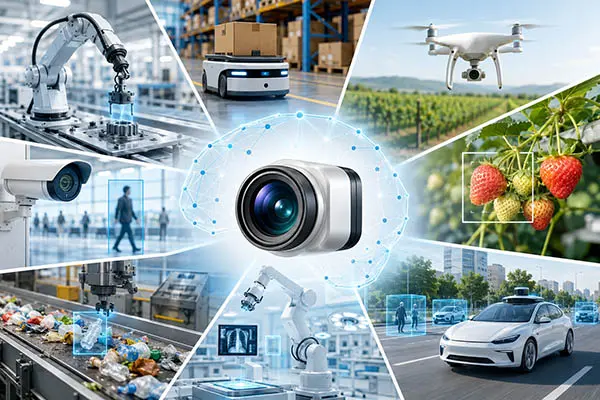
For many years, machine vision was primarily associated with factory automation. Cameras inspected components, read codes or verified that products had been assembled correctly. Today, the technology is expanding far beyond conventional industrial image processing.
Modern systems do not merely detect shapes, colours and defects. They can analyse spatial relationships, track movement, distinguish materials and interpret situations. Machine vision is therefore evolving into a broader form of machine perception that combines cameras, sensors, artificial intelligence and real-time computing.
This development is a key enabler of autonomous vehicles, intelligent robots, automated logistics and many emerging Physical AI applications.
From machine vision to machine perception
Machine vision usually refers to a technical system that captures and processes images for a defined task. A typical example is a camera positioned above a production line to verify whether a package has been sealed correctly.
Machine perception goes further. It often combines visual information with data from depth cameras, radar, LiDAR, microphones, force sensors, thermal sensors and other measurement systems.
The objective is not simply to recognise an object. A machine may also need to understand its position, movement, physical properties and relevance within a particular situation.
It must be able to answer questions such as:
What is present in the environment? Where is it located? Is it moving? Is it a person, a tool, an obstacle or a defective product? Which action is possible and safe?
Only when perception, decision-making and physical action are connected can a machine operate meaningfully in the real world.
Quality inspection in manufacturing
Quality control remains one of the most important machine vision applications. Camera systems identify scratches, cracks, deformation, incorrect colours, missing components and deviations in dimensions or surface quality.
Traditional image-processing systems use predefined characteristics and thresholds. AI-based systems can learn more complex defect patterns, making them particularly useful when products vary in appearance or when defects are difficult to describe through fixed rules.
Applications can be found in automotive manufacturing, electronics, food processing, pharmaceuticals, medical technology, battery production and semiconductor fabrication.
In the future, visual inspection will become more tightly integrated with production equipment. Instead of merely removing a defective component, the system will provide feedback to earlier process stages. If recurring surface defects are detected, for example, machine parameters could be adjusted automatically.
Quality inspection will therefore become part of a continuously optimised production process.
Flexible robotics and automated assembly
Industrial robots have traditionally operated most reliably in highly predictable environments. Components were placed in fixed positions, movements were programmed in advance and working areas were clearly separated.
Machine vision enables robots to handle objects whose position or orientation varies. They can locate components, verify assembly states and modify their movements in response to changing conditions.
A particularly important example is robotic bin picking. A robot must identify individual parts in an unstructured container, determine their three-dimensional position, select a suitable gripping point and avoid collisions.
Future robots will require less task-specific programming. They will increasingly learn from demonstrations, simulations and multimodal AI models. Visual perception will be combined with language instructions, force feedback and motion planning.
This transition is central to the development of Physical AI: machines that can perceive, reason and act within real environments.
Warehousing, logistics and material flow
Machine vision already supports a wide range of logistics processes. Cameras read barcodes and labels, measure parcels, inspect pallets and identify damaged shipments.
Mobile robots use visual sensors to navigate warehouses, avoid obstacles and determine their location. Robotic arms identify and sort products according to destination, size or packaging type.
The next generation of systems will create a more connected view of the entire facility. Rather than each robot observing only its immediate surroundings, cameras mounted on ceilings, shelves, gates and vehicles could jointly produce a dynamic model of a warehouse.
Such systems could track goods, locate available storage positions, optimise traffic routes and detect dangerous situations at an early stage. Current research and development increasingly focus on perception systems that can adapt to changing products, packaging formats and warehouse layouts.
Autonomous vehicles and mobile machinery
Autonomous vehicles depend on reliable environmental perception. Cameras identify road markings, traffic signs, pedestrians, vehicles and obstacles. Radar provides distance and velocity information, while LiDAR can create three-dimensional representations of the surroundings.
Similar technology is used in autonomous transport vehicles, construction machinery, port equipment, mining vehicles and agricultural machines.
Automation is often easier to implement in controlled areas such as factories, ports, mines and private sites than on public roads. Even in these environments, however, systems must cope with changing light, dust, rain, occlusion and unpredictable movement.
Future perception systems will combine sensor information more closely and attempt to predict behaviour rather than only detect objects. A vehicle may need to estimate whether a person standing near its path is likely to remain stationary or step into the operating area.
Healthcare and medical imaging
Visual AI systems already assist medical professionals in the analysis of X-rays, computed tomography scans, magnetic resonance images, ultrasound data, endoscopic video and microscopic tissue samples.
Machine vision can highlight suspicious areas, automate measurements and compare changes across multiple examinations. Final medical interpretation and responsibility, however, must remain with qualified professionals.
New applications are also emerging outside diagnostic imaging. Cameras and depth sensors can measure movement during rehabilitation, support robotic surgery and assist with patient observation.
Future systems may help identify fall risks, document rehabilitation progress or support medical staff with standardised procedures. European AI programmes include projects involving diagnostics, clinical processes and healthcare services.
Agriculture and food production
In agriculture, machine perception can identify individual plants, weeds, fruit, animals and visible signs of disease. Cameras may be mounted on tractors, field robots, drones or fixed monitoring systems.
Precision sprayers can apply chemicals only where they are required. Harvesting systems can estimate ripeness and determine the position of fruit. In greenhouses, visual systems monitor growth, pest activity and nutrient deficiencies.
In livestock farming, cameras can analyse movement, feeding behaviour and visible abnormalities. This allows changes to be detected earlier without requiring constant manual observation of every animal.
Open-field agriculture remains a challenging environment. Light, weather, vegetation and soil conditions continuously change. For this reason, assisted and partially autonomous systems are likely to remain more common than fully autonomous farms in the near term, with people retaining overall control.
Construction, infrastructure and maintenance
Machine vision can monitor buildings, roads, bridges, railway lines, power networks, wind turbines and industrial installations. Mobile cameras, drones and inspection robots capture cracks, corrosion, material damage and other visible changes.
When connected to digital twins, new images can be compared with previous conditions, engineering models or construction plans. This makes it possible to identify damage, detect incorrect installation and measure whether a defect is expanding.
Autonomous inspection systems could eventually examine difficult or dangerous locations at regular intervals. Potential environments include offshore installations, tunnels, pipelines, chemical plants and high-voltage infrastructure.
The economic value is not limited to reducing inspection costs. Earlier detection allows maintenance to be planned according to the actual condition of an asset rather than a fixed schedule.
Retail, public spaces and intelligent buildings
In retail, machine vision can monitor stock levels, identify empty shelves, analyse customer flows and enable automated checkout systems. In buildings, it can help measure occupancy, queues and the use of different areas.
Occupancy information may also support the control of lighting, ventilation and heating or cooling. Increasingly, these applications require edge-based processing that does not permanently store identifiable visual data.
Privacy, transparency and purpose limitation are crucial. A technically feasible application is not automatically socially acceptable or legally permitted. Organisations must determine which information is genuinely required and how unnecessary surveillance or misuse can be prevented.
Recycling and the circular economy
Visual recognition systems can classify waste according to material, colour, shape and contamination. In sorting facilities, they control robots, air jets or mechanical separation equipment.
Hyperspectral cameras can sometimes distinguish between materials that appear identical in visible light. This can improve the separation of plastics, textiles, metals and composite materials.
Future systems may visually identify products earlier in their lifecycle and retrieve information about repair, reuse or recycling. Machine vision could therefore contribute to circular processes throughout the value chain rather than only at the waste-sorting stage.
Safety and human–machine collaboration
In industrial environments, cameras can detect whether people enter hazardous areas, wear required protective equipment or approach moving vehicles. Machinery can then slow down or stop.
Reliable perception is also essential for collaborative robots. These systems must not only recognise a person, but also estimate their position and direction of movement.
Future robots may provide more situation-aware assistance. They could hand over tools, stabilise components or perform physically demanding parts of a task while people retain responsibility for planning, supervision and exceptional situations.
As autonomy increases, functional safety, cybersecurity and explainability become more important. A powerful AI model is not sufficient on its own. The complete system must remain safe when sensor data is incomplete, misleading or outside the conditions encountered during training.
Edge AI as an enabling technology
Many machine-perception applications require extremely fast response times. Transmitting large amounts of video data to a remote cloud platform may be too slow, expensive or inappropriate for privacy reasons.
A growing share of visual processing is therefore performed directly inside cameras, machines, vehicles or local edge computers. Only selected results or events are transferred to central platforms.
Edge AI reduces bandwidth requirements and allows systems to continue operating when network connections are unavailable. At the same time, it creates new challenges involving energy consumption, heat, model optimisation and the management of distributed devices.
Many future architectures will use a hybrid approach: rapid perception and reaction at the edge, combined with central analysis and model improvement in a data centre or cloud environment.
Multimodal perception and generative AI
The next generation of machine vision will operate less frequently as an isolated technology. Visual models will be combined with language, spatial information, sound, sensor measurements and movement data.
Generative AI may support the creation of training data, the simulation of rare defects and the adaptation of models to new product variants. In industrial machine vision, its potential is being investigated particularly for data augmentation, object detection and anomaly detection. Challenges remain around data quality, computing requirements and reliable validation.
Digital twins and simulation will also become increasingly important. Robots and perception models can be trained and tested in virtual environments before they are deployed in physical facilities. This approach is being developed for factories, autonomous machines and broader Physical AI applications.
The future is not about the camera alone
The camera will remain an important sensory component, but future capability will depend on the interaction of multiple technologies. Successful systems will combine optics, sensor fusion, AI models, edge computing, control systems and safe actuators.
Machine vision is therefore evolving from an automated inspection tool into a foundation for machines that can understand and respond to their surroundings.
Its greatest impact may not come from a single spectacular application. It will emerge through many practical improvements: lower production waste, safer workplaces, more precise agriculture, faster logistics, earlier maintenance and more flexible manufacturing.
Machine perception is becoming a key technology for the next stage of automation. It connects digital intelligence with the physical world and will play a decisive role in determining how reliably, economically and safely future autonomous systems operate.