Robotics and Physical AI: How Intelligent Machines Perceive, Decide and Act
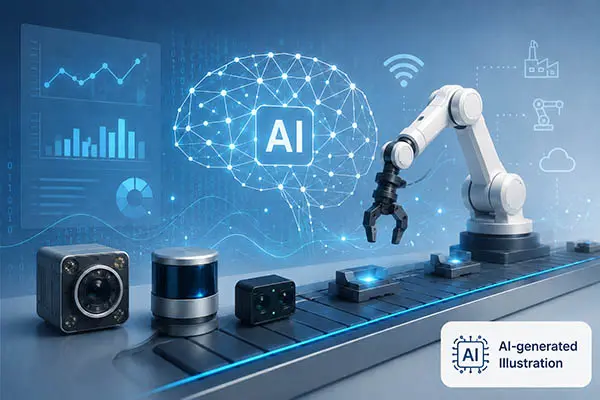
Robotics and artificial intelligence are becoming increasingly interconnected. Conventional robots usually perform clearly defined movements in structured environments. Systems based on Physical AI are intended to perceive their surroundings, interpret situations and adapt their behaviour when conditions change.
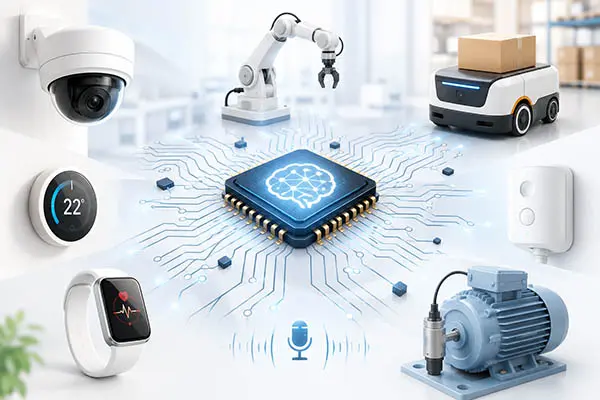
Physical AI describes artificial intelligence that is not limited to processing digital information but is directly connected to the physical world. Sensors provide information about the environment and the state of the machine. AI models evaluate this data. Actuators then convert the resulting decisions into movement or other physical actions.
Robots are one of the most important applications of this development. They combine perception, planning and movement within a continuous feedback loop.
What Is a Robot?
A robot is a programmable technical system that can perform tasks in the physical world.
Typical components include:
a mechanical structure,
drives and actuators,
sensors,
a controller,
software,
communication interfaces,
tools or grippers.
Depending on its design, a robot may move components, process workpieces, transport goods, explore environments or work alongside people.
Not every robot uses artificial intelligence. Many industrial systems operate with fixed movement sequences and predefined rules.
What Is Physical AI?
Physical AI refers to AI systems that perceive their surroundings, make decisions and act physically.
The central concept is a closed loop:
Sensors capture the real environment.
The system interprets the data.
A model evaluates the situation.
An action is planned.
Actuators execute the action.
Sensors verify the result.
This process is repeated continuously.
Physical AI therefore connects several fields:
sensing,
machine vision,
sensor fusion,
Edge AI,
robotics,
control engineering,
motion planning,
machine learning,
digital twins.
How Does Physical AI Differ from Purely Digital AI?
Many familiar AI applications operate exclusively on digital information.
They analyse:
text,
images,
speech,
documents,
software code,
user data.
Errors often remain within the digital environment.
Physical AI acts on real objects and processes.
A robot can pick up a component, an autonomous vehicle can brake and a production system can change process parameters.
This creates additional requirements:
safe reactions,
short response times,
robust sensing,
precise movements,
reliable fault detection,
clearly defined operating limits.
An incorrectly classified image may be inconvenient. An incorrect robot movement can damage equipment or endanger people.
Which Types of Robots Exist?
Industrial Robots
Industrial robots are used mainly in manufacturing.
Typical tasks include:
welding,
painting,
assembly,
palletising,
machine loading,
material handling,
quality inspection.
They often operate in clearly structured areas and perform repetitive movements with high precision.
Collaborative Robots
Collaborative robots, commonly known as cobots, are designed to work alongside people.
They may include safety functions such as:
force limitation,
torque monitoring,
speed adjustment,
collision detection,
safety-rated stop functions.
Cobots do not automatically replace conventional industrial robots. They are particularly suitable for flexible tasks, smaller batch sizes and frequent product changes.
Mobile Robots
Mobile robots move independently or semi-autonomously through their surroundings.
Examples include:
autonomous mobile robots,
automated guided vehicles,
delivery robots,
inspection robots,
mobile manipulators.
They are used in manufacturing, logistics, hospitals, agriculture and public infrastructure.
Humanoid Robots
Humanoid robots resemble the human body in their form or movement.
They often have legs, arms, hands and a head containing sensor systems.
A potential advantage is that they can operate in environments originally designed for people.
However, the technical challenges are significant. Balance, energy consumption, manipulation and safe interaction all require advanced engineering.
Service and Assistance Robots
These systems support people outside conventional production environments.
Applications can be found in:
healthcare,
cleaning,
hospitality,
retail,
security,
domestic environments,
public services.
Field Robots
Field robots operate in unstructured outdoor environments.
Examples include:
agricultural robots,
construction robots,
mining robots,
underwater robots,
inspection drones.
They must handle weather, uneven terrain and changing environmental conditions.
How Do Robots Perceive Their Environment?
Robot perception is based on sensors.
Typical sensor systems include:
cameras,
3D cameras,
LiDAR,
radar,
ultrasound,
force sensors,
torque sensors,
tactile sensors,
position sensors,
accelerometers,
microphones,
temperature and distance sensors.
Each sensor provides only part of the complete picture.
A camera detects colours, shapes and objects. LiDAR provides spatial distance information. Force sensors measure contact. Position sensors monitor joint angles and movement.
Sensor fusion combines these different sources of information.
Machine Vision in Robotics
Machine vision is a central technology for intelligent robots.
Camera systems help robots:
detect objects,
determine positions,
identify grasping points,
locate obstacles,
monitor task progress,
identify quality defects.
A conventional robot often requires components to be positioned very precisely.
An AI-based vision system can also detect slightly displaced, differently oriented or unsorted objects.
This makes robotic applications more flexible.
Force and Touch Sensing
Visual information alone is not sufficient for many tasks.
During gripping, insertion or assembly, a robot must also detect forces and contact.
Force and torque sensors can measure:
gripping force,
contact force,
resistance during insertion,
tool load,
collisions.
Tactile sensors can detect pressure distributions and touch.
This information is particularly important when handling delicate objects, working with tight tolerances or collaborating with people.
How Does an Intelligent Robot Make Decisions?
An intelligent robot processes information at several levels.
Perception
The system detects objects, people, obstacles and machine conditions.
State Estimation
It determines its own position, joint configuration, speed and current task.
Task Planning
The robot decides which action should be performed next.
Motion Planning
It calculates a safe path for the arm, gripper or mobile platform.
Control
The controller executes the planned movement precisely.
Feedback
Sensors verify whether the action was completed successfully.
If a deviation occurs, the movement may be corrected or planned again.
What Role Does Artificial Intelligence Play?
AI is used mainly where fixed rules are not sufficient.
Typical tasks include:
object detection,
image segmentation,
grasp-point estimation,
language processing,
anomaly detection,
motion prediction,
task planning,
learning from demonstrations.
An AI model may identify which object needs to be picked and which grasping position is suitable.
The actual movement is then often carried out using conventional planning and control algorithms.
In practice, robotic systems are therefore frequently hybrid combinations of AI and traditional robotics.
Learning from Demonstration
In learning from demonstration, a robot learns from examples provided by a person.
A human demonstrates a movement or manually guides the robot arm through a task.
The system may capture:
movement sequence,
speed,
forces,
object position,
order of individual steps.
The robot then attempts to perform the task independently.
This approach can simplify programming, especially for tasks involving many product variants.
Reinforcement Learning
With reinforcement learning, a system learns through trial, feedback and rewards.
Successful actions receive positive feedback, while unsuitable actions are penalised.
In robotics, reinforcement learning can be used for:
grasping,
walking,
balancing,
motion optimisation,
navigation.
Direct training on real robots can be slow, expensive or dangerous.
For this reason, much of the training takes place in simulation.
Simulation and Digital Twins
Digital twins and simulation environments play an important role in Physical AI.
Robots can use them to:
test movements,
train grasping strategies,
practise rare situations,
examine collision scenarios,
simulate sensors,
optimise control parameters.
Simulation reduces the cost and risk of physical experiments.
However, transferring a model from simulation to a real robot is not straightforward.
Differences between the virtual and physical worlds are often called the sim-to-real gap.
These differences may include:
different friction,
inaccurate material models,
changing lighting,
sensor noise,
mechanical play,
unknown environmental influences.
Edge AI in Robotics
Robots often need to react within milliseconds.
Perception and decision-making are therefore usually performed locally.
Edge-AI systems can:
analyse camera images,
combine sensor data,
detect obstacles,
adjust movements,
identify anomalies.
A permanent cloud connection would be too slow or unreliable for many safety-critical functions.
The cloud can still support:
model training,
fleet analysis,
software updates,
long-term data evaluation,
central task coordination.
Foundation Models for Robotics
A more recent approach involves large AI models that can process different tasks, objects and situations.
These models may combine information from:
images,
language,
sensor data,
robot states,
action instructions.
An operator could, for example, tell a robot which object should be moved.
The model connects this instruction with camera images and derives an action plan.
For industrial applications, such systems must be reliable, controllable and restricted by clear safety limits.
Typical Applications
Flexible Assembly
Robots identify different components and adapt their movements to product variants.
Bin Picking
A robot picks unsorted parts from a container.
It must detect the objects, determine their orientation and calculate suitable grasping points.
Quality Inspection
A robot combines movement and machine vision to inspect components from different angles.
Logistics
Mobile robots transport materials, plan routes and respond to obstacles.
Machine Tending
Robots load machines, remove workpieces and monitor process steps.
Agriculture
Robots identify plants, weeds, fruit or soil structures and perform targeted work.
Inspection and Maintenance
Mobile systems examine areas that are difficult to access or hazardous.
Medicine and Rehabilitation
Robotic systems support surgery, therapy and physical rehabilitation.
What Are the Benefits of Physical AI in Robotics?
Greater Flexibility
Robots can handle more variants and changing conditions.
Less Complex Programming
Some behaviour can be learned from data or demonstrations.
Improved Human–Robot Collaboration
Sensors and adaptive control enable safer interaction.
Greater Autonomy
Mobile and stationary robots can plan more of their tasks independently.
Operation in Unstructured Environments
AI helps robots work outside precisely prepared workstations.
Continuous Improvement
Operational data can be used to improve models and processes.
What Are the Main Challenges?
Safety
A learning system must remain safe even in unexpected situations.
It requires clear limits and monitored responses.
Reliability
AI models can make mistakes, especially with unfamiliar objects or changed environmental conditions.
Data Requirements
Many methods require large and representative training datasets.
Real-Time Performance
Perception, planning and control must respond within short time intervals.
Computing Power
Complex vision and AI models require powerful hardware.
Energy Consumption
Mobile robots and humanoid systems must balance computing performance with battery life.
Explainability
In industrial and safety-critical applications, it must be possible to understand why a robot performs a particular action.
Integration
Robots need to communicate with machines, IT systems and existing processes.
Cybersecurity
Connected robots require protection against manipulated commands, insecure updates and unauthorised access.
Keeping Humans at the Centre
Physical AI does not automatically remove people from technical processes.
Many systems are intended to support human workers.
Possible forms of cooperation include:
taking over physically demanding work,
assisting with complex assembly,
transporting materials,
inspecting dangerous areas,
supporting decisions.
Tasks, responsibilities and safety boundaries must be clearly defined.
People contribute experience, contextual understanding and improvisation. Robots provide precision, endurance and repeatable performance.
Robotics and Industrial AI
Robotics is an important part of Industrial AI.
Industrial AI analyses machine and process data. Robotics converts decisions into physical action.
An intelligent production system may:
identify a component using cameras,
evaluate its quality,
select a suitable processing step,
control a robot accordingly,
inspect the result again.
This creates a closed process of perception, decision and action.
From Automation to Autonomy
Conventional automation usually follows predefined rules.
Autonomy means that a system can make its own decisions within defined limits.
The transition takes place gradually.
A robot may first execute only fixed movements. It may later detect object positions independently. At a more advanced stage, it may select grasping points or alternative paths on its own.
The central challenge is to combine increasing flexibility with safety and control.
Conclusion
Robotics and Physical AI connect artificial intelligence with the physical world.
Sensors capture the environment and the state of the machine. AI models interpret this information. Planning and control convert decisions into real movement.
This enables robots to operate with greater flexibility, adaptability and autonomy.
Technical success, however, depends on more than powerful AI models. Reliable sensing, precise mechanics, real-time processing, functional safety and clearly defined operating limits are equally important.
Physical AI turns digital intelligence into a technology that can act. Robotics is one of its most important and visible applications.