Machine Vision with AI: How Machines Understand Images and Automate Processes
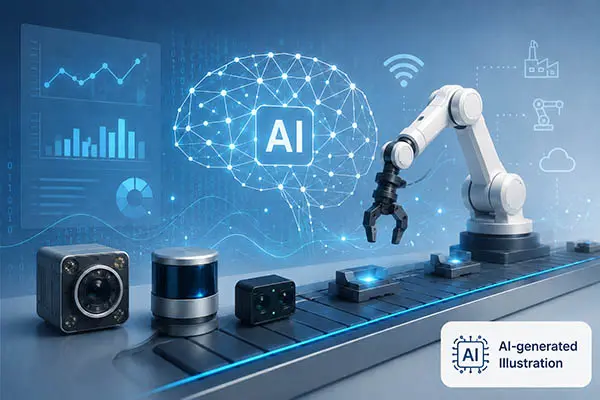
Machine vision describes the automated acquisition and evaluation of visual information by technical systems. Cameras, optics, lighting and image-processing software work together to detect objects, features and operating conditions.
Artificial intelligence has significantly expanded the capabilities of machine vision. Conventional systems often rely on fixed rules. AI-based methods can learn complex patterns from example data and remain effective when shapes, surfaces or environmental conditions vary.
Machine vision with AI is used primarily in industry, robotics, logistics, mobility, medical technology and quality inspection.
What Is Machine Vision?
Machine vision is a technical system for automated visual inspection, measurement and control.
A typical system consists of:
one or more cameras,
suitable lighting,
optics and filters,
an image-processing unit,
analysis software,
an interface to a machine or controller.
The camera captures an image. The image is then processed and evaluated. The system may determine whether a component has been assembled correctly, whether packaging is damaged or where an object is located.
Machine vision therefore goes beyond image capture. Its purpose is to produce a useful technical decision.
How Does Machine Vision Differ from Computer Vision?
The terms machine vision and computer vision are often used in similar ways, but they do not mean exactly the same thing.
Computer vision is the broader field in which computers analyse and interpret images and video.
Machine vision usually refers to the practical use of these methods in machines, production systems and automated processes.
Computer vision may analyse social-media images, medical scans or satellite data. Machine vision is more strongly associated with industrial tasks such as inspection, measurement, identification and robot guidance.
The boundaries are becoming increasingly blurred, especially as AI-based methods are used in both fields.
How Does a Machine-Vision System Work?
A machine-vision system usually operates in several stages.
1. Image Acquisition
A camera captures the object or process.
Different camera types may be used depending on the application:
area-scan cameras,
line-scan cameras,
3D cameras,
thermal cameras,
hyperspectral cameras,
event-based cameras.
The choice depends on factors such as object size, speed, resolution and environmental conditions.
2. Lighting
Lighting is a critical part of the system.
It highlights relevant features and reduces unwanted influences. Depending on the task, the system may use front lighting, backlighting, dark-field lighting or structured light.
Good lighting can greatly simplify image analysis.
3. Image Preprocessing
The captured image is prepared for analysis.
Typical steps include:
noise reduction,
contrast adjustment,
colour correction,
sharpening,
geometric correction,
normalisation.
The objective is to provide the relevant visual information as consistently as possible.
4. Feature Extraction
The system searches for relevant characteristics.
These may include:
edges,
contours,
shapes,
colours,
textures,
surface defects,
positions,
dimensions.
In conventional systems, these features are defined through fixed rules. AI-based systems can learn some of them automatically.
5. Evaluation and Decision
The system compares the detected information with predefined criteria or a trained model.
Possible results include:
component accepted,
defect detected,
object position determined,
wrong product identified,
text or code read,
robot movement approved.
6. Action
The result is sent to the machine, controller or higher-level system.
A defective product may be rejected, a robot repositioned or an alarm triggered.
Conventional Image Processing and AI
Conventional image processing usually relies on predefined rules.
Examples include:
specific brightness values,
defined edges,
geometric tolerances,
fixed colour thresholds,
predefined contours.
These systems work well when products and conditions remain highly consistent.
AI-based image processing uses trained models. These models learn from many examples which features are relevant to a specific task.
This is particularly useful when:
products vary in appearance,
defects have different forms,
backgrounds are inconsistent,
surfaces are complex,
fixed rules would be difficult to create.
AI is not automatically the better solution. For clearly defined measurement tasks, conventional image processing may be simpler, more transparent and more efficient.
Many applications therefore combine both approaches.
Which AI Methods Are Used?
Image Classification
The complete image is assigned to a class.
Examples include:
acceptable or defective,
product type A or B,
full or empty packaging,
damaged or undamaged.
Object Detection
The system identifies multiple objects and determines their position within the image.
This is used in parts recognition, logistics and robot guidance.
Segmentation
Segmentation assigns each relevant image pixel to a class.
This makes it possible to determine defect areas, object contours or material regions very precisely.
Anomaly Detection
A model learns what a normal, defect-free product looks like.
Deviations are identified as potential defects.
This method is useful when only a small number of examples of specific defects are available.
Character Recognition
Optical Character Recognition, or OCR, identifies letters and numbers.
Typical applications include:
serial numbers,
labels,
batch codes,
licence plates,
documents.
Pose Estimation
Pose estimation determines the position and orientation of an object or person.
In robotics, this helps a system pick randomly arranged components.
Typical Industrial Applications
Quality Inspection
Machine vision checks surfaces, geometry, completeness and assembly conditions.
It may detect:
scratches,
cracks,
deformation,
missing parts,
incorrect colours,
defective labels,
incomplete packaging.
Dimensional Inspection
Camera systems measure distances, diameters, angles and positions.
For precise measurement tasks, calibration, optics and lighting are especially important.
Robot Guidance
Cameras determine the position and orientation of an object.
A robot can then pick, sort or assemble components.
Identification
Barcodes, QR codes, text and product characteristics can be read automatically.
This supports traceability and process control.
Completeness Checks
The system verifies whether all required parts are present.
Examples include:
connectors,
screws,
seals,
package inserts,
labels.
Process Monitoring
Machine vision monitors ongoing processes.
This allows deviations to be detected at an early stage.
2D and 3D Machine Vision
2D Image Processing
2D systems work with flat images.
They are particularly suitable for:
contour inspection,
colour recognition,
surface inspection,
text and code recognition,
position detection.
3D Image Processing
3D systems capture depth information in addition to conventional images.
Common methods include:
stereo vision,
time of flight,
structured light,
laser triangulation,
LiDAR.
3D systems are suitable for:
volume measurement,
height inspection,
robot guidance,
deformation detection,
inspection of complex geometries.
What Role Does Deep Learning Play?
Deep learning has significantly expanded machine vision for complex visual tasks.
Neural networks can learn features directly from training data. Developers do not need to define every edge, colour or shape manually.
This is useful for:
varying defect patterns,
natural surfaces,
changing lighting conditions,
irregular objects,
inspection rules that are difficult to describe.
Deep learning requires suitable training data.
The data must be:
representative,
correctly labelled,
sufficiently diverse,
high quality.
A model trained only under ideal conditions may quickly lose accuracy in real production environments.
Edge AI and Machine Vision
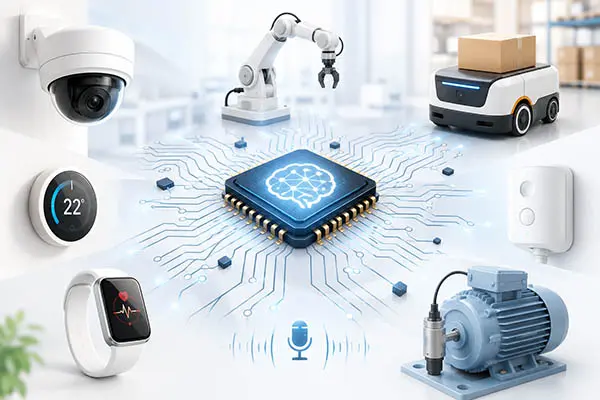
Machine-vision systems generate large amounts of data. Continuous transfer to the cloud is often impractical, especially with high-resolution cameras or fast production lines.
For this reason, AI is increasingly executed directly at the machine.
Edge-AI systems can handle:
image acquisition,
preprocessing,
model execution,
decision-making,
machine communication.
This enables short response times and reduces data traffic.
Only relevant images, defect cases or key figures need to be sent to central systems.
Which Hardware Is Required?
The appropriate hardware depends on frame rate, resolution, model size and response-time requirements.
Possible platforms include:
industrial PCs,
embedded systems,
GPUs,
AI accelerators,
smart cameras,
edge computers,
FPGA-based systems.
A simple presence check requires far less computing power than a high-resolution 3D inspection using several AI models.
What Are the Main Challenges?
Changing Lighting Conditions
Variations in lighting can strongly affect colours, contrast and surface appearance.
Product Variants
Different shapes, materials and surfaces increase complexity.
Rare Defects
Only a limited number of training images may exist for certain defect types.
Contamination
Dust, oil or condensation can affect cameras and optics.
Model Drift
If products or processes change, detection performance may decrease.
False Alarms
Too many false defect detections can disrupt production unnecessarily.
Explainability
In safety-critical or regulated applications, it may be necessary to understand why the system made a specific decision.
What Should Be Considered During Implementation?
A successful machine-vision project begins with a clearly defined task.
Important questions include:
Which defects or features must be detected?
What do acceptable and unacceptable products look like?
What level of accuracy is required?
How quickly must the decision be made?
Which environmental conditions apply?
How many product variants exist?
How will the system be tested?
How will models be updated later?
Data collection should also be planned at an early stage.
Training data must represent real production conditions. This includes different batches, lighting situations, materials and defect types.
Machine Vision in Robotics and Physical AI
In robotics and Physical AI, machine vision is a central part of perception.
A robot must determine:
where an object is located,
how it is oriented,
whether it can be grasped,
whether obstacles are present,
whether a process has been completed successfully.
AI-based vision allows robots to operate in more variable and less structured environments.
Image processing does not merely provide information. It directly influences the movement and actions of the system.
Machine Vision and Sensor Fusion
Cameras provide extensive visual information, but they also have limitations.
Image data is therefore often combined with additional sensors such as:
radar,
LiDAR,
force sensors,
position sensors,
temperature sensors,
ultrasound.
A robot may use a camera to determine the position of a component and a force sensor to verify actual contact.
Sensor fusion therefore improves the reliability of the complete system.
Conclusion
Machine vision with AI enables machines not only to capture visual information but also to interpret it.
The technology is used for quality inspection, robotics, identification, measurement and process monitoring.
AI extends conventional image processing particularly when patterns are complex, conditions vary or fixed rules are difficult to define.
A reliable system, however, requires more than a powerful model. Suitable cameras, stable lighting, representative data, appropriate hardware and careful process integration are equally important.
Machine vision is therefore becoming a key technology for intelligent machines, Edge AI and Physical AI.