Digital Twins: How Virtual Representations Improve Machines and Processes
A digital twin is a digital representation of a real object, machine, system or process. It combines technical models with current operating data, making it possible to monitor conditions, analyse changes and simulate future developments.
Digital twins are used in industry, energy, mobility, building technology, logistics and medical applications. They create a connection between the physical and digital worlds.
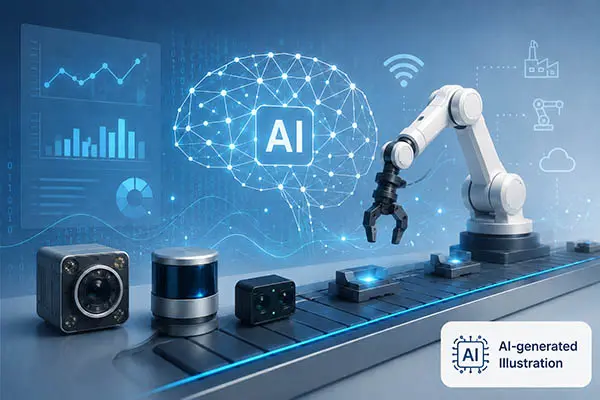
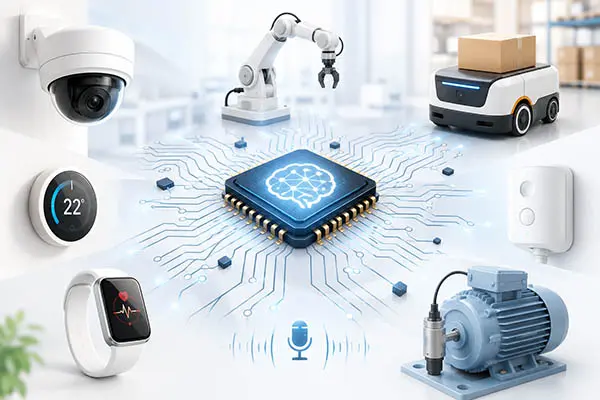
Sensors provide information from the real system. Software models place this data into context, describe relationships and support decisions. In combination with Industrial AI, Edge AI and predictive maintenance, digital twins can help operate machines more efficiently, identify failures earlier and optimise processes.
What Is a Digital Twin?
A digital twin represents the properties, condition and behaviour of a real system in digital form.
The physical counterpart may be:
an individual sensor,
a motor,
a pump,
a robot,
a production machine,
a manufacturing line,
a building,
a vehicle,
a wind farm,
a logistics network.
Depending on the application, the digital twin may contain different types of information.
These can include:
geometry and structure,
technical specifications,
current sensor data,
operating conditions,
historical measurements,
maintenance information,
simulation models,
process parameters,
software versions,
expected behaviour.
A digital twin is therefore more than a static 3D model. The defining feature is its connection to real operating data.
How Does a Digital Twin Differ from a Digital Model?
Not every digital model is automatically a digital twin.
Digital Model
A digital model represents an object or process virtually. It may be used for design, planning or simulation.
However, there is not necessarily an automated data exchange with the real system.
Digital Shadow
A digital shadow receives data from the physical system.
Changes in the machine are captured digitally, but the main data flow is one-way: from the physical world to the digital environment.
Digital Twin
A digital twin has a continuous or regular connection with the physical system.
It can represent the current condition, perform analyses and return results to people or technical systems.
In advanced applications, this may also lead to automatic adjustments in the real process.
How Does a Digital Twin Work?
A digital twin typically consists of several layers.
1. Physical System
The process begins with the real machine, facility or infrastructure.
It performs a technical task and produces operating data.
2. Sensing and Data Acquisition
Sensors measure relevant quantities such as:
temperature,
pressure,
vibration,
force,
torque,
position,
speed,
flow,
energy consumption,
air quality,
image data.
Data from controllers, maintenance systems and business software may also be included.
3. Communication
The data is transferred through industrial networks, gateways, edge systems or cloud connections.
Depending on the application, this may occur continuously, at fixed intervals or only when certain events occur.
4. Data Platform
The different information sources are stored, structured and connected.
The platform allows measurements, technical documentation and operating conditions to be evaluated together.
5. Digital Model
The model describes the structure and behaviour of the real system.
It may include:
CAD models,
physical models,
mathematical equations,
simulation models,
process models,
statistical methods,
AI models.
6. Analysis and Visualisation
The digital twin represents conditions and supports analysis.
It can:
visualise current operating data,
identify deviations,
calculate loads,
predict future conditions,
simulate maintenance actions,
compare process changes.
7. Feedback to the Physical System
The results can be provided to operators, maintenance teams or control systems.
In advanced applications, the process may be adjusted automatically.
Which Data Does a Digital Twin Need?
Data requirements depend strongly on the intended purpose.
A digital twin used to visualise a production facility needs different information from one designed to calculate the remaining life of a bearing.
Typical data sources include:
sensors,
machine controllers,
SCADA systems,
manufacturing execution systems,
ERP systems,
maintenance databases,
CAD and engineering data,
quality information,
energy and consumption data,
simulation data,
environmental information.
The objective is not to collect as much data as possible. The data must be relevant, reliable and correctly timed for the specific use case.
Which Types of Digital Twins Exist?
Digital twins can be applied at different levels.
Component Twin
A component twin represents an individual part, such as a bearing, sensor or electric motor.
Equipment Twin
An equipment twin describes a complete machine or technical system.
It considers several components and their interactions.
Process Twin
A process twin represents a production or operational process.
It may analyse material flow, energy consumption, lead times or quality parameters.
System Twin
A system twin connects several machines, facilities or sites.
Examples include a factory, power grid or logistics network.
Product Twin
A product twin follows a product through parts of its lifecycle.
It can connect information from development, production, operation and maintenance.
Typical Applications
Condition Monitoring
A digital twin displays the current condition of a machine or system.
Operators can view measurements, operating states and warnings in a central interface.
Predictive Maintenance
The digital twin combines current sensor data with historical information and technical models.
This can help predict wear and potential failures.
Process Optimisation
Different process parameters can be evaluated virtually.
This makes it possible to analyse how changes affect quality, energy consumption or throughput.
Virtual Commissioning
A controller or production system can first be tested in a simulated environment.
Errors can be identified before the physical system is fully built or started.
Product Development
Engineers can simulate loads, movement, temperature distribution and material behaviour.
Designs can therefore be improved before a physical prototype is created.
Training
Employees can practise procedures on a virtual version of the system.
This is especially useful for complex, expensive or safety-critical equipment.
Energy Optimisation
Digital twins can represent energy flows, load profiles and operating states.
Inefficient operating strategies can be identified and alternatives tested.
Buildings and Infrastructure
Digital twins of buildings, bridges or cities combine planning data with current measurements.
They can support maintenance, energy planning, traffic control and safety analysis.
What Role Do Sensors Play?
Sensors provide the connection between the physical object and its digital representation.
Without current measurement data, the digital twin remains largely a static model.
Depending on the application, different sensor types may be used:
temperature and humidity sensors,
vibration sensors,
pressure sensors,
force and torque sensors,
flow sensors,
current and voltage sensors,
position and motion sensors,
cameras,
radar,
LiDAR,
environmental sensors.
Sensors must not only be accurate. Placement, sampling rate, calibration and long-term stability are also important.
Incorrect measurements lead to an inaccurate digital representation and unreliable analysis.
What Role Does Artificial Intelligence Play?
Artificial intelligence adds learning and predictive capabilities to digital twins.
AI models can:
detect unusual conditions,
identify relationships in large datasets,
predict future developments,
narrow down failure causes,
recommend optimal process parameters,
combine simulated and real data.
An AI model may learn which combination of temperature, vibration and load indicates the beginning of bearing damage.
The digital twin provides the technical context. It identifies which component is affected, how it interacts with other parts and under which operating conditions it is used.
Physics-Based and Data-Driven Models
Digital twins can combine different types of models.
Physics-Based Models
These are based on known engineering relationships.
Examples include:
heat transfer,
fluid dynamics,
kinematics,
material stress,
electrical networks.
These models are understandable and transparent but may require significant computing power.
Data-Driven Models
These models learn relationships from historical or current measurement data.
They can capture complex patterns but require suitable training data.
Hybrid Models
Hybrid approaches combine physical knowledge with machine learning.
A physical model may describe the basic behaviour of a machine, while an AI model adds influences such as ageing or effects that are difficult to model directly.
This combination can be especially robust and efficient.
Edge, Cloud or Hybrid Architecture?
Digital twins can operate across different IT layers.
Edge
At the edge, data is processed directly on or near the machine.
This is useful for:
fast condition assessment,
local control,
data filtering,
operation without a permanent cloud connection.
Cloud
The cloud is suitable for:
large-scale simulations,
long-term data storage,
cross-site comparisons,
central model management,
fleet analysis.
Hybrid Architecture
Many applications combine both levels.
The edge system handles time-critical information. The cloud supports long-term analysis, model training and central management.
Benefits of Digital Twins
Greater Transparency
Machine conditions and process relationships become easier to understand.
Less Downtime
Problems can be detected earlier and maintenance planned more effectively.
Faster Development
Products and systems can be tested virtually before physical changes are implemented.
Lower Costs
Simulation can reduce prototypes, failed trials and unplanned downtime.
Improved Quality
Process deviations can be detected and analysed earlier.
Greater Energy Efficiency
Alternative operating strategies can be compared virtually.
Lifecycle Support
A digital twin can connect information from development and production through to operation and maintenance.
What Are the Main Challenges?
Data Integration
Machines, sensors and software systems often use different formats and interfaces.
Connecting them can require significant effort.
Data Quality
Incomplete, incorrect or unsynchronised data produces unreliable results.
Model Accuracy
A model is always a simplified representation of reality.
It must be accurate enough for the intended purpose without becoming unnecessarily complex.
Maintenance Effort
If the real system changes, the digital twin must also be updated.
This includes physical modifications, software updates, new components and changed process conditions.
Computing Requirements
Detailed simulations may require considerable computing power.
Cybersecurity
Digital twins contain sensitive technical and operational information.
Access, interfaces and data transmission must be protected.
Unclear Objectives
A digital twin should solve a specific problem.
A highly detailed model without a clear purpose can quickly become expensive and difficult to maintain.
How Should a Digital-Twin Project Begin?
The project should start with a clearly defined use case.
Important questions include:
Which real system should be represented?
Which decision should be improved?
Which data is required?
Which data already exists?
How current must the model be?
What level of accuracy is necessary?
Who will use the digital twin?
How will economic value be measured?
A pilot project may initially focus on one critical machine or a single process step.
The model should be expanded only after its value has been demonstrated.
Digital Twins and the Product Lifecycle
A digital twin can connect different stages of a product lifecycle.
Development
Design and behaviour are simulated.
Production
Manufacturing data and quality information are captured.
Operation
Current conditions and usage patterns are analysed.
Maintenance
Service activities, spare parts and wear are documented.
Improvement
Experience from operation supports future product generations.
This creates a continuous information loop between engineering and real-world use.
Digital Twins and Physical AI
Physical AI describes systems that perceive their surroundings and act within the physical world.
Digital twins can support these systems by providing a structured model of the machine and its environment.
A robot may simulate movements in the digital twin before performing them physically.
A production system can test different parameters before changing the real process.
Autonomous systems can use virtual models to predict situations and evaluate possible actions.
The digital twin therefore becomes a virtual testing environment for physical AI systems.
Conclusion
Digital twins connect real machines, sensors, technical models and software to create a dynamic digital representation.
They support condition monitoring, simulation, process optimisation and predictive maintenance.
Their value does not come from a complex 3D model alone. Relevant data, a clear objective, suitable models and a reliable connection to the physical system are what matter.
Combined with Industrial AI, Edge AI and sensing technologies, digital twins become an important tool for creating more transparent, efficient and adaptable technical systems.