Embedded AI: When Artificial Intelligence Becomes Part of the Device
What is embedded AI?
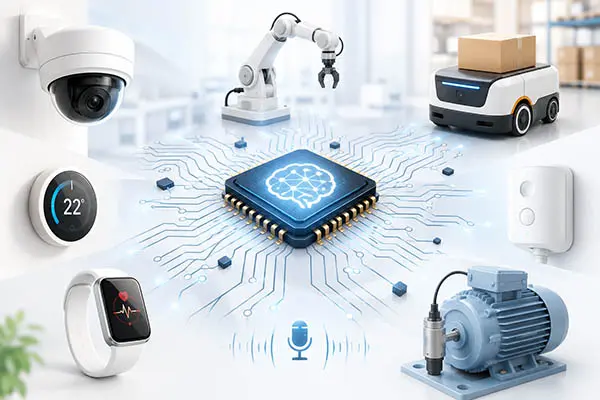
Embedded AI is the integration of artificial intelligence into a dedicated electronic device or embedded system. Instead of using AI only as external software or a centralized cloud service, the intelligence becomes part of the product itself.
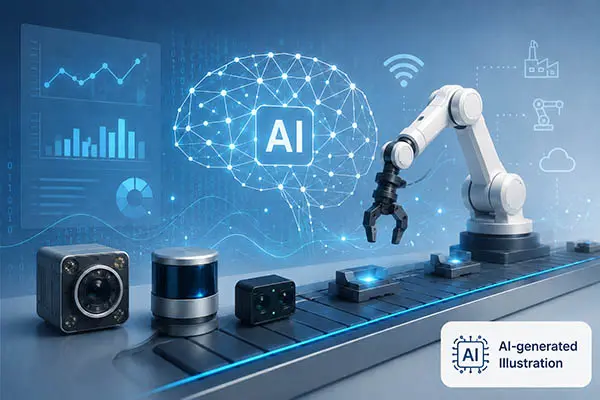
An embedded AI device may capture images, sounds, movements, temperatures, electrical signals or vibrations and analyze them locally. Based on the result, it can trigger an action: A camera detects a person, a machine identifies an abnormal vibration pattern, or a wearable classifies a movement.
The category ranges from small microcontrollers running compact machine-learning models to high-performance embedded processors equipped with dedicated neural processing units. Modern development tools can optimize and compile models for microcontrollers, microprocessors, smart sensors and specialized AI accelerators.
Embedded AI turns an electronic device from a system that merely collects data into one that can interpret its surroundings.
From sensor data to a local decision
A conventional sensor produces a measurement. An embedded AI system goes further by combining sensing, signal processing, a trained model and a resulting action.
A typical process includes five stages:
A sensor captures raw data.
The electronics prepare and filter the signal.
A machine-learning model analyzes the data.
The system detects a pattern, condition or anomaly.
The device reports the result or controls an actuator.
A vibration sensor, for example, does not necessarily need to send a continuous stream of raw measurements to the cloud. It can identify an unusual machine condition locally and transmit only an alert or a compact diagnostic result.
This approach reduces communication requirements and allows the system to react quickly.
Embedded AI and edge AI: closely related, but different
Embedded AI and edge AI are often used as interchangeable terms. Both move AI processing closer to the source of the data, but they emphasize different aspects.
Embedded AI focuses on integrating intelligence into a specific device or product. Edge AI focuses on where processing takes place within a distributed computing architecture: at or near the network edge rather than exclusively in a centralized data center.
A smart camera that performs object detection locally is both an embedded AI device and an edge AI system. An industrial computer analyzing data from several production machines is also an edge AI system, but it may not be described as a conventional embedded AI device.
Edge AI can therefore include sensors, cameras and microcontrollers as well as gateways, industrial PCs and on-site servers. Embedded AI is more closely associated with intelligence built into a defined product.
How does embedded AI differ from TinyML?
TinyML is a specialized part of embedded AI. It focuses on running particularly compact machine-learning models on highly resource-constrained microcontrollers.
These systems usually have limited memory, modest computing power and a very small energy budget. Typical tasks include wake-word detection, gesture recognition, simple anomaly detection and the classification of machine sounds.
Embedded AI is the broader category. It includes TinyML, but also covers embedded Linux systems, intelligent cameras, vehicle controllers, robotics platforms and devices with powerful AI accelerators.
A useful simplified relationship is:
TinyML is a highly compact form of embedded AI. Embedded AI is often part of edge AI.
In practice, the boundaries are not rigid. The classification depends on the hardware, the model and the task the device performs.
Which hardware is used?
The appropriate hardware depends on the requirements of the application. A low-power anomaly detector has very different needs from a vision system that detects several objects in real time.
Microcontrollers
Microcontrollers are suitable for compact, energy-efficient and clearly defined tasks. A single device can handle sensor acquisition, signal processing, control functions and AI inference.
Modern microcontrollers may include vector processing, digital signal processing or dedicated NPU capabilities. This makes it possible to execute increasingly sophisticated neural networks within a microcontroller-class power and size envelope.
Microprocessors and systems-on-chip
More powerful microprocessors and systems-on-chip are commonly used for computer vision, speech processing and advanced human-machine interfaces. These platforms can combine CPU cores, graphics processors, image signal processors and AI accelerators.
Neural processing units
A neural processing unit, or NPU, is designed to accelerate the mathematical operations used by neural networks. It can execute suitable AI workloads more efficiently than a general-purpose CPU.
NPUs are increasingly integrated into microcontrollers, processors and embedded computing platforms. They expand the range of local AI applications from basic classification to object detection, segmentation, speech processing and multimodal models.
Smart sensors
In a smart sensor, part of the processing takes place inside the sensor module. Some components combine sensing with signal processing or basic machine-learning functions.
This allows the sensor itself to determine whether a relevant event has occurred. The main processor does not need to examine every individual raw measurement.
Why use embedded AI?
The main advantage is not simply that computation takes place locally. Embedded AI can change the architecture and capabilities of an entire product.
Fast response
The device does not have to send data to a remote server before making a decision. This is important for machine control, safety functions, robotics and interactive systems.
Reduced data transmission
Cameras, microphones and industrial sensors can generate substantial amounts of data. Local analysis allows a device to transmit only events, results or compressed information.
Operation without continuous connectivity
Many products must continue working when the network is unavailable. A locally deployed model enables autonomous or partially autonomous operation.
Improved privacy
Sensitive image, voice, health or operational data can remain on the device. Raw data does not always need to be transferred to an external platform.
Energy and cost efficiency
Local processing can reduce wireless communication, bandwidth consumption and recurring cloud costs. Achieving this benefit requires careful coordination between the model and the target hardware.
Smarter products
Manufacturers can add capabilities directly to their products. A sensor becomes a condition-monitoring device, a camera becomes an analytical system and a tool becomes a context-aware assistant.
Typical applications
Industrial condition monitoring
Embedded AI systems analyze vibrations, sounds, electrical currents or temperatures and detect unusual operating conditions. Maintenance teams can receive an early warning before a problem becomes critical.
Machine vision
Smart cameras inspect components, detect objects, count products or monitor work areas. The images can be analyzed directly inside the camera or an integrated vision system.
Robotics
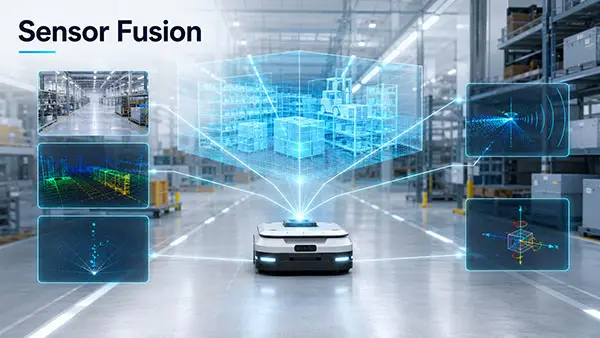
Robots need local perception and rapid decisions. Embedded AI supports object recognition, grasp-point detection, navigation, collision avoidance and sensor-data interpretation.
Vehicles and mobile machinery
Embedded AI can support driver assistance, environmental perception, equipment monitoring and intelligent controls in vehicles and mobile machines.
Wearables and medical devices
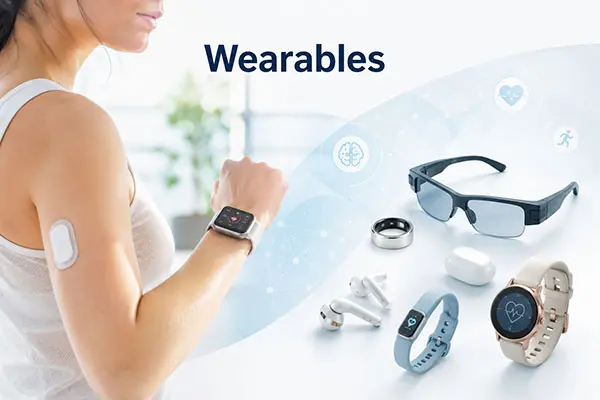
Wearables can analyze movement patterns, physiological signals and user input. Local processing enables immediate feedback while limiting the amount of personal data that must be transmitted.
Smart homes and buildings
Devices can recognize speech, presence, gestures or unusual sounds locally. Heating, ventilation, access and security systems can respond more intelligently to changing conditions.
Consumer devices
Headphones, household appliances, power tools and domestic robots can use embedded AI for automatic adjustment, condition analysis and more natural interaction.
How is an embedded AI application developed?
Development should begin with a clearly defined problem rather than with a preferred model. The team must first determine which data is available, what decision the device needs to make and how reliable that decision must be.
Relevant training data is then collected and prepared. A model is trained, evaluated and optimized for the target hardware. Techniques such as quantization, pruning and other forms of model compression may be used.
Not every model can be transferred unchanged to an embedded device. Model size, memory footprint, supported operators and available computing resources must be considered early in the development process.
After integration, the system must be tested under realistic operating conditions. The evaluation should cover more than model accuracy. Important factors include:
response time
energy consumption
memory requirements
thermal behavior
robustness against interference
privacy and cybersecurity
software updates
behavior when predictions are uncertain
Successful embedded AI therefore requires close cooperation between sensor specialists, embedded engineers, data scientists, product developers and domain experts.
The main challenges
Embedded AI operates under tighter constraints than a typical cloud application. Computing power, memory, energy and cooling are limited.
Data quality is another major issue. Sensors are affected by environmental conditions, ageing, installation positions and production tolerances. A model that works well in a laboratory may behave differently inside a machine with changing speeds, temperatures or background noise.
The product lifecycle also matters. Embedded devices may remain in use for many years. Manufacturers need a strategy for monitoring, updating and protecting models throughout that period.
Embedded AI is therefore not only a model-accuracy problem. It is a system-engineering task in which hardware, software, data and product operation must work together.
From connected devices to intelligent products
Embedded AI is changing the role of sensors and electronics. Devices no longer have to stop at collecting measurements. They can interpret data, recognize patterns and act immediately.
The cloud still has an important role. It can support model training, fleet management, software updates and analysis across multiple devices. Immediate decisions, however, are increasingly moving into the product itself.
This creates a distributed form of artificial intelligence. Data centers handle large-scale training and centralized analysis, while embedded systems respond where data is generated and physical processes take place.
Embedded AI is therefore becoming a key technology for smart sensors, autonomous machines, robotics, wearables and physical AI. It connects digital intelligence with real products and makes artificial intelligence an integral part of the physical world.