Wearables with Sensors and AI: From Data Trackers to Intelligent Assistance Systems
Wearable devices have evolved significantly in recent years. Simple step counters have become connected systems capable of continuously collecting, processing and, in some cases, interpreting data related to the human body. This development is driven by the combination of advanced sensors, energy-efficient processors and artificial intelligence.
Wearable technology is no longer limited to fitness watches. It is increasingly used in healthcare, industrial environments, occupational safety, logistics, care services and professional sports. Wearables can detect movement, monitor vital signs, analyse physical strain and identify unusual changes at an early stage.
What Is a Wearable?
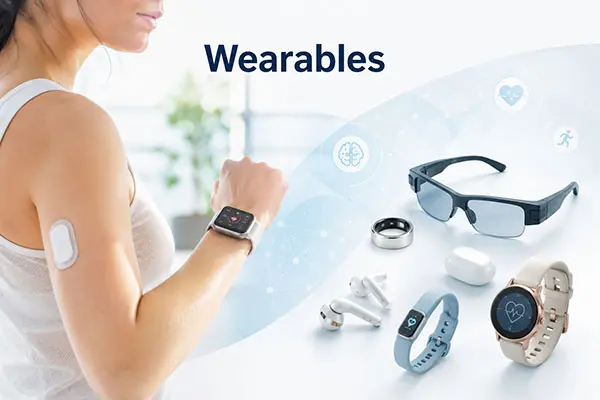
Wearables are electronic devices worn directly on the body or integrated into clothing, equipment and personal accessories. Common examples include:
smartwatches and fitness bands
smart rings
smart glasses
medical patches and skin sensors
sensor-enabled textiles
hearables and intelligent hearing devices
exoskeletons
smart helmets, shoes and gloves
However, the value of a wearable does not depend on its physical format alone. What matters is which data it collects and how reliably the system can transform that data into useful information.
Which Sensors Are Used in Wearables?
Wearables can contain a wide range of sensors, depending on their intended application. Several sensor types are often combined to improve measurement quality and provide a more complete understanding of the user’s condition and activities.
Motion Sensors
Accelerometers and gyroscopes are among the most widely used components in wearable devices. They detect acceleration, rotation, orientation and changes in movement.
These sensors allow a device to count steps, identify gestures, analyse posture, recognise activities or detect falls. Magnetometers can provide additional information about spatial orientation. Together, these components are often integrated into an inertial measurement unit, or IMU.
Optical Sensors
Optical sensors are commonly used to measure heart rate and blood oxygen saturation. Light-emitting diodes illuminate the skin, while photodetectors measure changes in the reflected light.
Under suitable conditions, these signals can be used to estimate heart rate, pulse-wave characteristics and blood oxygen levels. Measurement quality, however, depends strongly on device position, movement, fit, skin contact and environmental conditions.
Electrical and Bioelectrical Sensors
Electrodes can capture electrical signals generated by the human body. Relevant measurement methods include:
electrocardiography for cardiac activity
electromyography for muscle activity
electrodermal activity for changes in skin conductance
bioimpedance measurements for electrical properties of body tissue
These methods create valuable opportunities for health and performance monitoring, but they also require reliable skin contact, advanced signal processing and careful interpretation.
Temperature, Pressure and Chemical Sensors
Temperature sensors can measure skin temperature or conditions in the immediate environment. Pressure sensors are used in smart footwear, insoles, gloves and rehabilitation devices.
Chemical and biochemical sensors are also becoming more important. They can analyse components of sweat, interstitial fluid or exhaled breath. This creates new possibilities for monitoring physiological and metabolic changes continuously.
Environmental and Position Sensors
A wearable can also collect information about its surroundings. Relevant measurements include:
air quality
noise
ultraviolet radiation
atmospheric pressure
humidity
ambient temperature
location and direction of movement
Combining body-related and environmental data provides valuable context. An increased heart rate, for example, can have very different meanings depending on physical activity, temperature, stress or workload.
Why Wearables Need Artificial Intelligence
Sensors initially produce raw data. This data can contain noise, motion artefacts, outliers and changes caused by the measurement environment. Artificial intelligence helps identify relevant patterns and interpret sensor readings within the correct context.
Common AI tasks in wearable devices include:
activity and gesture recognition
detection of normal and abnormal patterns
sleep-stage analysis
fall and posture detection
physical-load assessment
personalisation of reference values
filtering of disturbed sensor signals
prediction of trends and changes
Personalisation is one of the main benefits of AI. People differ in movement style, resting heart rate, skin properties, daily routines and physiological responses. An intelligent system can learn an individual baseline and identify deviations more accurately.
Edge AI: Intelligence Directly on the Body
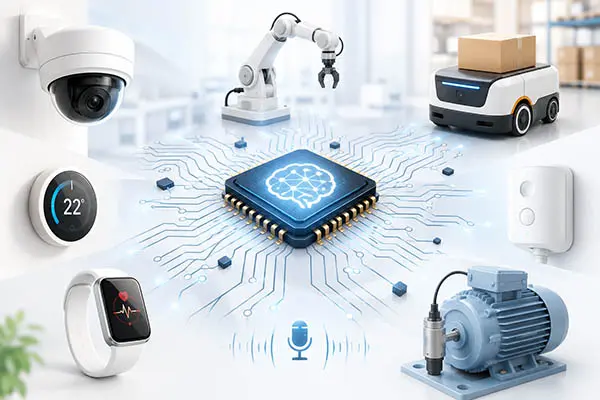
Many modern wearables process part of their data directly on the device. This approach is commonly referred to as Edge AI.
Local processing can offer several advantages:
shorter response times
reduced data transmission
less dependence on cloud connectivity
greater control over sensitive information
potentially lower energy consumption with the right system architecture
A wearable can, for example, detect a fall locally and trigger an alert immediately. It does not need to transmit all raw sensor data to a remote server before taking action.
The technical challenge is to run capable AI models on small and energy-efficient processors. Models therefore need to be compressed, optimised and adapted to limited memory and computing resources.
Sensor Fusion Improves Reliability
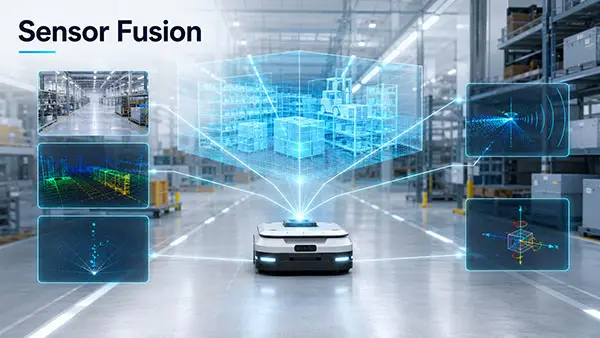
A single sensor often cannot provide a complete picture. More reliable assessments become possible when several sources of information are combined.
A fall-detection system could evaluate:
sudden acceleration
a change in body orientation
a period of inactivity
an unusual heart rate
location information
This form of sensor fusion can reduce false alarms. At the same time, it increases the complexity of data processing, testing and system validation.
Applications in Healthcare
Wearables can support continuous monitoring outside hospitals and medical practices. Potential applications include:
monitoring heart rate and heart rhythm
supporting rehabilitation programmes
analysing mobility and gait
detecting falls
assisting with sleep analysis
documenting therapy and activity patterns
monitoring chronic conditions
Wearables do not replace professional medical diagnosis. They can, however, provide additional longitudinal data and reveal changes that may not be visible during an isolated examination.
Medical applications require high measurement quality, traceable algorithms and development processes suited to the relevant regulatory requirements.
Wearables in Industry and Occupational Safety
Interest in wearable technology is also growing in industrial environments. Wearables can support employees without continuously interrupting their work.
Potential applications include:
detecting ergonomically unfavourable movements
monitoring physical strain
warning users about heat, noise or hazardous substances
supporting navigation in warehouses and production facilities
displaying digital work instructions through smart glasses
managing access and safety functions
assisting maintenance and inspection tasks
Employee acceptance is particularly important. Systems that collect body-related or performance data must be introduced transparently. The purpose of data collection, access rights and retention periods should be clearly defined.
Sports, Training and Performance Analysis
In sports, wearables enable detailed analysis of movement, workload and recovery. In addition to speed, distance and heart rate, modern systems can evaluate movement quality, asymmetry, ground-contact time and recurring strain patterns.
AI can help define individual training zones and identify changes over longer periods. However, performance should not be assessed using individual metrics alone. Sleep, stress, nutrition, illness and environmental conditions also influence physical capability.
Data Protection and Security
Wearables often process highly sensitive information. Body-related data may reveal details about health, behaviour, location and daily routines.
Manufacturers and operators should therefore consider essential protection principles from the beginning of development:
collecting only the data that is actually required
implementing clear consent and access mechanisms
encrypting stored and transmitted data
providing secure software and firmware updates
making data processing understandable
defining deletion and retention policies
preventing unauthorised profiling
Local AI processing can reduce the amount of data transmitted to external systems. It does not automatically solve every privacy issue. Data stored on the wearable itself must also be protected.
Challenges in Measurement Quality and Reliability
Wearable data can appear more precise than it actually is. Errors can be caused by several factors:
loose or incorrect positioning
movement and vibration
sweat and moisture
insufficient skin contact
ambient temperature
lighting conditions
sensor ageing
differences between user groups
A reliable wearable must therefore perform not only in controlled laboratory conditions but also in realistic daily situations.
It is equally important to define the intended purpose of each measurement. A sensor may be suitable for identifying long-term trends without matching the accuracy of a clinical measurement device.
Energy Consumption Remains a Limiting Factor
Wearables are expected to be small, lightweight and usable for long periods. At the same time, sensors, wireless communication, displays and AI processors all require energy.
Developers must balance sampling frequency, computing power, transmission rates and battery life. Typical approaches include:
event-driven measurements
adaptive sampling rates
low-power wireless communication
local preprocessing
compact AI models
activating individual sensors only when required
Intelligent power management is therefore an important part of the overall system design.
Outlook: Wearables Are Becoming Context-Aware
The next generation of wearable devices will not simply display individual measurements. These systems will increasingly interpret situations and combine different types of information.
Future wearables may be able to distinguish whether a physiological change is associated with exercise, stress, heat, lack of sleep or illness. Achieving this will require closer integration of sensor technology, AI, medical knowledge and contextual data.
The most useful systems will operate reliably in the background and intervene only when they can provide meaningful information or support a relevant action.
Conclusion
Wearables are evolving from mobile data trackers into intelligent assistance systems. Sensors capture movement, vital signs and environmental conditions. Artificial intelligence filters this data, recognises patterns and adapts the analysis to individual users.
The greatest potential lies in combining multiple sensors with local AI processing. At the same time, measurement quality, energy consumption, privacy, security and algorithmic transparency remain critical challenges.
Successful wearable solutions will not be defined by the number of integrated sensors. Their real value will depend on whether they can turn collected data into reliable, understandable and practical benefits.