Edge AI Explained: Intelligence Directly at the Sensor and Device
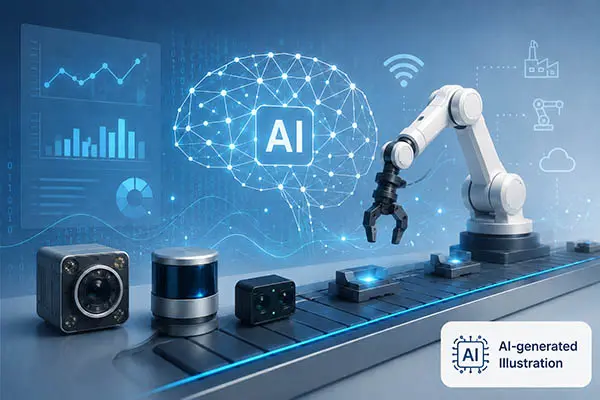
Edge AI refers to the execution of artificial intelligence directly where data is generated: on machines, cameras, sensors, vehicles or other devices. Instead of transferring all data to a data centre or cloud platform first, it is processed locally.
This approach is particularly relevant for industrial applications. Production systems, autonomous machines and intelligent sensors often need to react within milliseconds. Long transmission paths or unstable internet connections can become a serious limitation. Edge AI shortens the path between data acquisition, analysis and action.
What Does “Edge” Mean?
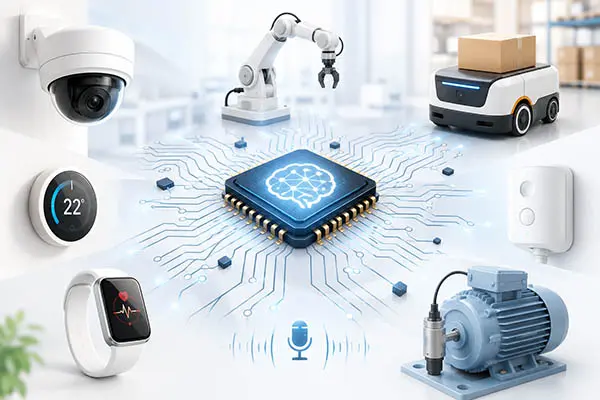
The term “edge” describes the outer boundary of a network. It refers to devices located close to the physical source of the data. These may include:
industrial cameras,
intelligent sensors,
embedded systems,
machine controllers,
robots,
vehicles,
drones,
mobile devices,
industrial edge computers.
These devices collect data from their environment and process it partially or completely on site.
A conventional cloud system first sends sensor data to a remote server. The data is stored and processed there before the result is sent back. Edge AI moves at least part of this processing to the local device.
How Does Edge AI Work?
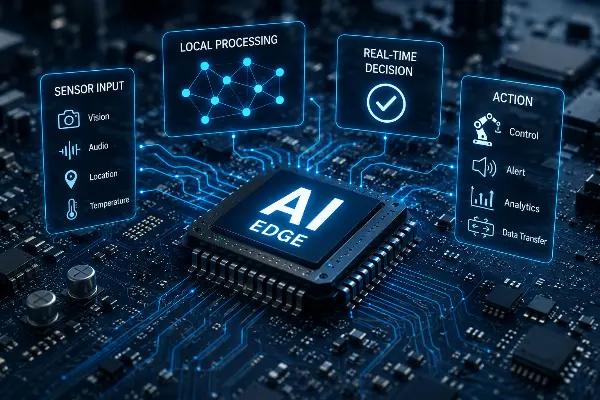
An Edge AI system usually consists of several components.
The process begins with a sensor or camera. It captures images, temperatures, vibrations, sounds, pressure values, movements or other physical quantities.
The raw data is then prepared for analysis. This may include filtering, normalisation, data reduction or the extraction of relevant features.
A trained AI model then analyses the data. It identifies patterns, anomalies, objects or operating conditions.
The result can trigger an immediate action. A machine may be stopped, a defective component removed, a warning generated or a robot movement adjusted.
The required computing power can be provided by different types of hardware:
microcontrollers,
processors,
graphics processing units,
specialised AI accelerators,
system-on-chip solutions,
industrial edge computers.
The most suitable hardware depends on the amount of data, the required response time, energy consumption and the complexity of the AI model.
Why Is AI Moving to the Edge?
Local data processing offers several important advantages.
Faster Responses
Because data does not need to be transferred to the cloud first, decisions can be made very quickly. This is essential for robot control, safety functions and automated visual inspection.
Reduced Data Traffic
Cameras and sensors can generate large volumes of data. Transmitting all of it creates high bandwidth and storage requirements. Edge AI can evaluate the data locally and forward only relevant results.
Instead of sending an entire video stream, the system may only transmit the information that a defect has been detected.
Higher Availability
An Edge AI system can continue to operate even without a stable cloud connection. This is important in factories, vehicles, remote installations and mobile systems.
Improved Data Privacy
Sensitive data does not always have to leave the local system. This may include images, audio recordings, operational information or personal data.
Lower Operating Costs
Reduced data transmission and lower cloud storage requirements can decrease operating costs over time. However, local hardware, maintenance and software management also create additional expenses.
Typical Applications
Edge AI is already used in many different fields.
Industrial Machine Vision
Cameras inspect components, packaging, surfaces and assembly processes. AI models detect defects directly on the production line.
Predictive Maintenance
Vibration, temperature or current sensors monitor machinery. A local model identifies unusual patterns that may indicate wear or an impending failure.
Robotics
Robots must perceive their surroundings and react quickly to changes. Edge AI processes data from cameras, force sensors, distance sensors and position sensors in real time.
Vehicles and Mobile Systems
Driver assistance systems, autonomous vehicles, agricultural machinery and drones analyse their surroundings locally. A continuous cloud connection would be too slow or unreliable for many safety-critical functions.
Buildings and Energy
Intelligent systems optimise lighting, heating, ventilation and energy consumption. Local models can recognise occupancy, usage patterns or equipment conditions.
Medical Technology
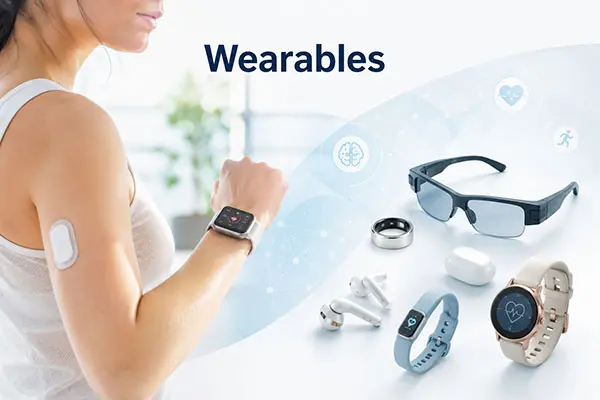
Wearable devices and medical sensors can evaluate measurement data locally and generate early warnings when unusual patterns are detected.
Edge AI and Cloud AI Are Not Opposites
Edge AI does not completely replace the cloud. In many applications, both approaches are combined.
Complex AI models are often trained in powerful data centres. The finished model is then transferred to an edge device, where it performs the actual analysis.
The cloud may still be used for:
central data storage,
model training,
fleet management,
software updates,
long-term analysis,
comparison across multiple sites,
device monitoring.
The edge layer handles time-critical decisions and reduces the amount of data that needs to be transmitted.
What Are the Main Challenges?
Edge AI creates specific technical requirements.
Limited Computing Resources
Edge devices often provide less memory and computing power than servers. AI models therefore need to be compressed, optimised or designed specifically for embedded hardware.
Energy Consumption
Mobile devices, wireless sensors and battery-powered systems must operate with very little energy. The workload of the AI model must be carefully matched to the hardware.
Maintenance and Updates
AI models can lose accuracy over time if machines, environments or products change. Models therefore need to be monitored and updated when necessary.
Security
Edge devices are often located outside protected data centres. They must be secured against manipulation, unauthorised access and unsafe software updates.
Data Quality
Even a powerful AI model can only deliver reliable results when the sensor data is sufficiently accurate, stable and representative.
What Is TinyML?
TinyML is a subfield of Edge AI. It focuses on running very compact machine-learning models on small microcontrollers.
These systems often require very little energy and can be integrated directly into sensors or battery-powered devices.
Typical applications include:
sound recognition,
motion classification,
motor monitoring,
gesture recognition,
local anomaly detection,
intelligent condition monitoring.
TinyML brings AI capabilities to applications where conventional computer hardware would be too large, expensive or energy-intensive.
What Role Do Sensors Play?
Sensors form the foundation of every Edge AI system. They provide the data from which the model derives its decisions.
Depending on the application, different sensor types may be used:
cameras,
microphones,
accelerometers,
force sensors,
temperature sensors,
pressure sensors,
radar,
LiDAR,
ultrasound,
current and voltage sensors.
Sensor selection and placement strongly influence the quality of the entire system. An AI model can only compensate for unsuitable or poor-quality measurement data to a limited extent.
Conclusion
Edge AI brings artificial intelligence closer to the physical world. Data is processed directly on machines, sensors and devices, allowing systems to react faster, more independently and more efficiently.
This approach is especially important in industry, robotics, mobility and intelligent measurement technology. The success of an Edge AI system does not depend only on the performance of its AI model. Suitable sensors, reliable measurement data, appropriate hardware and a secure system architecture are equally important.
The future of many AI applications will therefore not exist exclusively in large data centres. Increasingly, intelligence will be located directly at the source of the data.