Embedded AI in Sensors: How Artificial Intelligence Operates Directly Inside Sensors
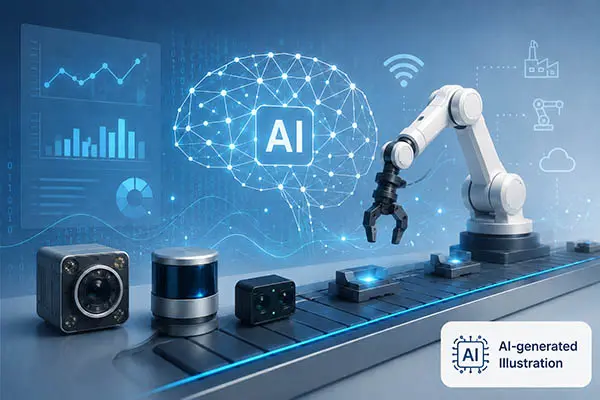
Sensors measure physical quantities such as temperature, pressure, motion, sound, light and force. Conventional sensing systems transmit these measurements to a controller, edge computer or cloud platform for further processing.
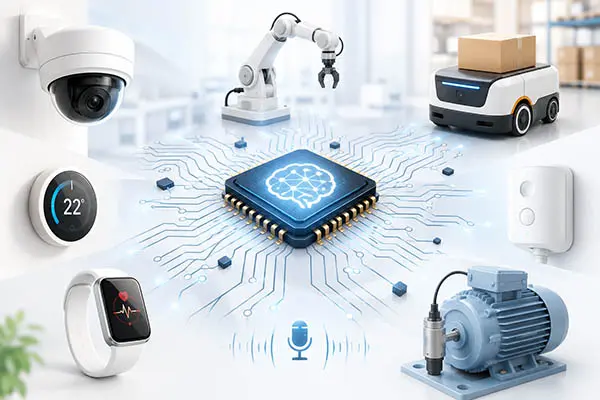
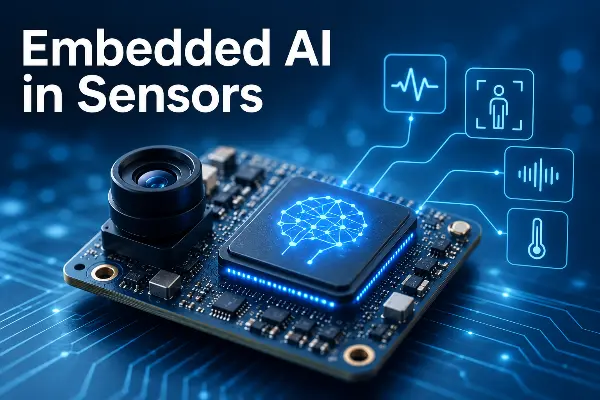
Embedded AI changes this approach. Algorithms and machine-learning models run directly inside the sensor, within the sensor module or on a nearby microcontroller. The sensor therefore provides not only raw measurements but also interpreted information.
An intelligent vibration sensor may report that a machine’s operating behaviour has changed instead of transmitting only acceleration values. A camera can detect objects locally without sending every image to a central system. An acoustic sensor can identify unusual sounds and forward only relevant events.
Embedded AI therefore turns sensors into active data-processing components.
What Is Embedded AI?
Embedded AI is the execution of artificial-intelligence functions on embedded systems.
Embedded systems are specialised electronic units designed for clearly defined tasks. They include:
microcontrollers,
digital signal processors,
AI accelerators,
systems on chip,
intelligent sensor modules,
industrial controllers,
compact edge devices.
Embedded-AI systems usually have limited resources.
Compared with servers and cloud platforms, they provide:
less computing power,
less memory,
limited energy,
restricted cooling,
lower communication bandwidth.
AI models therefore need to be compact and efficient.
What Is Embedded AI in Sensors?
Embedded AI in sensors means that AI functions are executed directly inside a sensor or close to its sensing electronics.
Depending on the architecture, processing may take place:
inside the sensing device,
on an integrated microcontroller,
on a processor within the sensor module,
on a local edge chip,
in an intelligent gateway close to the sensor.
The term covers different levels of integration.
A basic intelligent sensor may monitor thresholds and filter signals. A more advanced embedded-AI sensor may recognise patterns, classify operating states or detect anomalies.
From Measurement to Information
A conventional sensor may provide values such as:
temperature: 68.4 degrees Celsius,
vibration: 4.2 millimetres per second,
current consumption: 8.7 amperes,
sound pressure: 72 decibels.
These values still need to be interpreted.
An embedded-AI sensor may instead generate information such as:
normal operating state,
developing imbalance,
unusual load,
probable bearing problem,
relevant sound class detected.
Part of the analysis therefore moves directly to the measurement point.
Why Integrate AI Directly into Sensors?
Local processing offers several technical benefits.
Reduced Data Volume
Many sensors generate continuous data streams.
Particularly data-intensive sensors include:
cameras,
microphones,
radar,
LiDAR,
high-frequency vibration sensors.
Transmitting only relevant features or detected events can greatly reduce the data volume.
A camera may not need to stream video continuously. It may only report:
person detected,
object missing,
quality defect found,
movement inside a defined area.
Low Latency
Time-critical decisions can be made directly at the sensor.
This is important for:
machine monitoring,
collision avoidance,
robotics,
safety functions,
quality inspection,
process control.
The shorter the path between measurement and decision, the faster the system can respond.
Operation Without a Permanent Connection
An embedded-AI sensor can continue operating without a cloud or network connection.
This is relevant for:
mobile devices,
remote installations,
vehicles,
agriculture,
infrastructure monitoring,
safety-critical systems.
Privacy
When sensitive data is processed locally, raw information does not always need to be transmitted.
A camera may output only the information that a person is present without storing or forwarding the complete image.
An acoustic sensor may detect selected sound classes without continuously transmitting audio recordings.
System-Level Energy Efficiency
Local processing consumes computing energy, but it can reduce wireless communication and central processing.
Because wireless transmission often requires significant energy, intelligent preprocessing may extend battery life.
Typical System Architecture
An embedded-AI sensor system usually contains several components.
Sensing Element
The sensing element converts a physical quantity into an electrical signal.
Examples include:
MEMS accelerometers,
microphones,
photodetectors,
pressure cells,
temperature sensors,
magnetic-field sensors,
radar chips.
Analogue Front End
The analogue front end prepares the sensor signal.
It may perform:
amplification,
filtering,
level adjustment,
noise reduction.
Analogue-to-Digital Converter
The analogue-to-digital converter changes the analogue signal into digital measurements.
Resolution and sampling rate affect the quality of subsequent analysis.
Processor
The processor performs signal processing and runs the AI model.
Possible processing units include:
microcontrollers,
DSPs,
neural accelerators,
FPGAs,
systems on chip.
Memory
Memory stores:
program code,
model parameters,
intermediate results,
calibration data,
configuration.
Communication Interface
Results are transmitted through an interface.
Typical options include:
I²C,
SPI,
UART,
CAN,
IO-Link,
Ethernet,
Bluetooth,
Wi-Fi,
industrial fieldbuses.
Conventional Signal Processing and AI
Embedded AI does not automatically replace conventional signal processing.
The two approaches are often combined.
Conventional signal processing may perform:
filtering,
Fourier transforms,
averaging,
spectral analysis,
debounce logic,
threshold monitoring.
AI may then perform:
pattern classification,
anomaly detection,
condition assessment,
event recognition,
forecasting.
A hybrid approach is often more efficient than a purely neural system.
Feature Engineering
AI models can process raw data directly. On embedded systems, however, it is often useful to calculate features first.
For vibration data, features may include:
root mean square,
peak value,
kurtosis,
frequency components,
energy within selected bands,
spectral peaks.
For audio, features may include:
volume,
frequency spectrum,
Mel-frequency coefficients,
temporal patterns.
Features reduce the data volume and simplify the model.
TinyML
TinyML refers to machine learning on highly resource-constrained devices.
Typical platforms are microcontrollers with:
a few hundred kilobytes of RAM,
limited flash memory,
low clock speeds,
very low power consumption.
TinyML is suitable for:
gesture recognition,
keyword spotting,
simple image classification,
condition monitoring,
anomaly detection.
Embedded AI is the broader term. TinyML describes a particularly resource-efficient subset.
Model Training and Inference
Embedded AI requires a distinction between training and inference.
Training
During training, the model learns from example data.
Training usually takes place on more powerful systems such as:
workstations,
servers,
cloud platforms,
GPU clusters.
Inference
During inference, the trained model is applied to new sensor data.
Inference later runs directly inside the sensor or embedded system.
Complete model training takes place on the sensor only in a limited number of applications.
Typical Development Process
1. Define the Use Case
The required task must first be clear.
Examples include:
identify motor condition,
classify gestures,
detect glass breakage,
recognise product defects,
report unusual temperature patterns.
2. Collect Sensor Data
Real data is captured under different operating conditions.
3. Label the Data
For supervised learning, examples need to be assigned to categories.
Examples include:
normal,
imbalance,
bearing fault,
overload.
4. Prepare the Data
Measurements are filtered, synchronised and normalised.
5. Train the Model
A suitable machine-learning model is developed.
6. Optimise the Model
The model is adapted to the target system’s memory, computing and energy limits.
7. Deploy the Model
The model is transferred to the microcontroller or sensor hardware.
8. Test Under Real Conditions
The complete system is validated in realistic operation.
Which AI Models Are Suitable?
The choice depends on the task and hardware.
Decision Trees
Decision trees are comparatively simple and interpretable.
They are suitable for structured sensor features.
Random Forests
Random forests combine several decision trees.
They can provide robust classification but require more memory and computing resources.
Support Vector Machines
Support vector machines are suitable for classification problems with a manageable number of features.
Small Neural Networks
Compact neural networks can detect more complex patterns.
They are commonly used for:
audio,
motion,
images,
time series.
Convolutional Neural Networks
Convolutional neural networks are particularly suitable for image and spectral data.
Small variants can run on embedded hardware.
Recurrent Neural Networks
Recurrent neural networks and related architectures can process temporal relationships.
They are suitable for:
sensor sequences,
speech,
vibration patterns,
motion data.
Autoencoders
Autoencoders are often used for anomaly detection.
The model learns normal behaviour.
When new data differs significantly from the learned pattern, the system can report an anomaly.
Model Compression
A model that runs on a server may be too large for a sensor.
Several optimisation techniques can be used.
Quantisation
Quantisation stores model values with lower numerical precision.
For example, 8-bit integers may replace 32-bit floating-point values.
Benefits include:
lower memory use,
faster processing,
reduced energy consumption.
Model accuracy may decline slightly and must be tested.
Pruning
Pruning removes connections or weights that contribute little to the result.
The model becomes smaller and requires fewer operations.
Knowledge Distillation
Knowledge distillation allows a small model to learn from a larger model.
The large model acts as the teacher, while the smaller model is optimised for the embedded target.
Architecture Simplification
The model can be simplified through fewer layers, smaller filters or reduced input data.
Memory Types
Embedded systems usually contain different types of memory.
Flash Memory
Flash stores program code and model parameters.
RAM
RAM stores current sensor data, intermediate results and model activations.
RAM usage is often a critical limitation for neural networks.
Non-Volatile Memory
Additional memory may store configuration, events or long-term statistics.
Computing Performance
Required computing performance depends on:
model size,
sensor data rate,
target latency,
number of channels,
numerical precision.
Typical performance indicators include:
clock rate,
operations per second,
MAC operations,
TOPS for more capable accelerators.
High theoretical performance does not automatically guarantee good energy efficiency or low latency.
AI Accelerators
AI accelerators are specialised processing units for neural networks.
They optimise operations such as:
matrix multiplication,
convolution,
activation functions,
parallel data processing.
An integrated accelerator can reduce CPU load and lower energy consumption.
Energy Management
Energy efficiency is especially important for battery-powered or energy-autonomous sensors.
Typical methods include:
sleep modes,
event-triggered activation,
reduced sampling rates,
local data filtering,
adaptive model activation,
switching off unused components.
A sensor may remain in a low-power state and run the full AI model only when a suspicious condition is detected.
Always-On Sensing
Always-on sensing means that a sensor remains active continuously.
It is relevant for:
voice activation,
motion detection,
security monitoring,
condition monitoring.
A multi-stage architecture is often used to keep power consumption low.
A low-power detector first identifies a possible event. A more complex model is activated only afterwards.
Event-Based Processing
With event-based processing, data is processed intensively only when a relevant condition changes.
Examples include:
movement detected,
sound threshold exceeded,
temperature trend changed,
object entered the field of view.
This reduces computing effort and data transmission.
Embedded Vision
Embedded vision combines cameras with local image processing.
Typical applications include:
object detection,
quality inspection,
people counting,
gesture recognition,
presence detection,
barcode and text recognition.
An embedded-vision system may process complete images internally and transmit only the result.
Acoustic Embedded AI
Microphones generate continuous streams of data.
Embedded AI can identify acoustic events such as:
machine faults,
glass breakage,
alarm signals,
speech keywords,
leaks,
unusual operating noise.
Acoustic systems require robust filtering because environmental noise complicates classification.
Vibration Analysis
Vibration sensors are among the most important tools in industrial condition monitoring.
Embedded AI may detect:
imbalance,
misalignment,
bearing problems,
looseness,
unusual load conditions.
Local analysis is especially useful because high-frequency vibration data creates large datasets.
Radar Sensors with Embedded AI
Radar sensors measure distance, velocity and movement.
AI can use radar data for:
presence detection,
gesture control,
vital-motion sensing,
object recognition,
level measurement,
collision avoidance.
Radar can operate in darkness, dust and certain conditions that limit optical systems.
Sensor Fusion
Embedded AI can combine data from several sensors.
A system may use:
acceleration,
angular rate,
magnetic field,
temperature,
pressure.
Sensor fusion improves state recognition.
A single sensor may be affected by interference. Different sensing principles provide additional context.
Anomaly Detection Inside the Sensor
Anomaly detection is an important use case.
The sensor learns normal operating behaviour and reports deviations.
This is useful when only a small number of known fault examples exists.
The system may report:
unusual vibration pattern,
changed current consumption,
abnormal sound,
unexpected temperature development.
An anomaly is not automatically a confirmed defect.
Personalisation and Calibration
Sensors operate under different conditions.
Machines, environments and users vary.
An embedded-AI system may therefore require local adaptation.
Possible approaches include:
commissioning calibration,
individual thresholds,
baseline learning,
adaptive normalisation,
parameter updates.
Complete online learning on small systems remains difficult and may introduce safety risks.
Model Updates
AI models may need to be updated.
Reasons include:
new fault classes,
changed operating conditions,
improved models,
security corrections,
new products.
Updates may be delivered through:
cable,
local gateway,
wireless connection,
over-the-air methods.
Secure updates require:
authentication,
signature verification,
version control,
rollback mechanisms.
Data and Model Versioning
An embedded-AI system should record:
firmware version,
active model version,
training-data basis,
current configuration,
update date.
This is important for maintenance, quality assurance and regulatory requirements.
Real-Time Capability
An embedded-AI system often needs to respond within a defined time.
Important parameters include:
sampling rate,
processing time,
end-to-end latency,
jitter,
missed deadlines.
In safety-critical applications, both average and maximum response times need to be known.
Deterministic Processing
Conventional control systems often operate deterministically.
This means that reaction times and workflows are predictable.
AI models can introduce additional complexity.
Industrial systems therefore often separate AI functions from clearly defined safety and control functions.
Reliability
Sensors may be affected by environmental conditions.
These include:
temperature,
humidity,
vibration,
electromagnetic interference,
ageing,
contamination.
The AI model needs to remain reliable under these conditions.
A model trained only with ideal laboratory data may fail in the field.
Robustness Against Data Shift
When real data differs from training data, the condition is known as data drift or distribution shift.
Possible causes include:
new machine states,
different materials,
sensor ageing,
changed mounting position,
new background noise.
The system should detect such changes or be reviewed regularly.
False Alarms and Missed Events
Two important metrics are:
false positive: the system reports an event that did not occur,
false negative: the system misses a real event.
The appropriate balance depends on the application.
In a safety function, a missed event may be especially critical. In maintenance, excessive false alarms can reduce user trust.
Explainability
Small models and conventional feature-based methods are often easier to interpret than complex neural networks.
In technical applications, it can be useful to output additional information alongside the classification.
Examples include:
affected frequency range,
relevant sensor feature,
confidence value,
deviation from baseline.
Safety
Embedded-AI sensors may form part of safety-related systems.
An AI classification should not automatically serve as the only protection layer.
Possible safety mechanisms include:
independent threshold monitoring,
redundant sensors,
plausibility checks,
safe states,
watchdog functions,
manual override.
Cybersecurity
Intelligent sensors contain software, memory and communication interfaces.
This creates possible attack surfaces.
Risks include:
manipulated firmware,
unauthorised model updates,
forged sensor data,
stolen keys,
insecure interfaces.
Protection measures include:
secure boot,
signed firmware,
encrypted communication,
secure key storage,
access control.
Typical Applications
Predictive Maintenance
Sensors detect machine changes at an early stage.
Quality Inspection
Cameras or acoustic sensors identify production defects.
Wearables
Embedded AI recognises activities, gestures or unusual movement patterns.
Smart Homes
Sensors detect presence, sounds or energy anomalies.
Robotics
Local sensor processing supports balance, grasping and collision avoidance.
Automotive
Sensors classify driving conditions, cabin situations and external objects.
Agriculture
Embedded AI evaluates plants, soil conditions and machine states.
Medical Devices
Body-worn sensors identify patterns and relevant events.
Benefits
Rapid Response
Analysis takes place directly at the data source.
Reduced Data Traffic
Only relevant results are transmitted.
Lower Cloud Dependence
Many functions operate without an external platform.
Improved Privacy
Raw data can remain local.
Greater System Autonomy
The sensor can operate without a permanent connection.
Scalability
Large numbers of intelligent sensors can work in a decentralised way without overloading central systems with raw data.
Challenges
Limited Resources
Memory, computing power and energy are constrained.
Complex Model Optimisation
A successful server model cannot automatically be transferred to a microcontroller.
Data Quality
Poor training data produces unreliable results.
Validation
Models need to be tested under real conditions.
Updates
Firmware and models need secure update mechanisms.
Misinterpretation
AI outputs are probabilities rather than guaranteed facts.
Maintainability
Hardware, firmware and model versions need to be managed together.
Make-or-Buy Decision
Companies can develop embedded-AI systems internally or use commercial solutions.
Internal development offers:
high adaptability,
control over data and models,
targeted optimisation.
Commercial solutions provide:
faster integration,
lower development effort,
tested hardware,
vendor support.
The decision depends on strategic importance, production volume, expertise and time to market.
Selecting Hardware
Important questions include:
What sensor data rate is generated?
What model size is required?
How short must the response time be?
How much energy is available?
Which interfaces are needed?
Is an AI accelerator useful?
How much flash and RAM are required?
Which environmental conditions apply?
Selecting the Model
The most accurate model is not automatically the best embedded model.
The relevant balance includes:
accuracy,
memory use,
processing time,
energy consumption,
robustness,
maintainability.
A slightly smaller model may be the better real-world solution.
How Should an Embedded-AI Sensor Project Begin?
A suitable starting point includes:
a clearly defined use case,
realistic sensor data,
a measurable target,
an appropriate hardware platform,
a compact baseline model,
testing under real conditions,
an update and monitoring concept.
The first step should be to determine whether conventional signal processing is already sufficient.
AI is especially useful when patterns are complex or difficult to describe with fixed rules.
Embedded AI and Intelligent Sensors
Not every intelligent sensor uses AI.
A smart sensor may provide conventional functions such as:
digital communication,
self-diagnostics,
calibration,
threshold monitoring,
signal filtering.
Embedded AI extends these functions with data-driven pattern recognition.
Embedded AI and Edge AI
Embedded AI and Edge AI overlap.
Embedded AI refers to AI running on embedded hardware.
Edge AI refers to AI processing close to the data source.
An intelligent sensor is therefore both an embedded-AI and an edge-AI system.
A capable industrial computer located near a machine is an edge-AI system but not necessarily a sensor.
Embedded AI as Part of Physical AI
Physical AI requires fast and reliable perception.
Embedded-AI sensors provide locally interpreted information.
A robot can therefore detect more quickly:
whether an object is slipping,
whether a joint is unusually loaded,
whether a person is approaching,
whether a motor shows abnormal vibration.
Embedded AI is therefore an important technical foundation for autonomous physical systems.
Conclusion
Embedded AI moves artificial intelligence directly into sensors and embedded systems.
Instead of delivering only raw data, sensors can recognise events, classify conditions and report anomalies.
The main benefits are low latency, reduced data traffic, local autonomy and improved privacy.
Implementation is technically demanding. Models need to fit within limited memory, computing and energy budgets.
Successful systems combine sensing, conventional signal processing, compact AI models and robust embedded hardware.
Embedded AI therefore transforms the sensor from a passive measuring device into an active component of intelligent machines and Physical-AI systems.