Sensor Fusion: Turning Individual Measurements into a Reliable View of the World
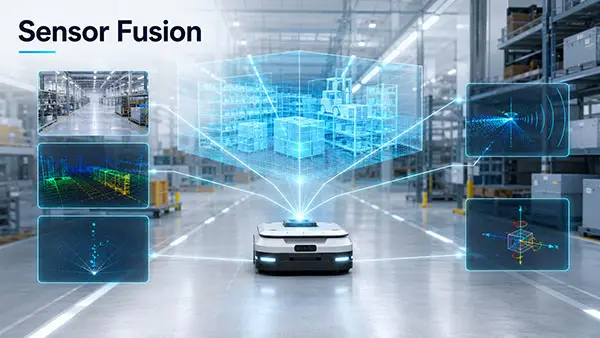
Sensors form the foundation of modern automation. Cameras identify objects, radar sensors measure distance and speed, while inertial sensors detect movement and acceleration. Each sensor provides valuable information, but every technology captures only part of the surrounding reality.
Sensor fusion combines information from multiple sensors to create a more accurate and reliable understanding of a situation. It enables machines, vehicles and intelligent systems to perceive their environment more precisely, assess events more effectively and make better decisions.
What Is Sensor Fusion?
Sensor fusion is the process of combining measurements from several sensors or information sources. Its purpose is to achieve greater accuracy, availability and reliability than a single sensor could provide on its own.
A system may combine different sensor technologies or use several sensors of the same type. An autonomous vehicle, for example, can rely on cameras, radar, ultrasonic sensors, LiDAR, satellite navigation and inertial measurement units. An industrial robot may combine visual information with force, position and acceleration data.
The signals are synchronized, evaluated and integrated into a common model. The result is not simply a larger volume of data. It is a more complete interpretation of the current situation.
Why One Sensor Is Usually Not Enough
Every sensor has specific strengths and limitations. A camera provides detailed visual information but may perform poorly in darkness, fog or direct glare. Radar operates largely independently of lighting conditions, although it usually provides less detail about an object’s shape and appearance.
LiDAR can produce precise three-dimensional measurements but may be affected by weather, contamination or difficult reflective surfaces. Inertial sensors react quickly to movement, yet their measurements can drift over time.
Sensor fusion compensates for these weaknesses. When one sensor delivers uncertain or incomplete information, other sensors can provide additional evidence. This creates robust systems that remain operational under changing environmental and operating conditions.
Main Levels of Sensor Fusion
Sensor information can be combined at several stages of the processing chain.
Data-Level Fusion
Data-level fusion combines largely unprocessed sensor measurements. This approach preserves a high amount of information but requires substantial processing power, communication bandwidth and accurate synchronization.
Feature-Level Fusion
In feature-level fusion, relevant characteristics are first extracted from the sensor data. These may include object contours, movement directions, temperature patterns or distinctive image points. The extracted features are then combined and evaluated.
Decision-Level Fusion
With decision-level fusion, each sensor system initially analyses its measurements independently. The resulting classifications or decisions are combined at a later stage. This approach is modular and relatively easy to scale, although some information contained in the original sensor data may be lost.
The most suitable method depends on the application, available processing resources, latency requirements and required level of accuracy.
Which Methods Are Used?
Sensor fusion systems rely on mathematical, statistical and increasingly machine-learning-based methods.
Established approaches include the Kalman filter and its extended variants. These filters estimate the state of a dynamic system by considering sensor measurements, uncertainty and motion models. Particle filters are useful for complex or nonlinear situations in which several possible states must be evaluated simultaneously.
Other systems use probabilistic models, Bayesian networks, fuzzy logic or rule-based methods. Modern applications increasingly incorporate neural networks and deep-learning architectures. These models can learn complex relationships between camera, radar, LiDAR and other sensor inputs.
Classical and AI-based methods are often combined. Physical and mathematical models provide stability and traceability, while machine learning can identify patterns that are difficult to describe using fixed rules.
Sensor Fusion and Artificial Intelligence
Sensor fusion is a core component of Physical AI. Intelligent machines need more than data processing capabilities. They must understand their physical environment and respond to changing conditions.
Artificial intelligence supports several important functions:
detecting and classifying objects
tracking people, vehicles and machines
evaluating conflicting sensor measurements
identifying anomalies and sensor failures
predicting future movement and system states
adapting to changing environmental conditions
The combination of sensors, sensor fusion and artificial intelligence connects perception more closely with physical action. This is essential for autonomous vehicles, mobile robots, drones and intelligent production systems.
Cloud or Edge Processing?
Many sensor fusion applications must make decisions within milliseconds. Processing is therefore increasingly performed directly inside the vehicle, robot, device or industrial machine.
Edge AI reduces latency, limits the amount of data that must be transmitted and allows systems to operate even when network connectivity is restricted. Sensitive raw data can also remain on the local device.
Cloud platforms still play an important role. They are suitable for training large AI models, analysing long-term sensor data, evaluating entire fleets and optimizing distributed systems.
Many real-world solutions use hybrid architectures. Time-critical processing takes place at the edge, while computationally intensive analysis and model updates are handled in the cloud.
Typical Applications
Automotive and Autonomous Driving
Vehicles combine information from cameras, radar, ultrasonic sensors, LiDAR, GNSS receivers and inertial sensors. These systems can identify lanes, obstacles, traffic signs, other road users and the vehicle’s own position.
Sensor fusion is also essential for advanced driver-assistance systems. Automatic emergency braking, adaptive cruise control, lane-keeping functions and automated parking depend on a reliable understanding of the vehicle’s surroundings.
Robotics
Robots must continuously determine their position, movements and relationship to the surrounding environment. Mobile robots use sensor fusion for localization and navigation. Industrial robots combine visual, force, torque and position information to handle components precisely and collaborate safely with human operators.
Industrial Monitoring and Predictive Maintenance
Machines and production systems can combine vibration, temperature, electrical current, pressure and acoustic measurements. Individual changes are often difficult to interpret. When several signals are evaluated together, the system can detect wear, imbalance or potential failure at an earlier stage.
Drones and Unmanned Systems
Drones combine cameras, altitude sensors, satellite navigation, accelerometers, gyroscopes and magnetometers. Sensor fusion stabilizes flight, supports navigation and enables operation in areas where satellite signals are limited or temporarily unavailable.
Medical Technology and Wearables
Wearable devices can measure movement, heart rate, oxygen saturation, skin temperature and electrical signals. Joint analysis of these measurements can provide a more complete view of activity, physical strain and potential health-related changes.
Smart Buildings and Environmental Monitoring
Building automation systems combine temperature, humidity, carbon dioxide, movement and occupancy sensors. The resulting information allows heating, ventilation, lighting and room usage to be controlled more efficiently.
Technical Challenges
Combining several sensor sources is technically demanding. Accurate time synchronization is one of the most important requirements. Even small timing differences can cause measurements to be assigned to different real-world events.
Spatial calibration is equally important. The system must know the exact position and orientation of every sensor.
Further challenges include:
different sampling rates and resolutions
noise and systematic measurement errors
contradictory sensor information
changing environmental conditions
limited processing power and energy
functional-safety requirements
protection against manipulation and cyberattacks
A reliable system must also detect whether a sensor is contaminated, obstructed, incorrectly calibrated or no longer functioning.
The Importance of Data Quality
The performance of a sensor fusion system depends on more than its algorithms. Data quality, representativeness and correct labelling are equally important.
AI-based systems require training data that covers different operating environments and difficult edge cases. These may include poor visibility, unusual objects, strong vibrations, temperature changes or partial sensor failures.
For safety-critical applications, good average performance is not sufficient. The system must also handle rare and unexpected situations reliably or transition to a safe operating state.
Sensor Fusion as a Foundation for Autonomous Systems
As systems become more autonomous, the quality of their perception becomes increasingly important. Sensor fusion allows machines not only to measure their environment but also to interpret it as a coherent situation.
Future developments will be driven by more powerful edge processors, new sensor technologies, efficient AI models and standardized data architectures. At the same time, explainability, functional safety, energy efficiency and cybersecurity will become increasingly important.
Sensor fusion is therefore far more than the technical combination of individual measurements. It forms the perception layer of modern intelligent systems and is a key technology for robotics, autonomous mobility, Industry 4.0 and Physical AI.