Industrial AI: How Artificial Intelligence Is Transforming Industrial Processes
Industrial AI: How Artificial Intelligence Is Transforming Industrial Processes
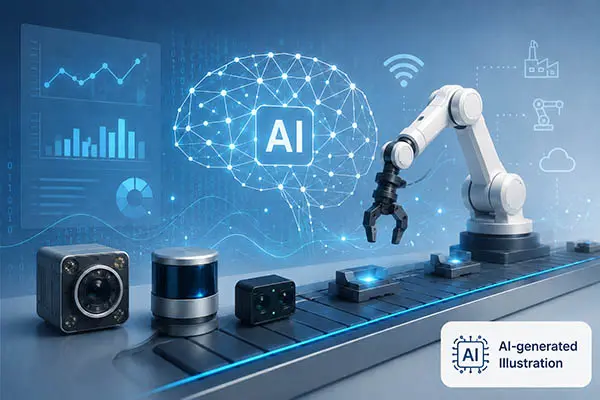
Industrial AI refers to the use of artificial intelligence in industrial applications. These include manufacturing, mechanical engineering, process industries, energy, logistics and technical maintenance.
Unlike many consumer-oriented AI applications, Industrial AI works directly with real machines, equipment and physical processes. The systems analyse sensor data, images, operating conditions and process parameters. They use this information to generate predictions, recommendations or automated decisions.
The objective is to make industrial processes more efficient, stable, flexible and transparent.
What Is Industrial AI?
Industrial AI combines artificial intelligence with industrial automation, sensing, measurement technology and process knowledge.
Typical tasks include:
monitoring machine conditions,
detecting quality problems,
predicting failures,
optimising energy consumption,
adjusting production processes,
controlling robots more intelligently,
analysing supply chains,
planning maintenance activities.
Industrial AI is not a single product. The term covers a wide range of technologies, methods and system architectures.
These include:
machine learning,
deep learning,
computer vision,
anomaly detection,
time-series analysis,
optimisation methods,
digital twins,
Edge AI,
generative AI for technical applications.
How Does Industrial AI Differ from General AI?
Many general AI applications work with text, images, speech or user behaviour.
Industrial AI mainly processes technical data from machines and processes.
This data may include:
temperature,
pressure,
vibration,
current consumption,
rotational speed,
force,
flow,
image data,
audio data,
position data,
process parameters,
maintenance records.
Another difference lies in the technical requirements.
Industrial systems often need to be:
reliable,
explainable,
safe,
capable of real-time operation,
available over long periods,
robust against disturbances.
An incorrect product recommendation in an online shop is usually not critical. An incorrect decision in a production system can cause scrap, downtime or a safety risk.
How Does Industrial AI Work?
An Industrial AI system usually operates in several stages.
1. Data Acquisition
Sensors, machine controllers, cameras and software platforms collect data from the process.
This data may be generated continuously or in response to events.
2. Data Preparation
Raw data is often incomplete, noisy or difficult to compare directly.
It may therefore need to be:
filtered,
synchronised,
normalised,
calibrated,
structured,
enriched with contextual information.
3. Model Development
An AI or machine-learning model is then developed.
The model learns relationships between input data and a desired result.
It may learn:
which vibration patterns indicate wear,
what a defect-free component looks like,
which process parameters lead to scrap,
when energy consumption is unusually high.
4. Validation
The model is tested using independent data.
This determines how reliably it performs under realistic conditions.
5. Deployment
The completed model is deployed in the plant, at the edge, in the cloud or within a hybrid architecture.
6. Monitoring
The model must continue to be monitored after deployment.
If machines, products or environmental conditions change, model performance may decrease.
Which Data Sources Are Used?
Industrial AI often processes several data sources at the same time.
Typical sources include:
sensors,
programmable logic controllers,
SCADA systems,
manufacturing execution systems,
quality databases,
maintenance systems,
cameras,
ERP systems,
digital twins,
logistics platforms.
The more data sources are connected, the more completely the system can assess a process.
However, complexity and integration effort also increase.
Typical Applications
Predictive Maintenance
Predictive maintenance aims to identify impending failures at an early stage.
It may analyse vibration, temperature, current consumption or sound.
The system looks for patterns that indicate wear or a developing fault.
The objective is to perform maintenance according to actual equipment condition rather than fixed intervals alone.
Quality Inspection
AI-based image processing detects defects in components, surfaces, packaging and assembly processes.
Compared with fixed rules, trained models can handle more complex and variable defect patterns.
Process Optimisation
Industrial AI analyses relationships between process parameters and outcomes.
The system may identify which combination of temperature, pressure and speed leads to better product quality.
Energy Optimisation
AI models can analyse load profiles, machine states and energy consumption.
This helps identify unnecessary consumption and improve operating schedules.
Production Planning
Industrial AI can combine production data, order volumes, material availability and machine capacity.
This information can be used to optimise sequences and resources.
Robotics
AI improves robot perception, motion planning and adaptability.
Robots can recognise variable objects, monitor processes and respond more flexibly to changes.
Anomaly Detection
Anomaly detection searches for unusual deviations in machine or process behaviour.
It is especially useful when only a small number of examples of specific faults are available.
Generative AI in Industry
Generative AI can analyse technical documents, summarise maintenance information, support operators or generate software code.
In industrial applications, it is often connected to technical databases and company-specific knowledge.
What Role Do Sensors Play?
Sensors are the foundation of many Industrial AI applications.
They connect the physical process with digital analysis.
Without reliable measurement data, an AI model cannot make dependable decisions.
Important sensor types include:
temperature sensors,
pressure sensors,
vibration sensors,
force sensors,
flow sensors,
current sensors,
cameras,
microphones,
position sensors,
radar,
LiDAR.
Sensor selection, placement and calibration directly affect the quality of the AI system.
Edge AI or Cloud AI?
Industrial AI can run in different locations.
Edge AI
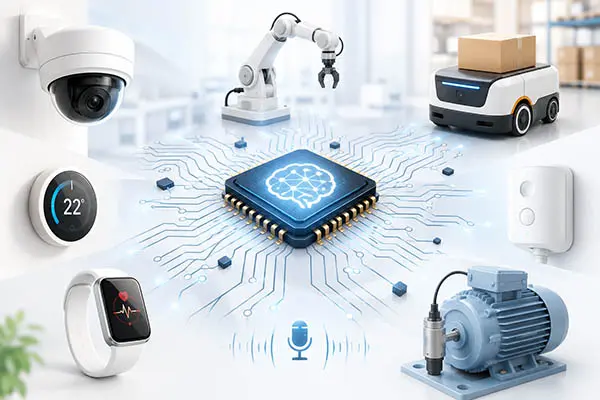
With Edge AI, processing takes place directly on or near the machine.
Advantages include:
short response times,
reduced data traffic,
higher availability,
improved control of sensitive data.
Cloud AI
Cloud systems provide high computing power and central scalability.
They are particularly suitable for:
model training,
cross-site analysis,
fleet management,
long-term data storage.
Hybrid Systems
In many cases, edge and cloud systems are combined.
Time-critical decisions are made locally, while long-term analysis and model training take place centrally.
What Role Do Digital Twins Play?
A digital twin is a digital representation of a machine, system or process.
It can combine current operating conditions, technical properties and historical data.
Industrial AI uses digital twins for:
simulation,
condition assessment,
process optimisation,
maintenance planning,
virtual testing,
failure analysis.
An AI model can work with both real operating data and simulated scenarios.
This makes it possible to study situations that occur only rarely in the real system.
Benefits of Industrial AI
Higher Equipment Availability
Failures can be detected earlier and maintenance planned more effectively.
Improved Quality
AI systems identify deviations and process problems more quickly.
Lower Costs
Reduced scrap, shorter downtime and optimised maintenance can lower operating costs.
Greater Energy Efficiency
Consumption and loads can be matched more closely to actual demand.
Increased Flexibility
Production systems can adapt more quickly to new variants and changing conditions.
Better Transparency
Data analysis reveals relationships that may be difficult to detect using conventional methods.
What Are the Main Challenges?
Data Quality
Industrial data is often incomplete, inconsistent or incorrectly labelled.
A model can only be as good as the data used for training and operation.
Limited Data Integration
Machines from different manufacturers use different interfaces, formats and protocols.
Combining these systems can require significant effort.
Rare Failure Cases
Many critical faults occur only infrequently.
As a result, there may not be enough training examples.
Model Drift
Products, machines and processes change over time.
A model that performs well initially may later lose accuracy.
Explainability
Industrial organisations often need to understand why a system made a particular decision.
This is especially important in quality-critical or safety-related applications.
Cybersecurity
Connected AI systems expand the digital attack surface.
Data, models, interfaces and updates must be protected.
Skills Shortage
Industrial AI requires knowledge across several areas:
data analysis,
automation,
sensing,
software development,
process engineering,
mechanical engineering.
Successful projects therefore need interdisciplinary teams.
How Should an Industrial AI Project Begin?
A good project does not start with an algorithm. It starts with a clearly defined problem.
Important questions include:
Which specific objective should be achieved?
Which decision should be improved?
Which data is available?
How will success be measured?
What error rate is acceptable?
How will the system be integrated into the process?
Who is responsible for the result?
How will the model be monitored later?
Clearly limited use cases are often best for the first project.
Examples include:
detecting a known quality defect,
monitoring the condition of a critical machine,
forecasting energy consumption,
automatically classifying process conditions.
A small, well-defined application often produces useful results faster than a broad transformation programme.
Humans Remain Part of the System
Industrial AI does not automatically replace human expertise.
In many applications, the system supports operators, maintenance teams or process engineers.
It identifies anomalies, organises information and proposes actions.
A human expert evaluates the recommendation and makes the final decision.
This collaboration is especially important in complex or safety-critical processes.
Industrial AI and Physical AI
Industrial AI focuses on intelligent decisions within industrial processes.
Physical AI goes one step further. In these systems, AI acts directly on the physical world.
A robot may recognise an object, plan a movement and pick it up.
A production system may adjust process parameters automatically.
An autonomous transport system may select its own route.
Sensing, Industrial AI, Edge AI and robotics therefore merge into closed loops of perception and action.
Conclusion
Industrial AI connects artificial intelligence with real machines, equipment and production processes.
The technology can improve maintenance, quality, energy use, planning and automation.
Success, however, does not depend on the AI model alone.
Reliable sensors, high-quality data, deep process knowledge, secure integration and continuous monitoring are equally important.
Industrial AI is therefore less a standalone software project than a combination of data, engineering and industrial expertise.