Intelligent Sensors Explained: Functions, Architecture and Applications
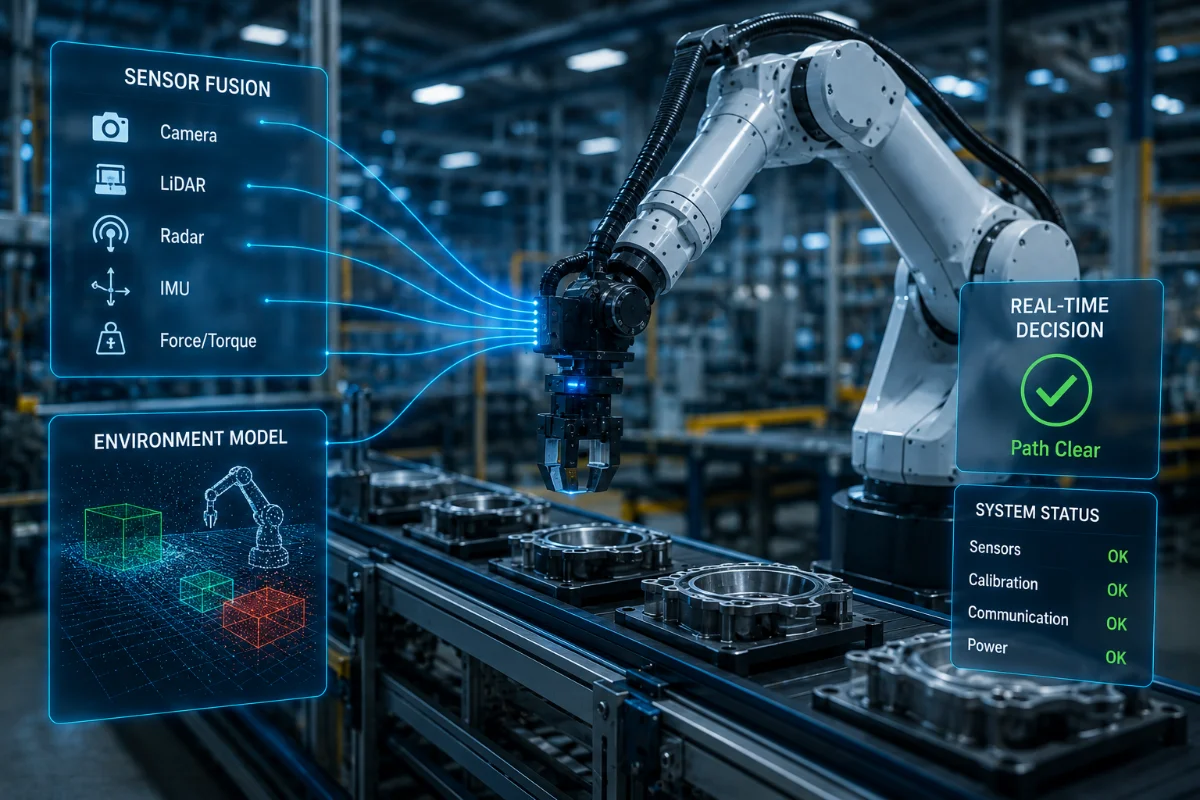
Intelligent sensors do more than capture a physical quantity. They process measurement data, evaluate operating conditions and communicate results to higher-level systems.
This distinguishes them from conventional sensors, which often provide only a raw signal. An intelligent sensor can filter, calibrate, digitise and monitor measurement data. In more advanced systems, it may also evaluate the data using algorithms or artificial intelligence.
Intelligent sensors are an important foundation for connected machines, the Industrial Internet of Things, Edge AI, predictive maintenance and Physical AI.
What Makes a Sensor Intelligent?
A conventional sensor converts a physical quantity into an electrical signal. A temperature sensor, for example, may produce a voltage or resistance value that changes with temperature.
An intelligent sensor adds further components and functions to this basic measurement process.
These may include:
signal conditioning,
analogue-to-digital conversion,
a microcontroller,
memory,
diagnostic functions,
communication interfaces,
local data processing,
self-calibration,
AI or machine-learning functions.
The exact configuration depends on the application. Not every intelligent sensor uses artificial intelligence. A sensor with digital signal processing, diagnostics and communication capabilities may already be considered intelligent.
Typical Architecture
An intelligent sensor usually consists of several functional blocks.
Sensing Element
The sensing element captures the physical quantity. Depending on the application, this may be temperature, pressure, force, acceleration, light, sound, humidity or a chemical property.
Signal Conditioning
The original sensor signal may be weak, noisy or non-linear. Signal-conditioning electronics amplify, filter and correct the signal.
Analogue-to-Digital Converter
Many sensing elements produce analogue signals. An analogue-to-digital converter transforms them into digital measurement values.
Processing Unit
A microcontroller or processor performs calculations. These may include calibration, compensation, averaging, threshold monitoring or pattern recognition.
Memory
Memory can store calibration data, device settings, measurement values or diagnostic information.
Communication Interface
The sensor transmits data to machine controllers, edge systems, gateways or cloud platforms.
Depending on the application, different interfaces and protocols may be used:
IO-Link,
Ethernet,
CAN,
Modbus,
PROFINET,
EtherCAT,
Bluetooth,
Wi-Fi,
LoRaWAN,
mobile communication,
industrial wireless protocols.
What Functions Do Intelligent Sensors Provide?
Digital Measurement Output
Instead of supplying a simple analogue signal, the sensor provides a processed digital measurement value.
This reduces sensitivity to interference and simplifies integration into digital systems.
Self-Diagnostics
The sensor can monitor its own condition. It may detect:
signal interruptions,
overload,
excessive temperature,
contamination,
drift,
incorrect supply voltage.
This information helps maintenance teams identify problems at an early stage.
Self-Calibration and Compensation
Temperature, ageing and environmental conditions can affect measurements. Intelligent sensors can partially compensate for these influences automatically.
Local Threshold Monitoring
The sensor can determine directly whether a measured value has moved outside a defined range. This enables faster reactions.
Event Detection
Instead of continuously transmitting all raw data, the sensor can report only relevant events.
A vibration sensor, for example, may detect that the operating behaviour of a motor has changed in an unusual way.
Data Reduction
Sensors can calculate averages, indicators or features. This reduces the amount of data that needs to be transmitted to higher-level systems.
Local AI Processing
More advanced intelligent sensors can execute machine-learning models directly on the device.
They can identify patterns, classify operating conditions or detect anomalies.
Intelligent Sensors and Edge AI
Intelligent sensors and Edge AI overlap in many applications.
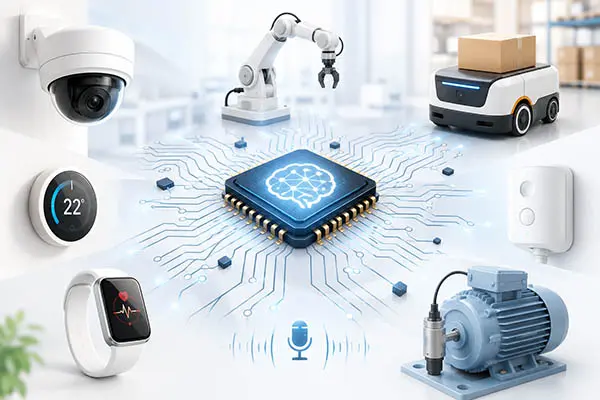
An intelligent sensor can be seen as the smallest form of an edge system because processing takes place directly at the source of the data.
The boundary between a sensor, an embedded system and an edge computer is not always clearly defined.
A basic intelligent sensor performs signal processing and diagnostics. An advanced AI sensor may identify complex patterns and make independent decisions.
Examples include:
cameras with integrated object detection,
vibration sensors with anomaly detection,
radar sensors with motion analysis,
microphones with sound classification,
force sensors with process evaluation.
Advantages of Intelligent Sensors
Faster Responses
Because part of the processing takes place directly in the sensor, events can be detected immediately.
Reduced System Complexity
A processed digital measurement value is easier to use than a sensitive analogue raw signal.
Less Data Traffic
The sensor transmits only relevant results or compressed information.
Improved Maintenance
Diagnostic data helps identify sensor faults and machine problems at an early stage.
Easier Commissioning
Automatic parameter configuration, digital communication and stored device data simplify integration.
Higher Measurement Quality
Compensation, filtering and calibration can improve accuracy and stability.
Typical Applications
Machine Condition Monitoring
Vibration, temperature and current sensors monitor motors, pumps, gearboxes and bearings.
They can detect changes before a failure occurs.
Process Automation
Pressure, flow, level and temperature sensors provide not only measurement values but also status and diagnostic information.
Robotics
Force, torque, position and distance sensors support robots during movement, gripping and collision avoidance.
Quality Inspection
Intelligent cameras and optical sensors detect surface defects, dimensional deviations and assembly errors.
Building Automation
Sensors measure temperature, air quality, occupancy and energy consumption. Local analysis enables demand-based control.
Agriculture
Soil, climate and plant sensors provide information for irrigation, fertilisation and yield optimisation.
Medical Technology and Wearables
Wearable sensors analyse movement, heart rate, temperature and other physiological parameters.
What Are the Challenges?
Cost
Additional electronics and software increase the price compared with simple sensors.
Energy Consumption
Local processing and wireless communication require energy. This is especially important in battery-powered devices.
Software Maintenance
Intelligent sensors contain firmware and, in some cases, AI models. These components must be maintained and updated securely over the product lifetime.
Cybersecurity
Connected sensors may create potential attack surfaces. Authentication, encryption and secure updates are therefore essential.
Interoperability
Not all devices and protocols are compatible. Standardised interfaces and data models simplify integration.
Data Quality
Automatic processing does not eliminate the need to select, install and calibrate the sensing element correctly.
How Should an Intelligent Sensor Be Selected?
Selection should not be based only on accuracy or measurement range.
Important criteria include:
sensing principle,
measurement range,
resolution,
accuracy,
repeatability,
response time,
environmental conditions,
ingress protection,
communication interface,
computing capability,
energy consumption,
diagnostic functions,
update capability,
integration effort,
long-term availability.
AI-based sensors require additional questions:
Which data was used to train the model?
How reliable is the detection performance?
How are false alarms handled?
Can the model be adapted?
How is model performance monitored?
Can updates be installed securely?
Intelligent Sensors in the Industrial Internet of Things
In the Industrial Internet of Things, machines, devices and sensors are connected across digital networks.
Intelligent sensors form the lowest level of the data architecture. They provide information about real processes and operating conditions.
A typical data path may look like this:
The sensor captures a physical quantity.
The measurement is processed locally.
Unusual conditions are detected directly.
Relevant data is transmitted to a gateway.
An edge system performs further analysis.
Long-term data is stored in a cloud or data platform.
This distributed architecture combines fast local responses with centralised analysis.
What Role Do Intelligent Sensors Play in Physical AI?
Physical AI requires a direct connection between digital intelligence and the physical environment.
Sensors provide the information that an AI system needs for perception and decision-making.
Intelligent sensors go one step further. They process data directly at the source and can make simple decisions independently.
In robots, autonomous machines and adaptive production systems, this creates short feedback loops between perception, analysis and action.
Conclusion
Intelligent sensors combine measurement technology, data processing and communication within a single device.
They provide not only measurement values but also status information, diagnostics and, in some cases, local decisions. This makes them an important building block for modern automation, Edge AI and connected systems.
Their performance, however, does not depend only on software and computing power. A suitable sensing principle, correct installation, reliable calibration and secure system integration remain essential.
As machines and physical systems become more closely connected with artificial intelligence, sensors that do not merely capture data but also understand and evaluate it will become increasingly important.