Sensor Fusion in Practice: How Machines Perceive Their Environment Reliably
Sensor fusion is the combination of data from multiple sensors. The objective is to create a more accurate, robust and complete understanding of a situation than would be possible with a single sensor.
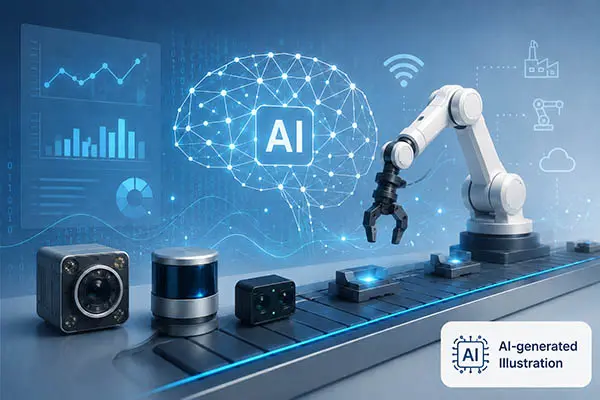
Humans use this principle continuously. We orient ourselves using vision, balance, hearing and touch at the same time. Technical systems work in a similar way: cameras, radar, LiDAR, accelerometers, force sensors and temperature sensors provide different types of information that can be evaluated together.
Sensor fusion plays a central role in robotics, autonomous vehicles, industrial automation, machine vision and Physical AI.
Why Is One Sensor Often Not Enough?
Every sensor has strengths and limitations.
A camera provides detailed visual information, but it may struggle in darkness, glare or poor visibility.
Radar can measure distance and speed in rain or fog, but it usually provides less visual detail.
LiDAR can generate precise three-dimensional point clouds, but it may be expensive and can be affected by certain environmental conditions.
Accelerometers and gyroscopes react quickly to movement, but their measurement errors can accumulate over time.
By combining several sensors, these limitations can be reduced.
A Simple Example
Consider a mobile robot moving through a factory.
A camera recognises markings, people and obstacles. A LiDAR sensor measures distances to walls and objects. Wheel encoders track the rotation of the wheels. An inertial measurement unit records acceleration and rotational movement.
Each sensor provides only part of the required information. Together, the data enables a more reliable estimate of the robot’s position, speed and surroundings.
If one measurement becomes inaccurate or temporarily unavailable, other sensors may partially compensate for the missing information.
How Does Sensor Fusion Work?
Sensor fusion involves several processing steps.
First, the sensors capture their respective physical quantities. These data streams often differ in format, accuracy, update rate and timing.
The data must then be synchronised. Measurements collected at different times can otherwise lead to incorrect conclusions.
Next, the sensors are calibrated and their data converted into a common reference system. A camera and a LiDAR sensor, for example, observe the same scene from different positions and use different coordinate systems.
The information is then combined. This may involve mathematical methods, probabilistic models or AI algorithms.
The result is a shared description of the system state, such as:
the position of a robot,
the distance to an object,
the speed of a vehicle,
the condition of a machine,
the classification of an item,
the probability of a defect.
Three Levels of Sensor Fusion
Sensor fusion can take place at different levels.
Data-Level Fusion
At the data level, relatively raw sensor data is combined. Image data, for example, may be linked directly with depth information.
This approach retains a large amount of information but requires significant computing power and precise timing.
Feature-Level Fusion
At the feature level, each sensor system first extracts relevant characteristics. A camera may detect edges or objects, while a radar sensor provides motion information.
These features are then combined.
Decision-Level Fusion
At the decision level, each sensor or subsystem produces its own result first. The individual decisions are combined afterwards.
A camera may identify a person with a certain probability while a radar system detects a moving object in the same location. Together, the two results increase confidence in the classification.
Important Methods
Different methods are used depending on the application.
Kalman Filter
The Kalman filter is a well-known mathematical method for estimating dynamic states. It is often used to combine measurements with different levels of uncertainty.
Typical applications include navigation, position estimation and motion tracking.
Extended Kalman Filter
Many real systems behave non-linearly. The extended Kalman filter adapts the basic principle to such systems.
It is widely used in robotics, vehicles and drone navigation.
Particle Filters
Particle filters represent possible states using a large number of individual hypotheses. They are suitable for complex and non-linear problems.
A common application is the localisation of mobile robots.
Bayesian Methods
Bayesian models combine existing knowledge with new measurement data. They are particularly useful for decision-making under uncertainty.
Neural Networks
Modern sensor-fusion systems increasingly use deep-learning models. These can learn relationships between different sensor data automatically.
For example, image, radar and LiDAR data can be processed together in a single model.
Typical Applications
Autonomous Vehicles
Vehicles combine cameras, radar, ultrasound, LiDAR, GPS and inertial sensors. This enables them to detect lanes, road users, distances and movement.
No single sensor provides sufficiently reliable information under all conditions.
Robotics
Robots require a detailed understanding of both their environment and their own state. They combine image data, force measurements, position sensors, distance sensors and motion data.
During a gripping operation, a camera may determine the position of an object while a force-torque sensor monitors contact.
Predictive Maintenance
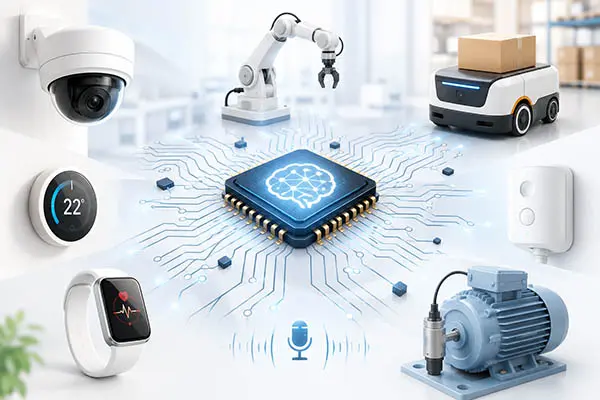
Condition-monitoring systems combine vibration, temperature, sound, current and pressure data.
A single measurement may have many possible causes. Multiple sensors allow a more accurate assessment of the machine condition.
Industrial Quality Inspection
Cameras inspect surfaces and dimensions. Additional sensors measure weight, temperature, force or electrical properties.
The combination can reveal defects that would remain invisible to a single inspection method.
Medical Technology
Wearables and medical devices combine data from motion sensors, heart-rate monitoring, temperature sensing and oxygen saturation measurement.
The combined analysis can provide a more complete picture of a person’s physical condition.
What Are the Main Challenges?
Sensor fusion can improve system performance, but it also increases complexity.
Time Synchronisation
Sensors often operate at different sampling rates. A camera may deliver 30 images per second, while a motion sensor produces several hundred measurements per second.
Without precise timestamps, data may be matched incorrectly.
Calibration
Sensors must be aligned spatially and metrologically. Even small calibration errors can produce inaccurate results.
Different Accuracy Levels
Not every sensor is equally reliable in every situation. The system must account for the uncertainty of each measurement.
Failures and Interference
Sensors may become dirty, blocked, aged or affected by environmental conditions. A robust system must detect such problems.
Computing Requirements
Processing large amounts of sensor data requires powerful hardware, especially when cameras, LiDAR and complex AI models are involved.
Sensor Fusion and Artificial Intelligence
Artificial intelligence expands the possibilities of conventional sensor fusion.
A neural network can learn which sensor data is most relevant in a particular situation. It can also identify complex relationships that are difficult to represent with fixed rules.
Modern systems often combine classical methods and AI.
Mathematical filters may handle position estimation, while a deep-learning model detects and classifies objects.
This hybrid approach combines the transparency of established methods with the flexibility of learning systems.
What Role Does Edge AI Play?
Many sensor-fusion applications must react in real time. Processing therefore often takes place directly on a vehicle, robot or edge computer.
Local processing provides several advantages:
short response times,
reduced data transmission,
higher availability,
better control of sensitive data.
In safety-critical applications, decisions cannot depend on a permanent cloud connection.
Sensor Fusion as a Foundation of Physical AI
Physical AI describes systems that perceive their environment, understand it and act within it.
For a robot or autonomous system to behave appropriately, it needs reliable information about both its surroundings and its own condition.
Sensor fusion provides a central foundation for this process. It connects perception, state estimation and action.
The more effectively different data sources are combined, the more safely and flexibly a physical AI system can operate.
Conclusion
Sensor fusion enables technical systems to use several perspectives at the same time. Combining different sensors improves accuracy, robustness and availability.
However, the benefit does not come simply from using more sensors. Reliable results depend on precise timing, careful calibration, suitable algorithms and a realistic assessment of measurement uncertainty.
For this reason, sensor fusion is one of the key technologies behind reliable machine perception in robotics, mobility, industry and Physical AI.