Sensors for Humanoid Robots: How Human-Like Machines Perceive Their Environment
Humanoid robots are designed around aspects of the human body and its movement capabilities. They often include a head with cameras, a movable torso, two arms, hands and legs. This structure is intended to allow them to operate in environments originally designed for people.
To stand, walk, grasp objects and interact safely with humans, a humanoid robot requires many different types of sensors. These sensors monitor not only the surrounding environment but also the robot’s own physical state.
Cameras identify objects and people. Force sensors measure contact. Joint sensors determine the positions of the arms and legs. Inertial sensors support balance, while tactile sensors provide information about how an object is touched or held.
Only by combining these different signals can a humanoid robot perform controlled and adaptable movements.
What Is a Humanoid Robot?
A humanoid robot is a technical system whose body shape or movement is based partly on the human body.
Typical characteristics include:
two legs,
two arms,
a torso,
a head containing sensor systems,
hands or grippers,
movable joints,
an upright posture.
Not every humanoid robot reproduces the complete human body. Some systems consist only of an upper body with arms and a head. Others are designed as complete two-legged robots.
The human-like structure is intended to provide a practical advantage. The robot may be able to use stairs, doors, tools, shelves, workstations and vehicles designed for people.
Why Is Sensing Particularly Demanding in Humanoid Robots?
A fixed industrial robot often operates in a clearly defined environment. Its position is known, workpieces are placed in specified locations and movement sequences are programmed precisely.
A humanoid robot is often expected to work in dynamic and less structured environments.
It may need to:
walk on uneven ground,
avoid obstacles,
recognise people,
pick up tools,
handle fragile objects,
maintain balance,
respond to unexpected contact,
perform changing tasks.
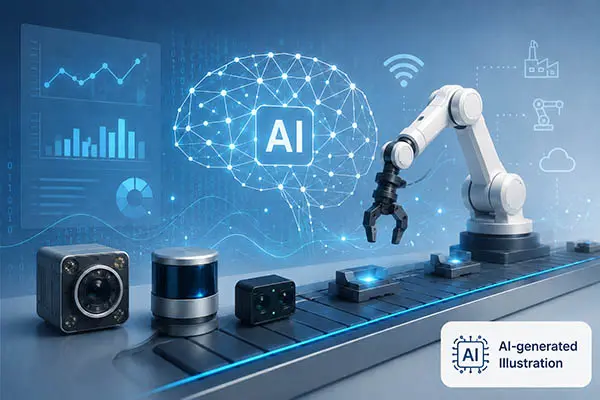
A single sensor type is not sufficient for these requirements. The robot needs information about its surroundings, its movements and the forces acting on its body.
Exteroception and Proprioception
The sensors of a humanoid robot can be divided broadly into two categories.
Exteroceptive Sensors
Exteroceptive sensors monitor the external environment.
They include:
cameras,
LiDAR,
radar,
ultrasound,
microphones,
distance sensors,
environmental sensors.
They help the robot determine what is present around it.
Proprioceptive Sensors
Proprioceptive sensors monitor the robot’s own physical state.
They include:
joint-position sensors,
encoders,
force and torque sensors,
accelerometers,
gyroscopes,
motor-current measurement,
temperature sensors.
They provide information about how the robot is standing, moving and being loaded.
Humans have a comparable internal sense of movement. Even without looking, we can estimate approximately where our arms and legs are positioned.
Cameras as Visual Sensors
Cameras are among the most important sensors in humanoid robots.
They are often installed in the head, torso or hands.
Cameras allow a robot to:
recognise people,
identify objects,
monitor work areas,
track movements,
analyse surfaces and shapes,
read text and symbols,
determine grasping points.
Different camera systems can be used depending on the application.
RGB Cameras
RGB cameras provide colour images similar to those from conventional digital cameras.
They are suitable for object recognition, scene understanding and visual communication.
Stereo Cameras
Stereo cameras use two image sensors positioned a short distance apart.
The system can calculate depth information from the different viewing angles.
Depth Cameras
Depth cameras capture distance information in addition to visual data.
They support spatial perception, navigation and grasp planning.
Event-Based Cameras
Event cameras do not record complete images at fixed intervals. Instead, they detect changes at individual pixels.
They respond very quickly and can offer advantages during rapid movement or strongly changing lighting conditions.
LiDAR and Spatial Perception
LiDAR systems measure distance using light pulses.
They produce a three-dimensional point cloud of the surrounding environment.
Humanoid robots can use LiDAR for:
navigation,
obstacle detection,
mapping,
localisation,
measuring room geometry,
determining distances.
LiDAR provides precise spatial information but may require additional installation space, energy and computing power.
Compact robots therefore often use cameras and depth sensors to perform some of the same tasks.
Radar and Ultrasound
Radar measures distance and motion using electromagnetic waves.
It can operate under conditions where cameras may be limited, such as darkness, dust or poor visibility.
Ultrasonic sensors are particularly suitable for short distances.
They can support:
collision avoidance,
distance measurement,
detection of nearby obstacles,
low-speed manoeuvring.
Both technologies complement visual sensors and can improve the robustness of the perception system.
Inertial Measurement Units and Balance
An inertial measurement unit, or IMU, usually combines accelerometers and gyroscopes.
It measures:
linear acceleration,
rotational movement,
orientation,
changes in position.
In humanoid robots, the IMU is particularly important for balance and stabilisation.
It helps identify whether the robot is:
falling forward,
swaying sideways,
accelerating,
stumbling,
losing contact with the ground.
The controller can then initiate corrective movement.
Because small measurement errors can accumulate over time, IMU data is usually combined with information from other sensors.
Joint-Position Sensors and Encoders
Humanoid robots contain many movable joints.
Each joint must be monitored precisely.
Encoders and position sensors measure:
joint angle,
motor speed,
direction of motion,
axis position.
This information is required to move the arms, legs, hands and torso in a controlled way.
The controller compares the planned position with the measured position.
Any difference can then be corrected.
Force and Torque Sensors
Force and torque sensors measure mechanical loads.
They may be installed:
inside joints,
at the wrists,
in grippers,
in the feet,
between a robot arm and a tool.
These sensors help the robot determine:
how strongly it is gripping an object,
whether a tool is encountering resistance,
whether a foot is firmly positioned on the ground,
whether an arm has collided with an obstacle,
how much load is being moved.
This information is particularly important when robots work close to people.
The robot must detect unexpected contact and limit or stop its movement.
Force Sensors in the Feet
Sensors in the feet are essential for two-legged robots.
They measure:
support forces,
pressure distribution,
shifts in the centre of pressure,
ground contact,
load on individual areas of the foot.
The system can use this information to determine whether the robot is standing securely and how its weight is distributed.
During walking, the load continuously shifts between both legs.
Foot sensing therefore provides important feedback for step planning and balance control.
Tactile Sensors and Artificial Skin
Tactile sensors are designed to reproduce aspects of the sense of touch.
They can be installed on the fingers, palms, arms or larger areas of the robot body.
Depending on their design, they may measure:
pressure,
touch,
shear force,
vibration,
temperature,
contact area.
A distributed arrangement of many tactile sensor elements is often described as electronic or artificial skin.
This allows the robot to determine where and how strongly it is being touched.
Applications include:
secure grasping,
detecting slipping objects,
delicate assembly,
human–robot interaction,
collision protection.
Sensors in Hands and Fingers
Robot hands are among the most demanding mechanical and sensing components.
A human-like hand contains many joints and must be able to grasp objects of different sizes and shapes.
Possible sensors include:
joint-position sensors,
force sensors,
tactile sensor arrays,
proximity sensors,
temperature sensors,
cameras in the hand or wrist.
The robot must determine more than whether it is touching an object.
It must also assess:
whether the object is being held securely,
whether it is slipping,
whether the grip force is too high,
whether the grasp should be adjusted.
Precise force control is essential when handling fragile objects.
Microphones and Acoustic Perception
Microphones enable speech capture and acoustic awareness.
A humanoid robot can use them to:
receive spoken instructions,
determine the direction of a voice,
detect warning signals,
identify unusual sounds,
communicate with people.
Several microphones can be arranged as a microphone array.
This improves the estimation of sound direction and can help reduce background noise.
Acoustic sensing can also monitor technical conditions, such as abnormal machine noises.
Proximity and Distance Sensors
Proximity sensors detect objects before direct contact occurs.
They can be installed on the hands, arms or body.
This allows the robot to:
slow a hand movement,
pre-position a gripper,
avoid collisions,
maintain safety distances.
Depending on the required range and accuracy, optical, capacitive, inductive or ultrasonic methods may be used.
Temperature and Internal Condition Sensors
Humanoid robots must monitor not only their surroundings but also their own technical components.
Temperature sensors may monitor:
motors,
power electronics,
batteries,
processors,
gearboxes.
Additional internal sensors measure:
battery voltage,
current consumption,
motor temperature,
cooling conditions,
mechanical load.
This data helps prevent overheating, overload and technical wear.
Sensor Fusion
A humanoid robot cannot rely on a single sensor.
The different data sources must be combined.
This process is known as sensor fusion.
A robot may simultaneously use:
cameras for object recognition,
LiDAR for distance measurement,
an IMU for orientation,
joint sensors for body posture,
foot sensors for balance,
force sensors for contact.
Together, these signals create a shared model of the environment and the robot’s own state.
Sensor fusion improves accuracy and robustness.
When a camera cannot identify an object clearly, depth or distance sensors may provide additional information.
Localisation and Mapping
A mobile humanoid robot must know where it is located.
It may combine:
camera images,
LiDAR data,
IMU measurements,
joint movement,
known maps,
recognised landmarks.
An important method is SLAM, or Simultaneous Localisation and Mapping.
With SLAM, the robot creates or updates a map while also determining its own position within that map.
This is particularly important indoors, where satellite navigation is usually unreliable.
Perception of the Robot’s Own Body
Humanoid robots require an internal body model.
This describes:
the length and position of limbs,
joint limits,
the centre of mass,
possible movements,
current posture,
contact points with the environment.
Sensor data continuously updates this model.
The controller can therefore determine whether an arm can reach a planned position or whether a movement may compromise balance.
This internal perception is known as proprioception.
Sensors and Motion Control
Sensors provide the feedback required for movement control.
The process can be simplified as follows:
The system plans a movement.
Motors execute the movement.
Sensors measure the actual state.
The controller compares the target and measured values.
Deviations are corrected.
This control loop operates continuously and at high speed.
During walking, many joints are involved at the same time.
Small changes in the ground surface or weight distribution must be compensated immediately.
What Role Does Artificial Intelligence Play?
AI helps humanoid robots interpret complex sensor data.
Typical tasks include:
object recognition,
person detection,
speech processing,
grasp-point estimation,
movement prediction,
situation assessment,
task planning,
anomaly detection.
Neural networks can learn to recognise objects from camera images or suggest suitable grasping positions.
Immediate joint stabilisation and balance control, however, are still often handled by conventional control methods.
Practical systems are therefore usually hybrid combinations of AI, robotics and control engineering.
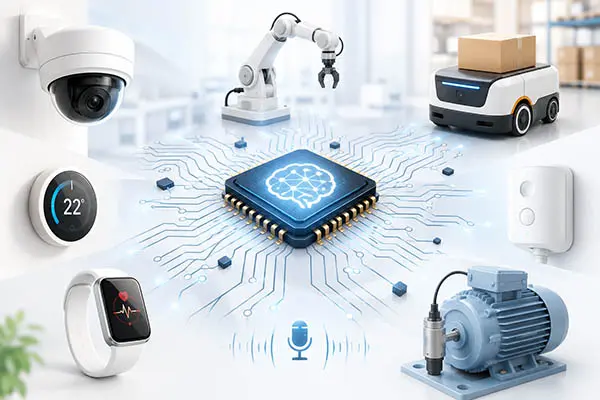
Edge AI Inside the Humanoid Robot
Many sensor signals must be processed in real time.
A humanoid robot cannot send every camera image or force measurement to a remote cloud before acting.
Processing therefore takes place mainly on the robot.
Edge-AI hardware can perform:
image analysis,
speech processing,
sensor fusion,
obstacle detection,
motion planning,
condition monitoring.
Cloud systems may still support model training, software updates and long-term data analysis.
Safety-critical decisions, however, must remain possible locally and without a network connection.
Typical Challenges
Large Number of Sensors
Humanoid robots often contain many joints and measurement points.
This creates large data volumes and complex wiring.
Space and Weight
Sensors, cables and processing units must fit into a compact mechanical design.
Additional weight also increases energy consumption.
Energy Requirements
Sensors and computing hardware require power.
In mobile robots, this directly affects operating time.
Calibration
Cameras, joint sensors, IMUs and force sensors must be aligned precisely.
Incorrect calibration can cause inaccurate movement.
Measurement Noise and Drift
Sensor values are never completely free from error.
Inertial sensors in particular can accumulate deviations over time.
Mechanical Stress
Sensors in the feet, hands and joints are exposed to high forces and repeated loading.
Real-Time Processing
The system must process data quickly enough to remain stable and respond safely.
Safety
Sensor failures must not result in uncontrolled movement.
Critical functions require plausibility checks, redundancy and safe fallback mechanisms.
Redundancy and Functional Safety
For critical functions, a single sensor may not be sufficient.
Several sensors can observe the same situation in different ways.
A humanoid robot may estimate body orientation using IMU data, joint positions and foot forces.
If the results differ significantly, the system can identify a possible fault.
Redundancy improves safety but also adds weight, cost and complexity.
It should therefore be applied specifically to critical functions.
Human–Robot Interaction
Humanoid robots are often intended to work close to people.
They require sensors that can detect people and physical contact reliably.
Important functions include:
person detection,
distance measurement,
gaze and gesture recognition,
speech capture,
force limitation,
touch detection,
collision avoidance.
The sensing system must not only be capable but also predictable.
People should be able to understand what the robot is perceiving and which movement it is likely to perform next.
Typical Application Areas
Industry
Humanoid robots may operate machinery, transport materials or perform simple assembly work.
Logistics
Possible tasks include order picking, sorting and internal transport.
Inspection
Robots can examine technical systems, hazardous areas and difficult-to-access environments.
Research
Humanoid platforms are used to study movement, grasping, perception and human–robot interaction.
Assistance
In the longer term, humanoid systems may support people with physically demanding or repetitive tasks.
Disaster Response
Human-like robots could use tools, doors and infrastructure in dangerous environments.
How Should Suitable Sensors Be Selected?
Sensor selection should be based on the specific task.
Important questions include:
Which objects and people must be recognised?
What movement accuracy is required?
Which forces will occur?
How quickly must the system react?
Which environmental conditions apply?
Which sensors are safety-critical?
What limits apply to weight and energy consumption?
How will sensor faults be detected?
How can components be maintained and calibrated?
Using more sensors does not automatically improve perception.
The important factor is whether the sensors provide relevant information and work together reliably.
Conclusion
Sensing is the foundation of capable humanoid robotics.
Cameras, depth sensors and LiDAR monitor the environment. Joint and inertial sensors determine the robot’s physical state. Force and tactile sensors enable controlled contact with objects and people.
Sensor fusion combines external perception with internal state estimation.
The main challenge does not lie only in the accuracy of individual sensors. Integration, calibration, real-time processing, energy efficiency and functional safety are equally important.
Humanoid robots can act flexibly and reliably only when they continuously and precisely perceive both their environment and their own body.