Smart Cities: When Vehicles, Infrastructure and Sensors Communicate
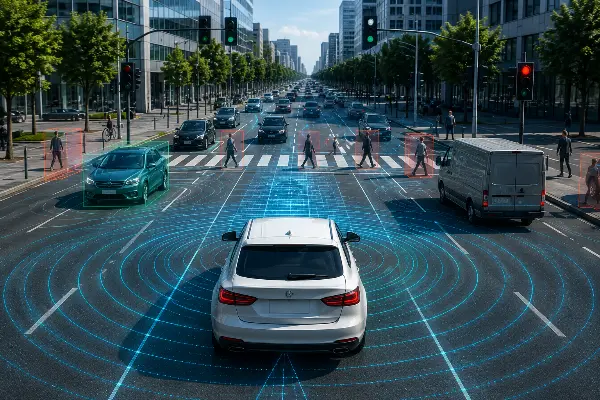
Smart cities use sensors, connected systems and artificial intelligence to manage transport, energy, public infrastructure and urban services more efficiently. The concept goes far beyond digital public services or intelligent traffic lights. A key element is the connection between vehicles and their surroundings.
Cars, buses, bicycles, traffic lights, roads, parking spaces and traffic-management systems can exchange data. This communication creates a digital picture of current traffic conditions and enables faster, safer and better-coordinated decisions.
Vehicle-to-Everything communication, commonly known as V2X, plays a central role in this process. It connects vehicles with other road users and urban infrastructure.
What Is a Smart City?
A smart city systematically uses data to improve urban processes and make better use of resources.
Sensors may capture:
traffic flow,
air quality,
noise,
parking occupancy,
energy consumption,
the condition of roads and bridges,
public-transport utilisation,
weather and environmental data.
This information can be processed locally, on edge systems or within central platforms. The results can be used to adjust traffic lights, redirect traffic, schedule maintenance or manage public services according to demand.
A smart city is therefore not based on a single technology. It combines sensing, connectivity, data platforms, Edge AI, cloud systems and automated decision-making.
What Role Do Connected Vehicles Play?
Modern vehicles contain a large number of sensors and communication systems. Cameras, radar, LiDAR, ultrasound, GPS and inertial sensors monitor the vehicle’s position and immediate surroundings.
V2X communication adds information that may be outside the direct range of the vehicle’s own sensors.
A vehicle may receive information that:
an accident has occurred behind a bend,
a traffic light will turn red in a few seconds,
an emergency vehicle is approaching,
a lane is closed,
pedestrians are present at an obstructed crossing,
slippery road conditions have been detected,
a parking space has become available.
This additional data complements the vehicle’s own sensors and improves situational awareness.
What Does V2X Mean?
V2X stands for Vehicle to Everything. It includes several types of communication.
Vehicle to Vehicle
Vehicle-to-Vehicle communication, or V2V, allows vehicles to exchange information directly.
This may include:
position,
speed,
direction,
braking events,
lane changes,
detected hazards.
A vehicle can therefore respond earlier to another car braking heavily, even when that car is hidden by surrounding traffic.
Vehicle to Infrastructure
Vehicle-to-Infrastructure communication, or V2I, describes communication between vehicles and road infrastructure.
This includes:
traffic lights,
road signs,
toll systems,
parking sensors,
roadworks,
digital lane displays,
traffic-control centres.
A traffic-light system may transmit the remaining time before a signal change. Vehicles can then adjust their speed and avoid unnecessary acceleration and braking.
Vehicle to Pedestrian
Vehicle-to-Pedestrian communication, or V2P, connects vehicles with pedestrians, cyclists and other vulnerable road users.
Communication may take place through smartphones, wearables or infrastructure sensors.
A vehicle could be warned about a pedestrian stepping into the road from between parked cars.
Vehicle to Network
Vehicle-to-Network communication, or V2N, connects vehicles with mobile networks and central data platforms.
This provides access to:
traffic information,
weather data,
map updates,
roadwork alerts,
cloud services,
fleet information.
Vehicle to Grid
Vehicle-to-Grid communication, or V2G, describes interaction between electric vehicles and the power grid.
Electric vehicles can not only be charged but may also feed electricity back into the grid under suitable conditions.
This can help balance peak demand and support the integration of renewable energy.
How Does the Communication Work?
V2X systems use wireless technologies designed for short response times. Depending on the system, communication may take place through direct radio links or mobile networks.
Safety-related messages must be transmitted quickly and reliably. A collision warning cannot arrive several seconds too late.
Data processing therefore often takes place across multiple layers.
The vehicle analyses its own sensor data locally. Road infrastructure and traffic lights process data through edge systems. Larger traffic analyses may take place within central platforms or the cloud.
This distributed architecture combines rapid local responses with wider coordination.
An Urban Traffic Example
A vehicle approaches a busy intersection.
The traffic-light system transmits its current phase and the remaining time before the signal changes. At the same time, a bus reports that it is delayed. The traffic system extends the green phase to give public transport priority.
A cyclist approaches from the right. A sensor at the intersection detects the cyclist, although a building blocks the vehicle’s direct view. The vehicle receives a warning and automatically reduces its speed.
At the same time, anonymised traffic data is sent to a city platform. The platform detects growing congestion and recommends alternative routes to other vehicles.
This example illustrates how sensing, communication and AI can work together.
What Are the Benefits?
Improved Road Safety
Vehicles can receive information about hazards before they become visible to onboard sensors.
Smoother Traffic Flow
Traffic lights and vehicles can be coordinated more effectively, reducing congestion and unnecessary stops.
Lower Energy Consumption
Smoother driving reduces fuel and electricity consumption.
Better Public Transport
Buses and trams can receive priority and be better coordinated with traffic infrastructure.
More Efficient Parking
Available parking spaces can be detected digitally and communicated directly to vehicles or navigation systems.
Faster Emergency Response
Emergency vehicles can be given clear routes, while traffic lights are adjusted automatically.
Better Urban Planning
Anonymised mobility data provides valuable information about traffic patterns, bottlenecks and infrastructure utilisation.
Which Sensors Are Used?
Smart-city mobility relies on many different sensor types.
Typical examples include:
cameras,
radar,
LiDAR,
ultrasonic sensors,
induction loops,
environmental sensors,
position sensors,
motion sensors,
parking sensors,
weather stations,
microphones for sound detection.
Combining several sensors increases reliability. A camera provides visual detail, while radar can deliver robust distance and speed information even in poor visibility.
What Role Does Edge AI Play?
Traffic systems often need to respond in real time. For this reason, data is increasingly processed directly at intersections, roadsides and inside vehicles.
An edge system can:
detect road users,
identify near misses,
adjust traffic-light phases,
count traffic flows,
recognise disruptions,
report relevant events to a central system.
This reduces the need to transmit and store all image and sensor data.
Instead of sending complete video streams, the system can forward only events, statistics or warnings. This reduces network traffic and may improve data privacy.
Privacy and Cybersecurity
Connected cities generate large amounts of sensitive data. This may include movement patterns, location data and information about the behaviour of road users.
Systems therefore need to be designed around clear privacy and security principles.
Important measures include:
data minimisation,
anonymisation,
secure authentication,
encrypted communication,
protection against manipulation,
clear retention periods,
transparent responsibilities.
The authenticity of safety messages is particularly important. A vehicle must be able to verify that a warning was issued by an authorised source.
What Are the Challenges?
Different Systems
Cities, vehicle manufacturers and infrastructure operators may use different technical platforms.
High Investment
Sensors, networks and data platforms require substantial investment and long-term maintenance.
Complex Responsibilities
Several organisations may share responsibility for operation, data processing and security.
Technology Lifecycles
Vehicles and infrastructure have very different lifecycles. A traffic-light system may remain in service much longer than a communication module.
Public Acceptance
Citizens need to understand which data is collected and what practical benefit the system provides.
Smart Cities and Autonomous Vehicles
Connected infrastructure can support autonomous vehicles, but it does not replace onboard sensing.
An autonomous vehicle must remain safe even when no infrastructure connection is available. V2X provides additional information and extends the perception range.
The combination of onboard sensors and external communication creates cooperative perception.
A vehicle can use not only its own cameras and radar systems, but also information from other vehicles and the surrounding infrastructure.
Conclusion
Smart cities connect vehicles, infrastructure and digital systems into a shared mobility network.
The central idea is that information should not remain isolated. Vehicles can communicate with traffic lights, other vehicles, pedestrians, power grids and central platforms.
This creates new opportunities for safety, traffic management and energy efficiency.
Success, however, depends on more than wireless communication and AI models. Reliable sensors, open interfaces, clear privacy rules and secure system architectures are equally important.