Smart Manufacturing: How Connected Production, Sensors and AI Are Transforming Industry
Smart manufacturing describes a connected, data-driven and increasingly self-optimising production environment. Machines, sensors, software platforms and employees work together within a shared digital system.
The objective is to make production processes more transparent, flexible and efficient. Equipment can report its condition, identify quality deviations at an early stage, coordinate material flows and adapt more quickly to new products or changing order volumes.
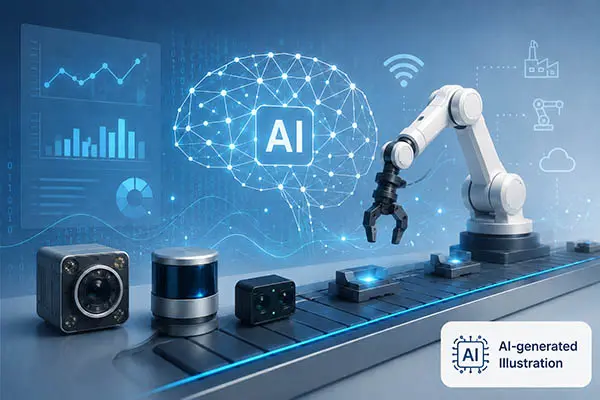
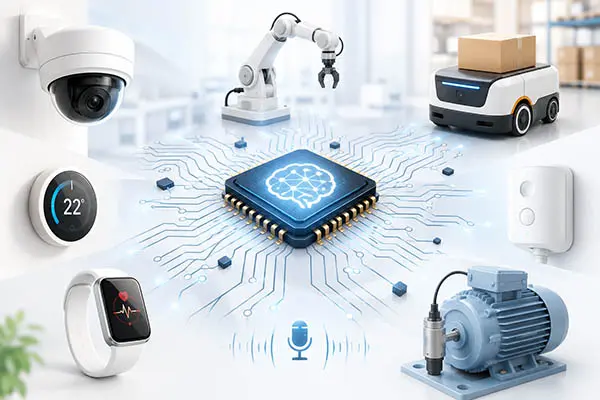
Sensors provide data from the physical production environment. Industrial AI analyses this information. Edge systems make time-critical decisions close to the machine. Higher-level software connects individual equipment with production planning, quality management, logistics and maintenance.
Smart manufacturing is therefore more than the technical modernisation of individual machines. It is a comprehensive approach to digital and intelligent production.
What Is Smart Manufacturing?
Smart manufacturing refers to a production environment in which machines, equipment, products and software systems continuously exchange information.
Typical objectives include:
higher productivity,
improved quality,
less downtime,
more efficient energy use,
faster product changeovers,
greater process transparency,
better traceability,
more flexible production planning.
An intelligent factory does not only collect data. It uses that data to understand processes, support decisions and, in some cases, adjust operations automatically.
Smart manufacturing can be applied in highly automated factories as well as in smaller production companies.
How Does Smart Manufacturing Differ from Conventional Automation?
Conventional automation often relies on fixed sequences.
A machine performs a predefined movement when certain conditions are met. These systems are reliable and efficient, but they may respond only to a limited range of changes.
Smart manufacturing adds:
connected data sources,
continuous condition monitoring,
flexible software,
AI-based analysis,
digital twins,
adaptive process control,
cross-site evaluation.
The main difference is the ability to combine information from several areas.
An individual machine may know that its temperature is increasing. A smart-manufacturing system may also recognise that product quality is decreasing, current consumption is rising and maintenance is overdue.
Several isolated signals therefore become a broader understanding of the process.
Which Components Are Part of Smart Manufacturing?
A smart-manufacturing system usually consists of several technical layers.
Sensors and Intelligent Devices
Sensors measure the actual condition of machines, products and processes.
Typical parameters include:
temperature,
pressure,
vibration,
force,
torque,
flow,
energy consumption,
position,
speed,
image data,
sound,
humidity,
material properties.
Intelligent sensors may process some of this data locally and transmit status or diagnostic information rather than raw values alone.
Machine Controllers
Programmable logic controllers and other industrial controllers handle direct machine control.
They process signals, control actuators and ensure that production steps are executed reliably.
Edge Systems
Edge computers process data directly on or close to the machine.
Typical tasks include:
image analysis,
anomaly detection,
data filtering,
local AI inference,
rapid process decisions,
protocol translation.
This reduces the need to transfer all data to a central platform.
Production Software
Higher-level systems connect machines with production planning and business operations.
Examples include:
manufacturing execution systems,
SCADA systems,
quality-management systems,
maintenance software,
ERP systems,
production control centres,
data platforms.
Cloud and Data Platforms
Cloud or central platforms store large amounts of data, compare sites and support model training, long-term analysis and fleet management.
Digital Twins
Digital twins represent machines, equipment or processes virtually.
They connect real sensor data with technical models and support simulation, condition assessment and optimisation.
How Does Smart Manufacturing Work?
A typical process can be described in several stages.
1. Capture Data
Sensors, machine controllers and software systems generate information about current operations.
2. Connect Data
Information from different sources is combined technically and temporally.
This may include machine conditions, quality data, orders, materials and energy consumption.
3. Analyse Data
Rules, statistical methods and AI models identify patterns, deviations and relationships.
4. Derive Decisions
The system generates alerts, recommendations or automated control commands.
5. Adjust the Process
Machine parameters, production sequence, maintenance planning or material flow are changed.
6. Verify the Result
New sensor data shows whether the adjustment was successful.
This creates a continuous cycle of sensing, analysis, action and learning.
What Role Does Artificial Intelligence Play?
Artificial intelligence adds learning and predictive functions to smart manufacturing.
AI systems can analyse large datasets and identify relationships that are difficult to describe with fixed rules.
Typical applications include:
quality inspection,
predictive maintenance,
process optimisation,
production planning,
anomaly detection,
energy optimisation,
robotics,
demand forecasting.
AI does not automatically replace conventional control engineering.
In many applications, both approaches are combined. Conventional controllers handle safety-critical and precisely timed functions. AI evaluates complex situations, detects patterns or recommends suitable settings.
Machine Vision in Intelligent Production
Machine vision is one of the most important technologies in smart manufacturing.
Cameras and AI models inspect:
surfaces,
dimensions,
assembly conditions,
labels,
completeness,
product variants,
component positions.
An intelligent vision system can detect defects directly on the production line.
The result may trigger an automatic response:
reject the product,
stop the process,
correct machine parameters,
document the inspection,
inform operators.
Machine vision therefore connects perception with process control.
Predictive Maintenance
Predictive maintenance is a central use case.
Sensors monitor equipment continuously. AI models identify changes that may indicate wear or an impending failure.
Maintenance can then be planned before an unplanned stoppage occurs.
Typical data sources include:
vibration,
temperature,
current consumption,
sound,
pressure,
lubricant condition,
maintenance history.
Predictive maintenance can improve equipment availability and support spare-parts and workforce planning.
Adaptive Process Control
In conventional production, parameters are often defined once and changed only occasionally.
Smart manufacturing enables more dynamic adjustment.
A system may consider:
material variation,
tool wear,
ambient temperature,
current product quality,
machine load,
energy prices,
order priorities.
Process parameters can then be adjusted automatically or after human approval.
Such changes must remain within clearly defined technical and safety limits.
Flexible Production and Lot Size One
Customers increasingly expect customised products and short delivery times.
Smart manufacturing is therefore intended to support small production batches economically.
Possible approaches include:
automatic parameter transfer,
digital work instructions,
flexible robots,
modular machines,
rapid tool changes,
automatic product identification,
adaptive inspection programs.
A product can be identified through a code. The machine then loads the correct program and quality criteria automatically.
This makes high-variation production possible with less manual setup.
Connected Products and Traceability
Products can be tracked digitally throughout manufacturing.
A dataset may contain:
material batch,
production time,
machine parameters,
inspection values,
tools used,
process deviations,
software versions.
This traceability is particularly important in industries with demanding quality and documentation requirements.
If a fault appears later, the company can investigate the exact production conditions.
Robotics in Smart Manufacturing
Robots in intelligent production do more than execute repetitive movements.
With machine vision, force sensing and AI, they can respond more flexibly to different situations.
Typical tasks include:
assembly,
machine loading,
bin picking,
palletising,
quality inspection,
internal material transport,
packaging.
Mobile robots connect production stages and transport materials according to demand.
Collaborative robots support people with physically demanding or high-variation tasks.
Humans and Machines
Smart manufacturing does not mean that production employees disappear.
People remain important for:
process expertise,
troubleshooting,
maintenance,
quality assessment,
exceptional situations,
continuous improvement.
Digital systems can support them by:
providing relevant information,
reporting deviations early,
displaying work instructions,
preparing decisions,
automating documentation.
User-interface design is critical. Systems should explain clearly what is happening and why an action is being recommended.
Energy Efficiency and Sustainability
Smart manufacturing can support more efficient use of energy and materials.
Sensors measure consumption at individual machines and production stages.
AI models can identify:
equipment running unnecessarily at idle,
energy-intensive processes,
load peaks,
opportunities to optimise production sequence,
sources of scrap or material loss.
An energy-management system can coordinate machine operation, on-site generation, storage and electricity tariffs.
Digitalisation alone does not guarantee sustainability. Data must lead to measurable improvements.
Edge AI and Cloud in Smart Manufacturing
Smart manufacturing often uses a hybrid architecture.
Edge AI
Time-critical data is processed locally at the edge.
Typical tasks include:
visual quality inspection,
rapid anomaly detection,
machine control,
local sensor fusion,
data reduction.
Cloud and Central Platforms
Central systems are suitable for:
cross-site evaluation,
long-term storage,
model training,
production comparisons,
central software management,
fleet analysis.
Immediate process control often remains local, while broader analysis takes place centrally.
Interoperability and Standards
Intelligent production often connects machines from different manufacturers and generations.
This creates challenges involving:
different protocols,
proprietary interfaces,
inconsistent data formats,
different device descriptions,
missing semantic information.
For effective integration, data must not only be transferred but also interpreted correctly.
A temperature value requires context:
Which machine?
Which component?
Which unit?
Which time?
Which operating state?
Standardised interfaces and data models reduce integration effort.
Brownfield Environments and Existing Equipment
Many factories are not built entirely from new equipment.
In brownfield environments, older machines need to be connected retrospectively.
Possible measures include:
installing additional sensors,
reading machine signals,
using gateways,
digitising analogue values,
connecting existing controllers,
measuring energy consumption separately.
Retrofit solutions can provide valuable data without replacing the complete machine.
However, data quality, cybersecurity and economic value must be assessed carefully.
Cybersecurity
Connected production systems increase the digital attack surface.
The following areas require protection:
machine controllers,
sensors,
networks,
user accounts,
software updates,
production data,
AI models,
external interfaces.
A security incident can affect not only data but also physical production processes.
Important measures include:
network segmentation,
secure authentication,
encrypted communication,
access controls,
regular updates,
monitoring unusual activity,
secure remote maintenance.
Cybersecurity should be part of the architecture from the beginning.
What Are the Benefits of Smart Manufacturing?
Higher Productivity
Downtime, waiting periods and inefficient processes can be reduced.
Improved Quality
Deviations can be detected earlier and processes adjusted more precisely.
Greater Flexibility
Product variants and smaller batches become easier to manage.
Less Downtime
Condition monitoring and predictive maintenance improve equipment availability.
Transparent Processes
Production data reveals causes and relationships.
More Efficient Use of Resources
Energy, materials and machine capacity can be used more effectively.
Better Traceability
Products and process steps can be documented in greater detail.
What Are the Main Challenges?
High Integration Effort
Machines, software and data sources must be connected.
Inconsistent Data
Missing standards and different formats complicate analysis.
Data Quality
Incomplete or incorrect data produces unreliable results.
Investment Requirements
Sensors, networks, software and employee training require funding.
Skills Shortage
Smart manufacturing requires expertise in production, automation, IT, data analysis and cybersecurity.
Changes to Workflows
New systems change tasks and responsibilities.
Vendor Dependence
Proprietary platforms may make future expansion more difficult.
Unclear Objectives
Digitalisation without a clear use case creates data but not necessarily value.
How Should a Smart-Manufacturing Project Begin?
The project should begin with a clearly defined operational problem.
Useful questions include:
Where do the largest production losses occur?
Which quality problems cause high costs?
Which processes lack transparency?
Where is reliable traceability missing?
Which machines consume the most energy?
Which data already exists?
Which decision should be improved?
A pilot project should:
focus on a clearly defined process,
have measurable objectives,
use available data,
involve the responsible operational team,
be integrated into existing workflows.
Possible first projects include:
condition monitoring for a critical machine,
AI-based quality inspection,
energy monitoring for a production line,
digital product traceability,
automatic capture of downtime reasons.
Smart Manufacturing and Industry 4.0
Smart manufacturing and Industry 4.0 are often used in similar ways.
Industry 4.0 describes the broad digital connection of industrial value creation.
Smart manufacturing focuses more specifically on practical implementation within production.
This includes:
connected machines,
intelligent sensors,
digital production control,
data-driven optimisation,
flexible automation.
The two concepts overlap strongly.
Smart Manufacturing and Physical AI
Physical AI combines perception, decision-making and physical action.
Smart manufacturing provides an industrial environment in which this can take place.
For example:
A camera detects a quality defect.
An AI model evaluates the likely cause.
The system adjusts process parameters.
A robot removes the defective product.
Sensors verify the result.
This creates a closed loop between physical production and digital intelligence.
Conclusion
Smart manufacturing connects machines, sensors, software and artificial intelligence within a data-driven production environment.
It can improve quality, flexibility, equipment availability and resource efficiency.
Success does not depend on connecting as many devices as possible. Clear objectives, high-quality data, secure interfaces, industrial expertise and meaningful employee involvement are more important.
Smart manufacturing is therefore not a single IT project. It is a gradual transformation process in which production, automation and data analysis develop together.