TinyML Explained: Machine Learning on Microcontrollers and Sensors
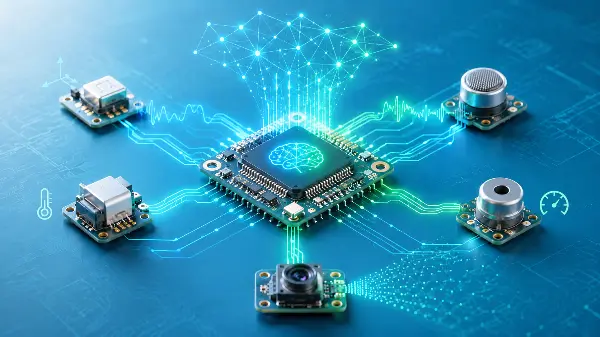
TinyML brings machine learning to small, energy-efficient devices. Instead of continuously sending sensor data to the cloud or a powerful server, data can be analyzed directly on microcontrollers, sensor platforms and compact embedded systems.
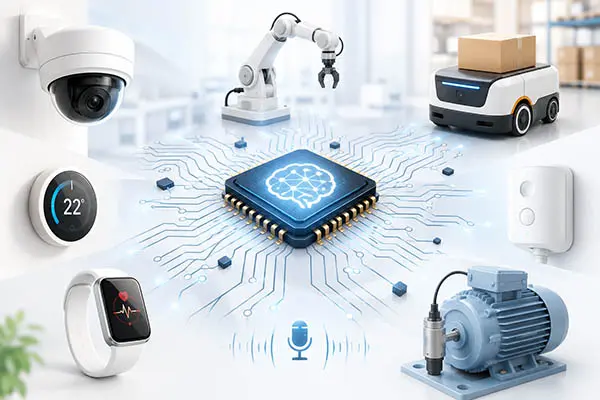
This allows devices to detect patterns, classify events and respond to their environment even when processing power, memory and available energy are limited. TinyML is therefore becoming an important technology for smart sensors, wearables, connected machines, smart home devices and battery-powered IoT systems.
What Is TinyML?
TinyML stands for Tiny Machine Learning. It describes the use of compact machine learning models on resource-constrained hardware.
Typical TinyML devices have:
limited memory,
relatively low processing power,
low clock speeds,
strict energy limits,
restricted communication capabilities.
Despite these limitations, they can perform tasks that previously required significantly more powerful computers.
Examples include detecting unusual machine vibrations, identifying specific movements, recognizing selected sounds or classifying operating states from sensor data.
TinyML therefore allows a sensor system to do more than collect measurements. It can interpret data directly at its source.
How Does TinyML Work?
A typical TinyML application consists of several stages.
First, one or more sensors collect data from the physical environment. This may include acceleration, temperature, sound, pressure, electrical current, images or biological signals.
The data is then prepared for analysis. Noise may be removed, values may be normalized and relevant features may be extracted.
A trained machine learning model processes the prepared data and generates a result. It may determine whether a machine is operating normally, whether a certain sound has occurred or which type of movement is being performed.
The result can trigger an immediate action. A device may send an alert, stop a motor, change a display or transmit only the relevant event instead of the complete raw data stream.
Model training is usually performed on a more powerful computer or cloud platform. After training, the model is compressed, optimized and deployed to the target device.
Why Is TinyML Important?
Sensors can produce large amounts of data continuously. Sending all raw data to a remote platform requires bandwidth, energy and infrastructure.
TinyML moves part of the intelligence directly to the device.
This provides several advantages.
Low Power Consumption
Microcontrollers require far less energy than high-performance processors. This enables long battery life and, in some applications, operation with energy harvesting.
Fast Response Times
Local processing avoids the delay of sending data to a remote server and waiting for a response. This is especially important in time-sensitive applications.
Reduced Data Transmission
Instead of transmitting continuous raw data, the device can send only relevant results, alerts or summarized information.
Improved Privacy
Sensitive audio, image or health data can be processed locally. It may not need to leave the device at all.
Offline Operation
TinyML systems can continue working without a permanent internet connection. This is useful in industrial facilities, remote agricultural environments and mobile devices.
TinyML, Edge AI and Embedded AI
TinyML is often discussed together with Edge AI and Embedded AI. The terms overlap, but they are not identical.
Edge AI is a broad term for AI processing performed close to the source of the data. This may happen on a sensor, smartphone, industrial computer, vehicle controller or edge server.
Embedded AI describes AI functions integrated into an embedded system. Such a system may be very small, but it can also use comparatively powerful processors.
TinyML focuses specifically on machine learning for highly constrained platforms. These systems usually have limited memory, low power consumption and modest processing capabilities.
TinyML can therefore be viewed as a particularly compact form of Embedded AI and Edge AI.
Which Hardware Is Used for TinyML?
TinyML applications commonly run on microcontrollers integrated into sensors, products or machines.
Typical hardware components include:
microcontrollers,
digital signal processors,
low-power systems-on-chip,
sensor hubs,
compact AI accelerators,
smart sensors with integrated processing.
The right hardware depends on the application. A vibration monitoring device has different requirements from a voice interface or a vision-based detection system.
Important selection criteria include memory capacity, power consumption, interfaces, processing speed and real-time performance.
Which Models Are Suitable for TinyML?
Not every machine learning model can run on a microcontroller. Large neural networks often require too much memory and processing power.
TinyML therefore relies on compact models and optimized algorithms.
Common examples include:
small neural networks,
decision trees,
linear models,
compact convolutional neural networks,
autoencoders for anomaly detection,
time-series classification models,
keyword spotting models.
Optimization methods are also important. Quantization, for example, replaces high-precision numerical values with more compact formats. This reduces memory use and computational effort.
Other techniques include pruning, model compression and careful feature selection.
The goal is not always maximum accuracy. In many applications, the best solution is a balanced compromise between accuracy, response time, memory requirements and energy consumption.
Typical TinyML Applications
TinyML can be used wherever sensor data needs to be analyzed locally and efficiently.
Predictive Maintenance
Vibration, sound, temperature and electrical current can be analyzed directly on a machine. The system can identify changes that may indicate wear or an upcoming failure.
Anomaly Detection
A TinyML model can learn the characteristics of normal operation. If new sensor data differs significantly, the device can flag an anomaly.
Voice and Sound Recognition
Compact models can detect selected keywords, alarms or characteristic machine sounds. The complete audio stream does not necessarily have to be stored or transmitted.
Wearables
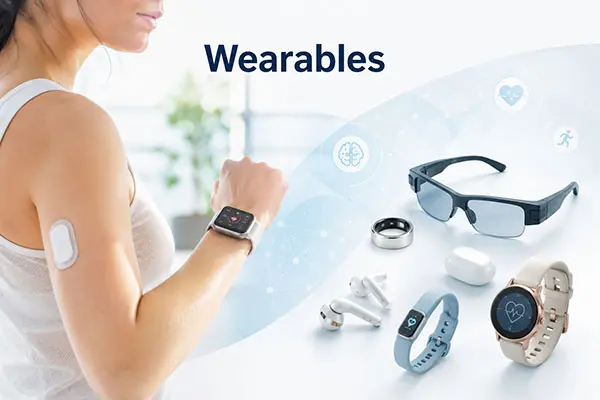
Fitness trackers, medical devices and smartwatches can classify movement, activity or biological signals locally.
Gesture Recognition
Accelerometers and gyroscopes can be used to identify specific movement patterns. Applications include device control, sports analysis and assistance systems.
Smart Homes and Building Automation
TinyML can detect movement, occupancy, unusual sounds or abnormal consumption patterns. This can improve lighting, heating, security and energy management.
Agriculture and Environmental Monitoring
Battery-powered sensor nodes can analyze soil conditions, plant health, weather data, animal movement or environmental sounds.
Industrial Production
TinyML supports decentralized condition monitoring, process analysis and quality control directly on machines and production equipment.
What Role Do Sensors Play?
Sensors form the foundation of every TinyML system. The quality of the input data directly affects model reliability.
Common sensor types include:
accelerometers,
gyroscopes,
microphones,
temperature and humidity sensors,
pressure sensors,
current and voltage sensors,
magnetic field sensors,
optical sensors,
compact cameras,
biosensors.
Many applications combine several sensors. This type of sensor fusion can improve reliability because different measurement principles provide complementary information.
A wearable device may combine acceleration, heart rate and skin temperature. A machine monitoring system may use vibration, acoustic data and electrical current at the same time.
Challenges of TinyML
TinyML offers significant advantages, but it also introduces specific technical challenges.
Limited Memory
The model, software and intermediate data must fit into a small memory footprint.
Limited Processing Capacity
Complex models may be too slow or consume too much energy.
Training Data Quality
A model can only perform reliably if the training data represents realistic operating conditions.
Changing Real-World Conditions
Sensors age, environments change and machines do not always behave in exactly the same way. Models may therefore require updates or retraining.
Limited Explainability
Some models make decisions that are difficult to interpret. This can be a concern in safety-related applications.
Maintenance and Updates
Even small embedded devices require secure methods for updating firmware and machine learning models.
What Should Be Considered in a TinyML Project?
A successful TinyML project begins with a clearly defined task, not with the selection of a model.
The first step is to decide which event, condition or pattern must be recognized. Suitable sensors and representative data can then be selected.
Important questions include:
How accurate must the result be?
How quickly must the system respond?
How much energy is available?
How much memory does the hardware provide?
Must the device operate offline?
Which errors are acceptable?
How will the model be updated later?
A simpler model is often the better solution. A small and robust algorithm may perform more reliably in real operating conditions than a complex model that achieves slightly higher accuracy in a laboratory environment.
TinyML and the Future of Smart Sensors
TinyML is changing the role of sensors. They are evolving from basic measurement devices into local decision-making systems.
Future sensors will not only collect data. They will also filter, evaluate and classify it before passing information to other systems.
The combination of TinyML, sensor fusion, low-power hardware and wireless sensor networks is especially promising. It enables distributed systems in which many small devices observe and interpret their surroundings.
TinyML is therefore becoming an important foundation for smart products, industrial IoT applications and Physical AI systems.
Conclusion
TinyML brings machine learning to microcontrollers, sensors and other compact embedded devices. It enables local processing with low energy consumption, fast response times and reduced communication requirements.
Applications range from predictive maintenance and anomaly detection to wearables, voice interfaces and smart building systems.
TinyML does not completely replace more powerful edge or cloud platforms. Instead, it complements them by handling tasks that should be performed directly at the source of the data.
As sensors, microcontrollers and compact AI models continue to improve, more devices will be able not only to measure the physical world, but also to interpret it and respond independently.
Frequently Asked Questions About TinyML
What does TinyML mean?
TinyML stands for Tiny Machine Learning. It describes machine learning applications running on small, resource-constrained devices such as microcontrollers.
Is TinyML the same as Edge AI?
No. Edge AI is the broader concept of performing AI processing close to the data source. TinyML focuses specifically on small and energy-efficient hardware.
Does TinyML require an internet connection?
Not necessarily. Many TinyML systems process data entirely on the device and can operate without a permanent network connection.
Can TinyML run inside a sensor?
Yes. TinyML can run on a microcontroller integrated into a sensor, on a sensor hub or on a nearby embedded system.
What types of data can TinyML process?
Common data sources include movement, vibration, sound, temperature, electrical current, pressure, light, biological signals and compact image data.
Is the model trained on the microcontroller?
Usually not. Training normally takes place on a more powerful computer. The optimized model is then deployed to the microcontroller.