Wearables: How Sensors and AI Make Body-Worn Devices Intelligent
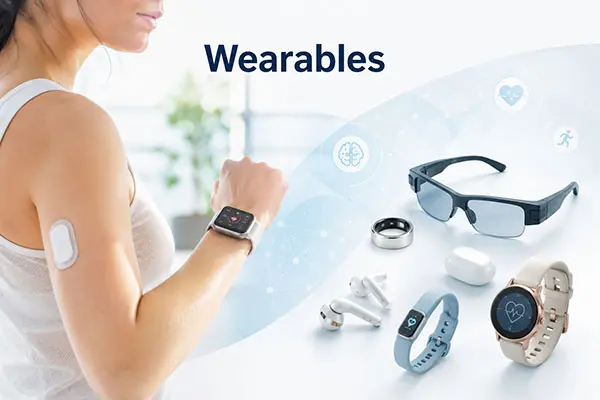
Wearables are electronic devices worn directly on the body. They include smartwatches, fitness trackers, smart rings, intelligent glasses, sensor patches, connected clothing and specialised sports or health devices.
Their main advantage is their proximity to the user. Wearables can continuously capture movement, physiological signals, environmental conditions and usage patterns. Sensors provide the measurements, while algorithms and artificial intelligence convert them into activities, trends or indications of unusual change.
Wearables are therefore evolving from simple step counters into versatile assistance systems for fitness, health, work, communication and safety.
What Are Wearables?
The term wearable refers to electronic technology designed to be worn on the body.
A wearable may be attached directly to the body, integrated into clothing or used as body-worn equipment. It often accompanies the user for long periods and can therefore collect continuous data.
Typical examples include:
smartwatches,
fitness bands,
smart rings,
intelligent glasses,
hearables,
sensor patches,
smart clothing,
chest straps,
sports sensors,
wearable safety devices.
Wearables differ from many other gadgets mainly through direct body contact and regular or continuous use.
Why Do Wearables Use So Many Sensors?
Wearables operate close to the body and can therefore measure information that stationary devices can capture only occasionally or indirectly.
This may include:
movement,
heart rate,
skin temperature,
blood oxygen saturation,
location,
sleep behaviour,
posture,
activity level,
ambient light,
noise exposure,
air quality.
A single sensor usually provides only limited information.
Combining several measurements enables a more complete assessment. An elevated heart rate, for example, may result from exercise, stress, heat or another form of strain. Motion and temperature data can help place the measurement into context.
Which Sensors Are Used in Wearables?
Accelerometers
Accelerometers measure movement along several spatial axes.
They are used for:
step counting,
activity recognition,
sleep analysis,
gesture detection,
fall detection,
exercise evaluation,
posture analysis.
An algorithm can identify typical movement patterns and estimate whether a person is walking, running, sitting or exercising.
Gyroscopes
Gyroscopes measure rotational movement.
They complement accelerometers and help determine the orientation and movement of a body part more accurately.
Typical applications include:
sports-motion analysis,
gesture control,
hand and arm tracking,
stabilisation,
virtual and augmented reality.
Optical Heart-Rate Sensors
Many smartwatches and fitness trackers measure heart rate optically.
Small LEDs illuminate the skin. A photodetector measures changes in reflected light related to blood flow.
The device uses this signal to estimate heart rate.
Measurement quality depends on factors such as:
skin contact,
device position,
movement,
skin characteristics,
ambient light,
sensor quality.
Blood Oxygen Sensors
Some wearables estimate blood oxygen saturation using different wavelengths of light.
The measurement is also based on optical changes within tissue.
Such values can provide useful indications, but they are not automatically equivalent to clinical measurements.
Temperature Sensors
Wearables can measure temperature at the skin or inside the device.
Possible applications include:
monitoring long-term temperature trends,
supporting sleep analysis,
evaluating training strain,
monitoring device electronics,
identifying changes in physical condition.
Skin temperature is not the same as core body temperature. It is strongly influenced by the environment, clothing and blood circulation.
Skin-Conductance Sensors
Electrodermal-activity sensors measure changes in the electrical conductivity of the skin.
These changes are partly related to sweat-gland activity.
Possible applications include:
strain analysis,
stress indicators,
relaxation exercises,
research applications.
Interpretation is complex because many external and individual factors affect the measurement.
Electrocardiography
Some wearables can record a basic electrocardiogram.
They capture the electrical activity of the heart using electrodes.
Depending on the design, the user may need to touch a contact on the device to complete the measuring circuit.
Such functions may identify unusual patterns but do not replace a comprehensive medical examination.
Bioimpedance Sensors
Bioimpedance methods measure the electrical resistance of the body or specific tissues.
They are used for:
estimating body composition,
analysing fluid distribution,
selected fitness and wellness functions.
Results depend strongly on measurement conditions, body contact and the underlying mathematical models.
Position and Environmental Sensors
Wearables may contain additional sensors such as:
GPS,
magnetometers,
altimeters,
barometric-pressure sensors,
ambient-light sensors,
microphones,
environmental-noise sensors,
air-quality sensors.
These provide context about movement and surroundings.
An altimeter may help identify stair climbing, while GPS provides distance and speed during outdoor activities.
How Do Wearables Use Artificial Intelligence?
Wearable sensors continuously generate large numbers of small measurements.
AI and machine learning help convert this data into understandable information.
Typical tasks include:
activity classification,
sleep-stage estimation,
movement recognition,
anomaly detection,
exercise assessment,
trend analysis,
personalisation,
speech processing,
gesture recognition.
An AI model may learn how walking, running and cycling appear in the sensor data.
The challenge is that people move differently and do not always wear devices in exactly the same way.
Sensor Fusion in Wearables
Sensor fusion combines information from several sensors.
A smartwatch may use:
an accelerometer,
a gyroscope,
a heart-rate sensor,
GPS,
an altimeter,
a temperature sensor.
This allows the system to classify activities more reliably.
An elevated heart rate combined with rapid movement and changing position is more likely to indicate exercise than an elevated heart rate without movement.
Sensor fusion reduces misinterpretation but cannot eliminate it completely.
Smartwatches
Smartwatches are among the best-known wearables.
They combine timekeeping, communication, fitness and assistance functions.
Typical features include:
notifications,
activity tracking,
heart-rate measurement,
navigation,
workout recognition,
contactless payment,
voice control,
music control,
safety functions.
Advanced models combine several sensors and analyse information over long periods.
Fitness Trackers
Fitness trackers focus mainly on movement, activity and exercise.
They may capture:
steps,
distance,
active time,
heart rate,
calorie estimates,
exercise intensity,
sleep duration.
Many of these values are model-based estimates.
Calorie expenditure, for example, is not measured directly. It is calculated from movement, heart rate and user information.
Smart Rings
Smart rings are compact wearables with close skin contact.
They are particularly suitable for:
sleep tracking,
activity analysis,
heart-rate trends,
skin-temperature measurement,
recovery assessment.
Their small size makes battery capacity, thermal management and antenna design especially challenging.
Their advantage lies in unobtrusive use and the possibility of wearing them during sleep.
Hearables
Hearables are intelligent devices worn in or around the ear.
They include wireless headphones and specialised hearing systems.
Possible functions include:
active noise cancellation,
speech enhancement,
translation,
spatial audio,
motion sensing,
wear detection,
hearing assistance.
The ear may also provide a useful measurement location for certain biological and acoustic signals.
Smart Glasses
Smart glasses combine visual displays, cameras, microphones and motion sensors.
Possible applications include:
navigation,
photography,
translation,
remote assistance,
industrial work instructions,
augmented reality,
object recognition.
In professional environments, smart glasses can display information directly within the worker’s field of view.
They also create significant privacy questions because cameras and microphones may be available continuously in everyday situations.
Smart Clothing and Textiles
Sensors can be integrated directly into clothing.
Possible applications include:
posture measurement,
breathing analysis,
muscle-activity monitoring,
temperature sensing,
pressure distribution,
sports-motion analysis.
Smart textiles need to remain flexible, washable and comfortable.
Integrating conductors, sensors, power supplies and wireless systems is technically demanding.
Sensor Patches
Sensor patches are worn directly on the skin.
They can provide close-contact measurements over long periods.
Possible applications include:
temperature monitoring,
motion sensing,
heart activity,
sweat analysis,
rehabilitation,
clinical monitoring.
Depending on their intended use, sensor patches may be consumer products or regulated medical devices.
Wearables in Sport
Wearables help athletes analyse training and movement.
They may measure:
speed,
distance,
heart rate,
movement patterns,
repetitions,
training duration,
recovery periods.
Specialised sensors can be attached to shoes, rackets, bicycles or clothing.
AI can identify technical patterns and provide personalised feedback.
Wearables in Healthcare
Wearables can make long-term trends visible.
They may indicate:
changing heart rate,
unusual activity patterns,
changed sleep duration,
low movement levels,
unusual temperature trends.
A clear distinction is essential.
A general fitness wearable is not automatically a medical diagnostic device. Its intended purpose, validation and regulatory status need to be considered separately.
Wearables in the Workplace
Wearables are also used in industry, logistics and services.
Possible applications include:
digital work instructions,
access control,
location tracking,
ergonomic analysis,
hazard warnings,
communication,
condition monitoring.
A wearable may warn a worker before entering a dangerous area or identify that a physically demanding posture has been maintained for too long.
Such applications need to be transparent so that safety technology does not become uncontrolled employee surveillance.
Safety and Emergency Functions
Wearables can provide support during emergencies.
Typical functions include:
fall detection,
emergency calls,
location sharing,
alerts for unusual measurements,
activation through a button or gesture.
Automatic fall detection usually relies on acceleration and motion data.
Similar movement patterns may also occur during sport or when the device is placed down forcefully, so false alarms remain possible.
Edge AI in Wearables
Many wearables process data directly on the device.
This is particularly important for:
rapid response,
privacy,
reduced data transmission,
operation without internet access,
energy efficiency.
Compact models can recognise movements or sounds locally.
Only summarised results may then be sent to a smartphone or cloud service.
Cloud Processing
Cloud systems may be used for:
long-term trend analysis,
synchronisation,
complex evaluation,
model training,
services across several devices,
data backup.
Many wearables therefore use a hybrid architecture.
Time-critical functions run locally, while more extensive analysis takes place on a smartphone or in the cloud.
Battery Life and Energy Efficiency
Wearables need to be small, light and usable for long periods.
At the same time, sensors, displays, wireless modules and AI processing require energy.
Developers therefore optimise:
measurement intervals,
display activity,
wireless transmission,
processing cycles,
sensor selection,
low-power modes.
A low-power motion sensor may remain active continuously and switch on more energy-intensive components only when needed.
Wearing Comfort
A wearable can produce useful long-term data only when it is worn regularly and correctly.
Important factors include:
weight,
size,
skin compatibility,
heat generation,
strap or mounting method,
water resistance,
ease of use.
Poor comfort causes people to wear the device less often. This creates data gaps and makes long-term analysis less reliable.
Data Quality
Wearable data is influenced by many factors.
These include:
loose fit,
skin contact,
movement,
sweat,
tattoos,
ambient light,
temperature,
posture,
individual physiology.
AI can identify or compensate for some measurement errors, but not all of them.
Accuracy therefore depends on the complete system of sensor, hardware, wearing position and algorithm.
Privacy
Wearables collect highly personal information.
This may include:
health data,
movement profiles,
location,
sleep behaviour,
exercise data,
voice,
usage habits.
Users should be able to understand:
which data is collected,
where it is stored,
who can access it,
how long it is retained,
whether it can be exported or deleted.
The combination of health, location and behavioural data is particularly sensitive.
Cybersecurity
Wearables often communicate with smartphones, apps and cloud services.
Possible risks include:
insecure Bluetooth connections,
weak user accounts,
outdated firmware,
poorly protected apps,
unencrypted data,
insecure programming interfaces.
Regular updates and secure authentication are therefore important.
What Are the Benefits of Wearables?
Continuous Data Collection
Wearables accompany users over long periods and make trends visible.
Immediate Feedback
Information and alerts are available directly.
Personalisation
Systems can adapt recommendations to individual patterns.
Everyday Assistance
Navigation, communication and reminders are available directly on the body.
Motivation
Activity and training data can encourage healthier behaviour.
Safety
Emergency, location and warning functions can provide support in critical situations.
What Are the Main Challenges?
Limited Measurement Accuracy
Small sensors and changing wearing conditions affect results.
Misinterpretation
Estimated values may be mistaken for exact medical findings.
Battery Life
Continuous measurement and wireless communication require energy.
Privacy
The collected data is often highly sensitive.
Platform Dependence
Functions may depend on apps, accounts or cloud services.
Limited Support Periods
Not all devices receive long-term software and security updates.
Information Overload
Too many measurements and warnings can confuse or worry users.
What Should Buyers Consider?
Important questions include:
Which sensors are installed?
Which values are measured directly and which are estimated?
Is the product intended for wellness or medical use?
Which functions operate locally?
Which data is transferred to the cloud?
How long will the device receive updates?
Can users export and delete their data?
How long does the battery last?
Is the device comfortable enough for continuous use?
Does it work without a paid subscription?
The number of features is less important than their reliability and practical value.
Wearables as Part of Physical AI
Wearables connect the human body with digital systems.
Sensors capture movement, physiological signals and the environment. AI interprets this information. The device responds with displays, alerts or recommendations.
Wearables usually act less autonomously than robots. Even so, they create a loop of sensing, analysis and response.
Combined with smart environments, assistance systems or exoskeletons, wearables may become an increasingly important part of Physical AI.
Conclusion
Wearables bring sensors and artificial intelligence directly to the human body.
They capture movement, physiological parameters, environmental conditions and usage patterns. AI converts this data into activity recognition, trend analysis, alerts and personalised recommendations.
Their greatest potential lies in continuous, body-proximate measurement.
At the same time, measurement accuracy, privacy, battery life and medical significance need to be assessed realistically.
Good wearables do not simply produce more data. They provide information that is understandable, relevant and handled responsibly.