All articles on sensing & AI
Articles, news and background at the intersection of sensing, measurement and AI.
Smart Homes: How Sensors, Connectivity and AI Make Buildings More Intelligent
A smart home connects sensors, devices, controllers and digital services within a shared system. Lighting, heating, shading, security, energy systems and household appliances can then be controlled automatically or through a central interface. In a simple application, a light responds to a motion…
Sensors for Humanoid Robots: How Human-Like Machines Perceive Their Environment
Humanoid robots are designed around aspects of the human body and its movement capabilities. They often include a head with cameras, a movable torso, two arms, hands and legs. This structure is intended to allow them to operate in environments originally designed for people. To stand, walk, grasp…
Robotics and Physical AI: How Intelligent Machines Perceive, Decide and Act
Robotics and artificial intelligence are becoming increasingly interconnected. Conventional robots usually perform clearly defined movements in structured environments. Systems based on Physical AI are intended to perceive their surroundings, interpret situations and adapt their behaviour when…
Digital Twins: How Virtual Representations Improve Machines and Processes
A digital twin is a digital representation of a real object, machine, system or process. It combines technical models with current operating data, making it possible to monitor conditions, analyse changes and simulate future developments. Digital twins are used in industry, energy, mobility…
Predictive Maintenance: How Sensors and AI Enable Smarter Maintenance
Predictive maintenance is a condition-based maintenance strategy that uses data to identify wear, abnormal behaviour and potential failures at an early stage. Unlike fixed maintenance schedules, predictive maintenance does not rely only on operating hours or calendar intervals. The actual condition…
Industrial AI: How Artificial Intelligence Is Transforming Industrial Processes
Industrial AI: How Artificial Intelligence Is Transforming Industrial Processes Industrial AI refers to the use of artificial intelligence in industrial applications. These include manufacturing, mechanical engineering, process industries, energy, logistics and technical maintenance. Unlike many…
Machine Vision with AI: How Machines Understand Images and Automate Processes
Machine vision describes the automated acquisition and evaluation of visual information by technical systems. Cameras, optics, lighting and image-processing software work together to detect objects, features and operating conditions. Artificial intelligence has significantly expanded the…
Autonomous Systems & Mobility: How Machines Perceive Their Environment and Act Independently
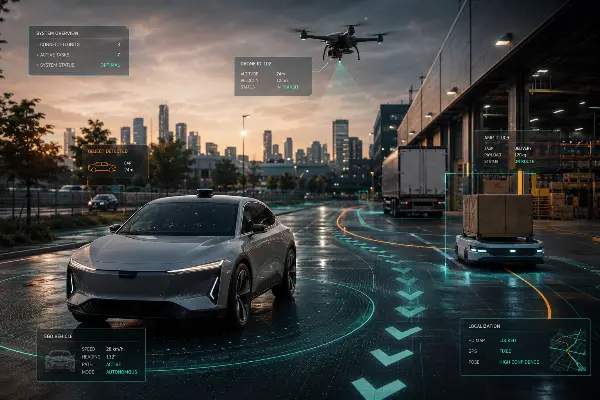
Autonomous systems can perform tasks without continuous human control. They perceive their surroundings, assess situations, make decisions and translate those decisions into actions. In mobility, the spectrum ranges from driver-assistance systems and self-driving vehicles to autonomous delivery…
Smart Cities: When Vehicles, Infrastructure and Sensors Communicate
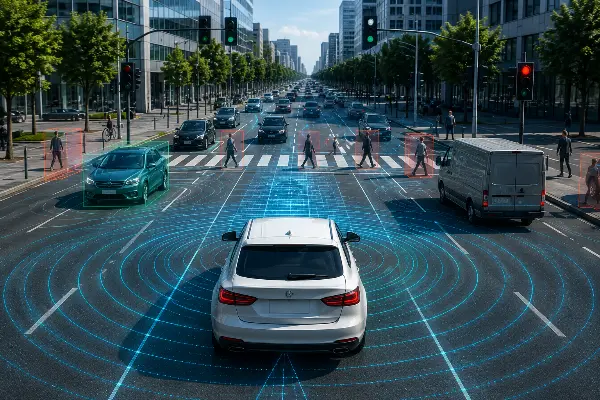
Smart cities use sensors, connected systems and artificial intelligence to manage transport, energy, public infrastructure and urban services more efficiently. The concept goes far beyond digital public services or intelligent traffic lights. A key element is the connection between vehicles and…
Intelligent Sensors Explained: Functions, Architecture and Applications
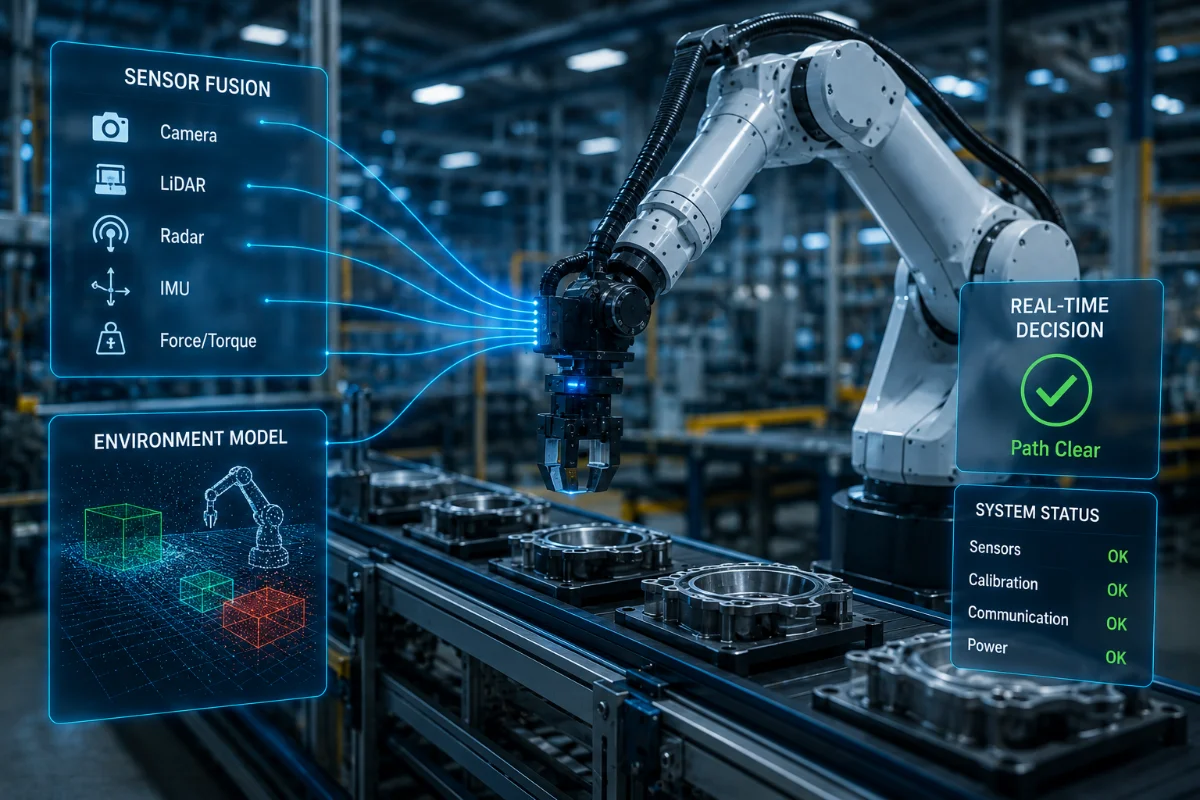
Intelligent sensors do more than capture a physical quantity. They process measurement data, evaluate operating conditions and communicate results to higher-level systems. This distinguishes them from conventional sensors, which often provide only a raw signal. An intelligent sensor can filter…
Sensor Fusion in Practice: How Machines Perceive Their Environment Reliably
Sensor fusion is the combination of data from multiple sensors. The objective is to create a more accurate, robust and complete understanding of a situation than would be possible with a single sensor. Humans use this principle continuously. We orient ourselves using vision, balance, hearing and…
Edge AI Explained: Intelligence Directly at the Sensor and Device
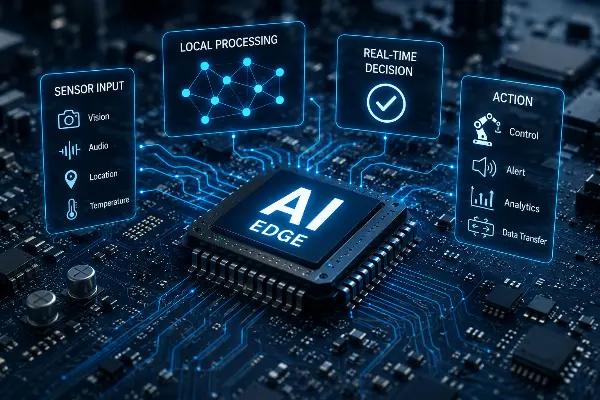
Edge AI refers to the execution of artificial intelligence directly where data is generated: on machines, cameras, sensors, vehicles or other devices. Instead of transferring all data to a data centre or cloud platform first, it is processed locally. This approach is particularly relevant for…